Summary
Entrepreneurial Mindset. The key to success for undergraduate engineering students.
Engineers can no longer depend on just their technical skill set to be successful. They also need an entrepreneurial mindset. An entrepreneurial mindset (EM) encompasses attitudes, habits, and behaviors that shape a unique approach to problem-solving, innovation, and value creation.
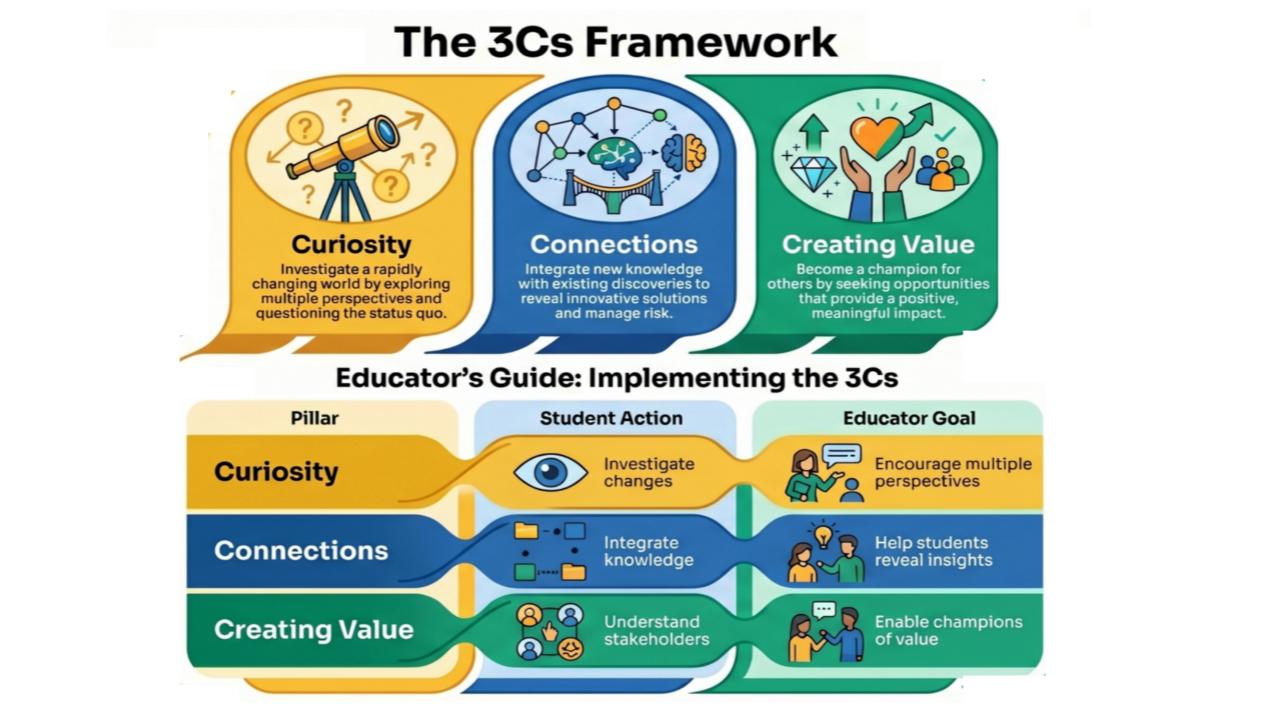
The 3Cs of Entrepreneurial Mindset: Curiosity, Connections, and Creating Value.
A thorough understanding of the 3Cs helps engineering students question, adapt, and make positive change in classes, campus, communities, and the world.
The Kern Family Foundation has catalyzed EM through KEEN: Kern Entrepreneurial Engineering Network.
All content in this post has been distilled from the Engineering Unleashed website.
Source: Engineering Unleashed
KEEN (02:48)
Douglas E. Melton, Ph.D, shares why the entrepreneurial mindset is the key to success for engineering undergraduate students.
Learn more about the mindset that’s transforming engineering education at https://engineeringunleashed.com/mindset
News
AI can out-produce code, but it can’t connect the dots: Rethinking Cyber Engineering Curriculum through Entrepreneurially Minded Learning (EML).
The other day, I was chatting with my daughter, who is an architect. We were discussing the anxiety around AI taking over tech jobs.
I told her, “I don’t think software architects are going anywhere. But developers? Many of their traditional roles will likely vanish.”
Then the real problem hit us.
How do you become a great architect? You spend years as a junior, mid-level, and senior developer. You learn by doing, failing, and executing.
If AI eats the bottom of that ladder, where does the next generation of senior strategists come from? This is exactly the crisis facing Cybersecurity Engineering.
We probably won’t need armies of pentesters who memorize standard attack tooling; AI already generates that faster than any human can type.
What we’ll desperately need are engineers who connect business risk, human behavior, and complex systems to anticipate the attacks nobody has scripted yet.
I’m convinced the answer is Entrepreneurially Minded Learning (EML), the framework developed by KEEN (the Kern Entrepreneurial Engineering Network), built on a simple equation: Mindset + Skillset.
Curiosity (chase the context not given in the prompt). Connections (link technical decisions to other domains). Value Creation (security as business survival, not serverlocking).
AI owns the Skillset now. The Mindset is the part that’s still entirely human, and it’s the part most curricula still don’t teach on purpose.
But I’ll say the hard part out loud instead of skipping past it: mindset alone doesn’t build judgment.
Judgment used to come from a decade of breaking things as a junior. If that decade disappears, EML has to do something harder than “teach curiosity”; it has to compress or replace the scar tissue that once came from years in the trenches.
That’s the real test, and it’s the one I think most programs claiming to “future-proof” students aren’t actually solving. I believe it’s solvable. I don’t think it’s solved yet, anywhere, including in my own classroom.
So here’s my challenge to this network: if junior execution roles disappear before students graduate, what builds the judgment that used to come from trenches?
I’ll defend EML as the right starting point. I want to hear why I’m wrong, or what’s missing. Educators, CISOs, hiring managers: disagree with me in the comments. That’s where this gets useful.
Entrepreneurship & Engineering Innovation Division (ENT) – Technical Session 7
🗓️ Tuesday, June 23, 2026 | 3:15 PM – 4:45 PM
📍 E-220E, Charlotte Convention Center
EML in Network Security: Cultivating Curiosity, Connections, and Value in Cybersecurity Education
M. Ajmal Khan, Ohio Northern University
How a shared language turns individual faculty into a community that carries change wherever it goes.
The most powerful driver of change isn’t a program or an institution, it’s the individual. It’s people coming together in a professional setting. That’s why career development is so important in higher education because it distills broad objectives, disparate language, and values into a discreet way of thinking. It creates a philosophy that’s instilled in individuals. People then carry those ideas with them wherever they go, creating connected, likeminded communities capable of affecting change at scale.
Experience has shown that an overarching, institutional initiative is certainly important to provide the roadmap for change and to articulate aspirational values, but its individuals that animate that change. It is at this person-by-person level that language can get conflated and break-downs can occur. That’s why the goal at Engineering Unleashed has been making sure individuals have a shared language that enables them to get on board with an idea, understand the reasons behind it, and then discover how they can contribute to a larger community.
It’s this community-centered approach that runs counter to much of the traditional professional development that’s focused on navigating and advancing a single institution or field. What has become clear over the course of Engineering Unleashed’s work with engineering faculty and administrators is that individuals take the learning with them, applying it wherever they are. “The faculty development aspect is more powerful than I even imagined,” says Doug Melton, Program Director at the Kern Family Foundation. “The fact that the idea resides in each faculty member is a really powerful dynamic and that it is also mobile adds to the sense of a movement building around an idea.”
“Part of the power of Engineering Unleashed and KEEN are they’re really designed around people and the connections that those people will form with each other,” Gillespie says. Gillespie used that training and network to initiate conversations with faculty across the country. She reached out with a basic pitch saying: I have an idea, would you like to be a part of it? What she found was likeminded faculty that then decided to collaborate to create and submit a conference session proposal highlighting their own professional experiences with the entrepreneurial mindset.
“I was able to bring people together around a topic that I had never met before. And it didn’t just end with that one conference session that we ran together,” Gillespie says. “Those are now people that I have stayed in touch with for multiple years as they’ve moved institutions, as I’ve changed positions.”
Kaitlin Mallouk is an Associate Professor at the Henry M. Rowan College of Engineering at Rowan University who went from attending her first workshop in 2018 to co-founding the Entrepreneurial Mindset in the First-Year (EMIFY) project and facilitating workshops at the national level. For Mallouk, the special sauce that animates an idea is individuals connecting to forge community. “We have pretty good evidence that one of the most effective ways to support change is through community,” Mallouk says. “KEEN provides a platform for that community-building, opportunities to engage with people and form relationships. From my perspective, that’s the most impactful part.”
The true power of these connections around an idea is that they compound not just across the country, but over time. “When we use the word community, we’re thinking about not only the community now, but the community in 10 years or 50 years’ time,” says the Kern Family Foundation’s Doug Melton. Creating that community infrastructure is how you build for the long-term, he says. “And that’s what we’re about.
About
3Cs: Curiosity, Connections, and Creating Value
A thorough understanding of the 3Cs helps engineering students question, adapt, and make positive change, from the classroom to campus, from within their communities to around the world. This emergent understanding came from years of work with KEEN faculty, students, and industry.
Curiosity
In a world of accelerating change, today’s solutions are often obsolete tomorrow. Since discoveries are made by the curious, we must empower our students to investigate a rapidly changing world with an insatiable curiosity. Learning Outcomes
- Demonstrate constant curiosity about our changing world
- Explore a contrarian view of accepted solutions
Connections
Discoveries alone are not enough. Information only yields insight when connected with other information. We must teach our students to habitually pursue knowledge and integrate it with their own discoveries to reveal innovative solutions. Learning Outcomes:
- Integrate information from many sources to gain insight
- Assess and manage risk
Creating Value
Innovative solutions are most meaningful when they create extraordinary value for others. Therefore, students must be champions of value creation. As educators, we must train students to persistently anticipate and meet the needs of a changing world. Learning Outcomes:
- Identify unexpected opportunities to create extraordinary value
- Persist through and learn from failure
The Engineering Skillset Circle
What’s missing from design?
Design has been billed as the ultimate act within engineering. But these skills are not enough to equip engineers to transform the world. Design skills must be complemented with opportunity recognition and impact assessment.
Adding opportunity recognition
By adding opportunity to design, students can refine concepts, think more broadly about the world around them, and understand the customer they are designing for. This allows for questions like, “What should be designed in the first place?”
Assessing and making an impact
Impact is significance multiplied by scale. Coupling impact skills to opportunity recognition and design implementation will enable students to have an eye for value creation. The KEEN Framework provides specific educational outcomes to develop students’ impact skills.
Connecting Skillset to Mindset: A Tandem Development
Engineers find success and personal fulfillment when they couple their skills with a mindset to create extraordinary value for others.
The key is an entrepreneurial mindset. Through educational interventions that connect to the 3Cs, you can equip students to understand opportunities, make an impact, and create value for themselves and others.
To understand this tandem development, think of a tandem bike where mindset provides direction and skillset provides the power:
Entrepreneurially Minded Learning
Entrepreneurially minded learning (EML) focuses on identifying unexpected opportunities with verifiable merit. To do that, one must be well informed.
Students are encouraged to be explorers and to be constantly curious, to connect information to gain insights, and to be always on the lookout for value.
Web Links
Videos
Why Entrepreneurial Mindset Matters
(02:48)
By: KEEN
Douglas E. Melton, Ph.D, shares why the entrepreneurial mindset is the key to success for engineering undergraduate students.
Learn more about the mindset that’s transforming engineering education at https://engineeringunleashed.com/mindset
What is the Entrepreneurial Mindset and How Does it Apply to Research?
(06:45)
By: KEEN
Are you ready to be part of the next big discovery?
Think about things you use. Your phone. A water tap. Getting a package from a delivery service. These things represent years of research, design, and consideration. But the skill behind these advancements is only half the equation. The other half requires an entrepreneurial mindset.
An entrepreneurial mindset means the ability to recognize problems as opportunities. To assess the impact of solutions. To create value. Research doesn’t exist in a vacuum. The entrepreneurial mindset helps you make choices about the research you pursue – and gets the results to the people who need them.
Now think of something you’re working on right now. Will this work create value for others? Could curiosity uncover new opportunities? Can you connect it to other applications?
With Lawrence Technological University, Rose-Hulman Institute of Technology.
KEEN Partner Institutions
Every great movement needs a great team. Meet ours.
KEEN (Kern Entrepreneurial Engineering Network) is a network of diverse universities across the United States. KEEN partner schools are committed to instilling the entrepreneurial mindset (EM) in 100% of undergraduate engineering students.
KEEN Partners
Source: Website
Transforming engineering education
In a dynamic and interconnected world, it’s important for undergraduate engineering schools to teach technical skills while fostering curiosity, connections, and creating value. But it’s not always obvious how to incorporate this mindset in classroom curricula and culture. That’s where KEEN can help.
KEEN is a partnership of 70 colleges and universities across the United States. The schools in the Network focus on one mission: To reach all of their undergraduate engineering students with an entrepreneurial mindset (EM) so they can create personal, economic, and societal value through a lifetime of meaningful work.
EM Courses
See courses in link below.
An Introduction to EML in 15 minutes
Source: Engineering Unleashed
An Introduction to Entrepreneurial Mindset and the 3Cs
11 lessons • 2 min
Course Introduction
00:41
Entrepreneurial Mindset (EM)
00:33
EM Continuum
00:17
The 3Cs
00:19
EM & Student Outcomes
Entrepreneurially Minded Learning (EML)
00:59
What is EML?
The Habits of EM
Examples of EML
Community Voices
Your Journey is Just Getting Started
How to Create a Card
Source: Engineering Unleashed
11 sections•43 lessons
Collapse all sections
Welcome!
7 lessons
Title & Template
2 lessons
Authors & Editors
3 lessons
Images
2 lessons
Classroom Fields
5 lessons
General (Basic) Fields
12 lessons
Adding Related Cards & Resources
2 lessons
Card Feedback
2 lessons
Previewing & Publishing
4 lessons
Sharing & Broadcasting
3 lessons
Congratulations!
1 lesson
Thank You
Rethinking Innovation Canvases for Cybersecurity Systems Engineering
Cybersecurity canvas guides students to frame real system risks. Used in capstone projects, it builds secure system reasoning and mission value insight.
Many innovative frameworks rely on business-oriented canvases to structure ideas and justify investments. These tools work well when value can be expressed in financial return or market advantage.
However, cybersecurity systems engineering operates under a different logic. In many cyber-physical and mission-critical environments, the primary value of a system is not revenue generation but risk reduction, trust preservation, operational continuity, and mission assurance. Traditional innovative canvases often struggle to capture these dimensions because they implicitly assume market-driven value propositions.
To address this gap, I developed the CSEC Canvas – Cybersecurity Systems Engineering Canvas, a structured framework designed to support problem framing and system reasoning in cybersecurity engineering contexts.
This canvas was developed while teaching CYSE 587 / SYST 687 – Cyber Security System Engineering, where students are required to defend system designs in a Shark-Tank-style seminar focused on technical feasibility and mission value rather than financial return.
Go to this post on GMU Cyber for more information.
Kern Family Foundation
The Kern Family Foundation’s mission is to empower the rising generation of Americans to build flourishing lives anchored in strong character, inspired by quality education, driven by an entrepreneurial mindset, and guided by the desire to create value for others. The foundations focus is on initiatives that have long-term, systemic impact. The foundation includes four program areas including:
Kern Entrepreneurship Education Network (KEEN)
The program’s mission is to graduate engineers with an entrepreneurial mindset so they can create personal, economic, and societal value through a lifetime of meaningful work. The long-term goal is for these new engineers to catalyze a transformation in the workforce and to build economic and technical commerce in their communities. This focus on entrepreneurial leaders is increasingly important as the U.S. competes to maintain its economic position in a global marketplace based on innovation. The program reaches students through a network of institutions. KEEN currently involves 19 universities around the country. The program provides institutional grants, topical grants, and small group grants. To learn more about participating universities and the grant application process. see https://communities.grantsoffice.com/s/grant/a0B3300000LXCfMEAX/kern-family-foundation