About onAir Networks

About onAir Networks 5

Summary

onAir Networks is a human-curated, AI-assisted network of topical hubs that bring together online communities of professionals, administrators, students, and the public to:

LEARN more about a field and advance its knowledge base;
DISCUSS key issues and challenges; and
ENGAGE with other people & organizations with a special focus on co-creating solutions to shared challenges

Key features of the onAir knowledge sharing platform include:

  • Curated public posts  synthesizing the best member content & AI summaries with member comments and Q&As;
  • Member posts and news items on themselves, their organizations, and their projects … auto updated and shared with other hubs;
  • Members owning their content with no tracking, algorithmic feeds or intrusive ads

News

i
Meet the Changemakers Day
VA Government HubOctober 24, 2023

This Meet the Changemakers event will occur on Tuesday October 24, 2023 between 2pm and 8pm at the Johnson Center Dewberry Hall on the Fairfax Campus (Google map). If you are unable to attend in person, you can watch our livestream of the town halls and presentations (and chat with fellow viewers).

Meet the Changemakers  activities will include:

Presentations by Mason research faculty –  Approximately 4-6 minutes about their research center and a research-based policy goal followed by a short Q&A session with the audience.
Mini Town Halls with Congressional Members and Virginia 2023 General Assembly candidates – 15 to 30 minute discussions with politicians and their policy proposals to address grand challenges being discussed at Meet the Changemakers day.
50 minute Town halls – Similar presentation as described above followed by federal, state, and local policymakers) discussing their views on the policy goal and what legislation they propose to address the goal followed by a Q&A session with the audience.
Opportunities to learn about Mason research centers and discuss their policy goals based on their research. Other stakeholders in the policy discussions will have tables in the lobby in addition to Mason students displaying their research posters.

Go to the links  below on the VA Government onAir Hub to:

Learn more about GMU research centers, university programs, the issues and “Who represents Me
Continue the conversation with Mason faculty, politicians, and the public in our upcoming aircasts (see our YouTube Channel0 and online forums in each VA Government post.
Learn more about the onAir networks that Mason alumni and students are developing to make it easy to find and interact with people and organizations who are developing and implementing solutions to grand challenges.

For more information, contact Sophie. Wagner@onair.cc

The Power of Crowd & Community
Diamandis.com, Peter H. DiamandisJuly 2, 2023

XPRIZE epitomizes the power of engaging and leveraging the Crowd, but here are some other examples:

GoFundMe. This Silicon Valley–based, for-profit crowdfunding platform helps people raise money to cover the costs of life events that can range from injuries and accidents (often subjects of major media attention) to weddings and personal debt. Between 2010 and 2020, GoFundMe raised nearly $10 billion from more than 120 million donors. Strictly speaking, GoFundMe is a Crowd play, with only a minority of regular donors and just 500 employees.

TikTok. Founded in 2018 in China (where it is known as Douyin), TikTok allows users to create and post short videos. By 2020, the company had achieved 2 billion downloads and was rated the world’s third-fastest-growing brand. By 2021, it was rated the most popular website in the world. Given the autonomous nature of its postings, TikTok is essentially a giant, Crowd-based company with almost no organized Community. It’s been so successful that lawmakers are alarmed at the addiction it creates in users and are considering banning the application altogether.

Wikipedia. The Crowd populates, but the Community validates. The world’s encyclopedia, Wikipedia, averages more than 18 billion page views per month, making it one of the most visited websites in the world. The site adds more than 20,000 new articles each month and has 27 million registered users. It contains many times the content of the traditional encyclopedia, can be accessed at light speed, links from one topic to another, and it is updated every second of every day. Best of all, it is free.

How to reverse polarization?
PBS NewsHourMay 31, 2023 (11:22)

Over the past few years, this country has seen a dramatic rise in partisan animosity with dangerous implications for the health of our democracy. Judy Woodruff profiles some of the work being done to understand what’s driving that trend and what might be done to reverse it. It’s part of her series, America at a Crossroads.

The Impact of U.S. Political Polarization
The Science Survey, Oliver WhelanMarch 14, 2023

The past decade has been a constant “back-and-forth” between Democrats and Republicans on almost every level of American government and society. Now, America is starting to feel the impacts.

As Biden’s first term draws to a close and the 2024 presidential election looms, an already divided America prepares for another round in a seemingly endless political tug of war. Now, as the aftermath of former President Donald J. Trump’s presidency is still being felt, both the Republican and Democratic parties scramble to find viable presidential contenders. With political tensions at a historical high, this election is set to be one of the most pivotal elections America has seen in a while – and it’s not because of the candidates, it’s because of the impact it will have on the American people.

Over the past decade, America has undeniably been influenced by political division. Despite the accepted belief that government is improved by the existence of opposing parties, the last few years have displayed anything but that. Anti-cooperation between Republicans and Democrats has hindered governmental processes, and in extreme cases, it has even allowed the country to regress in its policy decisions, like overturning Roe v. Wade and allowing states to censor education.

“[Political] polarization is so strong in the Congress now that it is much harder to get cross-party support for any bill or judicial confirmation than in the past,” said Bruce Cain, a Professor of Political Science at Stanford University. If the past few years of legislative standstills reveal anything, it’s that political divisions have prevented both sides from achieving their political goals.

i
An Overview of the “Uniting for Ukraine” Program
American Immigration Council, Fact SheetJanuary 13, 2023

On March 24, 2022, the Biden administration announced its intent to “welcome up to 100,000 Ukrainians and others” fleeing Russia’s invasion of Ukraine. On April 21, 2022, the Biden administration announced the creation of the Uniting for Ukraine program. This program allows Ukrainians displaced by the Russian invasion of Ukraine to apply to come to the United States through “humanitarian parole.” Ukrainians who are granted humanitarian parole may remain in the United States for up to two years and may seek to renew that status for additional periods of time. On November 11, 2022, the Biden administration announced that Ukrainians granted parole are automatically eligible for work authorization as part of their parole status.

Ukrainians who want to participate in this program must be sponsored by a supporter in the United States and are responsible for arranging their own air travel to the United States. The Department of Homeland Security (DHS) implemented the program on April 25.
What is “Humanitarian Parole?”
The Immigration and Nationality Act (INA) grants DHS the discretion to temporarily allow certain non-U.S. citizens to enter or remain in the United States even if they lack any lawful immigration status or legal basis for admission. Individuals who enter the United States under these conditions are granted “parole.” DHS may only grant parole to someone if there are “urgent humanitarian or significant public benefit reasons” for doing so. The INA does not define what constitutes an “urgent humanitarian” or “significant public benefit” reason, leaving this up to the discretion of the executive branch. U.S. Citizenship and Immigration Services (USCIS) states that one “urgent humanitarian” reason might include protection against “targeted or individualized harm.” Individuals who are not eligible for admission into the United States but who can demonstrate an “urgent humanitarian” reason for being allowed to enter or stay in the country may be granted “humanitarian parole.”
Who is Eligible for the Uniting for Ukraine Program?
In order to be considered for humanitarian parole under the Uniting for Ukraine Program, an individual must meet all the following criteria:

Resided in Ukraine “immediately prior” to the Russian invasion (through February 11, 2022) and was displaced by the invasion.
Is a Ukrainian citizen possessing a valid Ukrainian passport, or the immediate relative of a Ukrainian citizen who is applying for the program.
Has a supporter in the United States who has filed a Declaration of Financial Support (Form I-134) on behalf of the applicant.

Has been vaccinated for measles, polio, and COVID-19.
Has passed all biometric and biographic screening and security background checks.
Possesses a valid Ukrainian passport.

How Does Someone Apply for the Uniting for Ukraine Program?
There are five steps to the application process for humanitarian parole under the Uniting for Ukraine program:

The applicant must have financial support from someone in the United States. This “supporter” must file a Declaration of Financial Support online on behalf of the applicant in order for the applicant to be considered for the program.
Once USCIS approves the Declaration of Financial Support, the applicant must create a myUSCIS account, provide all required biographical information, and attest that they have been vaccinated for measles, polio, and COVID-19. If a person hasn’t been vaccinated for those diseases, they must obtain the first dose of the necessary vaccine prior to travel.
If USCIS approves the application for parole through the program, the applicant has 90 days to arrange their own air travel to the United States.
Once the applicant has arrived in the United States, they will be inspected by U.S. Customs and Border Protection (CBP) and considered for humanitarian parole for up to two years. The applicant must receive a medical screening for tuberculosis within 90 days of their arrival in the United States.
If the applicant is granted humanitarian parole, they are automatically eligible to work in the United States through their parole status.

Who Can Become a Supporter of an Applicant for the Uniting for Ukraine Program?
A supporter of an individual applying for humanitarian parole under the Uniting for Ukraine program must be lawfully present in the United States. This includes:

U.S. citizens.
Lawful permanent residents, lawful temporary residents, and conditional permanent residents.
Nonimmigrants in lawful status (that is, who maintain a nonimmigrant status and have not violated any of the terms or conditions of the nonimmigrant status).

Asylees, refugees, and parolees.
Recipients of Temporary Protected Status (TPS).
Beneficiaries of deferred action (including Deferred Action for Childhood Arrivals [DACA] and Deferred Enforced Departure [DED]).

What are the Shortcomings of the Uniting for Ukraine Program?
Refugee advocates generally support the decision of the Biden administration to offer refuge to Ukrainians displaced by the war with Russia. However, some advocates have also voiced concerns about the Uniting for Ukraine program. First of all, the two-year limit on humanitarian parole under the program seems arbitrary given that no one knows how long the war between Russia and Ukraine will last or how long it will take Ukraine to rebuild after the war. In addition, some advocates argue that the resources spent on Uniting for Ukraine would be better spent on strengthening and expanding the U.S. refugee program, which would help all people fleeing armed conflicts around the world rather than just Ukrainians. Others have also criticized the decision to provide protections for Ukrainians without creating similar parole programs for other nationalities experiencing conflict and displacement. For instance, Afghans fleeing Taliban rule after the U.S. withdrawal from Afghanistan are in desperate need of protection, but there is no ongoing formal special program that makes it easier for them to seek safety in the United States and many have been denied parole.

Climate change & the expanding role of universities
Maryland Matters, Maggie Holland & Candace Dodson-ReedMay 3, 2023

In 2022, with the passage of the Climate Solutions Act, the state of Maryland set the most ambitious greenhouse gas emissions reduction goals of any state in the U.S. The Act requires the state to reduce emissions by 60% from 2006 levels by 2031 and to achieve net-zero by 2045. And with the election of Governor Wes Moore at the end of 2022, this critical work was enhanced with his goal of ensuring that Maryland generates 100% clean energy by 2035.

Maryland has an opportunity to be a leader and it is exciting to set ourselves on a course to model proactive and rapid action to address emissions reductions with a governor, lieutenant governor, legislature, and state agencies that are poised and ready to act.

A key focus from our viewpoint is to address the potential risk of losing momentum and failing to act on the harder but most important ways forward to achieve these important goals.

Emissions reductions need to represent real changes in our energy systems. We have essentially stalled in the past on meaningful progress in transitioning to renewable and cleaner forms of energy like solar and wind. Prioritizing these transitions also requires a focus on:

Reducing our reliance on energy from other states. Maryland is a net energy importer because we consume about five times more energy than we produce in the state.
Accounting for the role we play in the transport and export of dirtier forms of energy elsewhere in the world, as the Port of Baltimore is the second-largest coal exporter in the United States.
Ensuring a just transition and sustained opportunities for work in the solar and wind industries, especially for those currently employed in the fossil fuel industry.
Reforming our own renewable portfolio standard so that we do not incentivize the counting of dirtier/polluting forms of energy production (e.g., waste incineration and other biomass burning) as top-tier energies.
Thoughtful updates to sustainability plans. Many plans for reaching net-zero rely on carbon offsets to meet targets while we try to make more substantial changes in our energy systems. But carbon offset investments can be problematic and further risk a lack of meaningful action to reduce emissions.
Universities play a critical role in helping execute this work for meaningful, long-term change.

In addition to ensuring that actively reducing their carbon footprint and environmental sustainability goals are key tenets of a university strategic plan, our great universities can be innovators and incubators, and can exchange ideas and practices. We often emphasize technological innovations and engineering solutions, but must also continue to tap into the breadth and depth of experience across disciplines, including the social sciences, arts, and humanities.

Our state universities would benefit from support to not only foster innovations to address a changing climate, but also to teach the next generation how to communicate on climate change and how to strategize on policy development and decision-making.

i

Mission and History
The Industry–University Cooperative Research Centers (IUCRC) program accelerates the impact of basic research through close relationships between industry innovators, world-class academic teams, and government leaders. IUCRCs are designed to help corporate partners and government agencies connect directly and efficiently with university researchers to achieve three primary objectives.

Conduct high-impact research to meet shared industrial needs in companies of all sizes;
Enhance U.S. global leadership in driving innovative technology development, and;
Identify, mentor and develop a diverse high-tech, exceptionally skilled workforce.

The IUCRC program provides a structure for academic researchers to conduct fundamental, pre-competitive research of shared interest to industry and government organizations. These organizations pay membership fees to a consortium so that they can collectively envision and fund research, with at least 90% of member funds allocated to the direct costs of these shared research projects.

Universities, academic researchers, and students benefit from IUCRC participation through the research funding, the establishment and growth of industrial partnerships, and educational and career placement opportunities for students. Industry members benefit by accessing knowledge, facilities, equipment, and intellectual property in a highly cost-efficient model; leveraging Center research outcomes in their future proprietary projects; interacting in an informal, collaborative way with other private sector and government entities with shared interests; and identifying and recruiting talent.

Successful IUCRCs require:

A capable research/management team with a strong entrepreneurial mindset;
Universities, faculty, and students interested in deep engagement with industry;
A community of industry and government partners seeking pre-competitive, use-inspired research projects.

The National Science Foundation (NSF) provides funding to support Center administrative costs and a governance framework to manage membership, operations, and evaluation. Each IUCRC is expected to grow over time and be independently sustainable by the end of the award period.

Every year, more than 2,000 students engage in industrially-relevant research at Centers nationwide, giving them on the job training for a career in the private sector. About 30% of these student researchers are hired by the member companies.

NSF created the IUCRC program in 1973 to foster long-term partnerships among industry, academe and government. These partnerships support research programs of mutual interest, contribute to the nation’s research infrastructure base, promote workforce development, and facilitate technology transfer.

NSF is a federal agency that supports fundamental research and education across all fields of science and engineering, with an $8.1 billion budget in fiscal year 2019.

See the work that our Industry University Cooperative Research Centers are engaging in across all technology and market sectors.

View Center Achievements

The IUCRC program generates breakthrough research by enabling close and sustained engagement between industry innovators, world-class academic teams and government agencies.

Adobe does generative AI
Adobe BlogMay 23, 2023

Overview of generative A! from Benedict Evans newsletter.

Every incumbent tries to make the new thing a feature of the old thing, and every incumbent has read the Clayton Christensen ‘Disruption’ book and wants to make sure they make the jump. Adobe made a very successful shift to subscription SaaS in the last decade, and now it’s trying the same with generative AI, launching a de novo image generation product in Firefly and adding generative features to Photoshop.


The more generally important part of this, I think, is the move to add interface, control and product to the prompt: instead of typing 50 words into a box and waiting to see what you get, there are options and switches to give you some control. Stepping up another level again, I think these kinds of features, like most automation and indeed like Photoshop, will produce more employment, not less: making these kinds of workflows easier and faster will lead to more people doing it.


However, the other side of a platform shift is that while the incumbents make it a feature, new companies create entirely new tools that are native to the new possibilities, and unbundle the use cases one by one. Figma is not a web version of Photoshop (and Adobe is trying to buy it, which may or not be allowed by competition authorities), and there will be generative AI equivalents.   DEMOFIREFLY

Resetting the score
Other, Benedict Evans January 15, 2015

Sometimes, an entire industry gets reset to zero, and all the entrenched advantages and parameters go away. The iPhone had that effect, and so did HMS Dreadnought.

Rather like the iPhone, it contained few things that were fundamentally new – most of the key features had been around for a while and considered elsewhere – but it was the first to put all of them together in one place in the right way, and, like the iPhone, this changed everything. Every other warship afloat was obsolete.

About

Overview

onAir Networks, a 501c3 nonprofit, oversees the management of the public onAir hubs and networks. onAir Networks has an exclusive license to use the onAir software platform from onAir Tech, a Public Benefit Corporation.

onAir Tech corporation, in addition to the development of its Knowledge and Information Sharing System (KISS), also supports public and custom hub administrators. onAir Tech focuses on custom hubs that share many of their posts with one or more public onAir hubs.

Supporting onAir

Individuals and organizations can support a hub in many ways including:

  • Donating or providing grants to onAir Networks & specific hubs or networks;
  • Sponsoring a post, category of posts, a newsletter, or entire Hub
  • Purchasing a member post for an individual, group, organization,or project
  • Volunteer to curate a public post and moderate its discussions, host videos and liverstreas, coordinate in person events, & participate in a hub advisory board

Select the Information icon in each hub’s site header to find out how to support a hub.

Notebook LM overviews

The infographic below was generated by Notebook LM based on this post.

About onAir Networks 1

The report below (blog post style) was generated by Notebook LM based on this post.
Beyond the Algorithm: 5 Surprising Lessons from the New Digital Knowledge Frontier


The current digital landscape is defined by algorithmic fatigue, a systemic exhaustion born from the pervasive attention economy. Users find themselves trapped in feedback loops of intrusive ads and polarizing content that prioritize engagement over enlightenment. To move past this cycle, we must transition from a reactive “scrolling” culture to a proactive knowledge architecture. Solving “grand challenges”—from climate stability to the preservation of democracy—requires a foundational redesign of our digital infrastructure, moving away from chaotic data streams toward structured synthesis pipelines.
The solution lies in curated, decentralized hubs that treat information as a public good rather than a commodity. Platforms like onAir Networks provide a blueprint for this shift, utilizing a human-curated, AI-assisted framework to reorganize the internet into actionable knowledge ecosystems. By moving beyond the “engagement-at-all-costs” model, we can build the governance structures necessary to address global crises. This document explores five key lessons from this emerging frontier, illustrating how a strategic approach to information sharing can transform civil discourse and policy scalability.

1. The Power of “Community” over the “Crowd”
The distinction between a “Crowd” and a “Community” is a critical pillar of knowledge architecture. As analyzed by Peter H. Diamandis, platforms like TikTok leverage the Crowd—a massive, unorganized entity that generates autonomous, addictive content but lacks a validation layer. While the Crowd is effective for rapid data population and fundraising via tools like GoFundMe, it often results in unverified information and algorithmic addiction that has increasingly alarmed global lawmakers.
In contrast, a Community provides the governance necessary for reliability. Wikipedia stands as the premier example; while the data is sourced from the crowd, it is the dedicated, registered community that verifies, structures, and links the information into a cohesive whole.
“The Crowd populates, but the Community validates.”
A platform focused on community curation, such as onAir Networks, serves as an essential antidote to the addictive, unorganized nature of purely crowd-based platforms. By utilizing topical hubs, these systems ensure that abundance does not come at the expense of accuracy.

2. The “Humanitarian Parole” Paradox
The Uniting for Ukraine program provides a stark look at the complexities of modern immigration governance. Under the Immigration and Nationality Act (INA), the Department of Homeland Security (DHS) utilizes “humanitarian parole” as a discretionary executive power. While this allowed over 100,000 Ukrainians to access work authorization and safety, the program’s structural limitations reveal a policy paradox.
The program has faced criticism for being “arbitrary,” specifically regarding its two-year limit, which fails to account for the unpredictable nature of war or the timelines required for national reconstruction. Furthermore, a glaring inconsistency exists between nationalities; for example, Afghan refugees fleeing the Taliban lack a similar “special program” model, leaving many denied parole despite facing individualized harm. This highlights a critical challenge in civic innovation: building equitable policy frameworks that move beyond discretionary, temporary fixes toward consistent, long-term humanitarian systems.

3. Why Automation Might Actually Create More Jobs
Contrary to the fear of Generative AI causing mass unemployment, history suggests that making complex workflows faster often expands the labor market. Adobe provides a prime example of this “platform shift” strategy. Having successfully transitioned to a SaaS (Subscription Software as a Service) model over the last decade, Adobe is now integrating AI features like Firefly directly into Photoshop, making it a “feature” of the incumbent’s existing infrastructure.
The strategic landscape is currently divided between incumbents making AI a feature and new entities “unbundling” specific use cases. For instance, Figma represents a tool native to new possibilities rather than a mere web-based version of legacy software. As automation lowers the barrier to entry for creative and technical tasks, the volume of people engaging in these workflows increases. Much like the transition to the iPhone, this technological “reset” suggests that AI-assisted creativity will likely lead to more employment by scaling the demand for specialized output.


4. Universities: The New Climate Policy Incubators
Addressing the climate crisis requires more than technical breakthroughs; it requires a systemic evolution in how we train policy leaders. Maryland’s Climate Solutions Act (2022) sets a high bar, requiring a 60% reduction in emissions by 2031 and net-zero status by 2045. However, meeting these targets involves confronting difficult local realities, such as the fact that the Port of Baltimore remains the second-largest coal exporter in the United States.
To navigate this, state universities must move beyond traditional research to become active policy incubators. This involves:

  • Integrating the social sciences and humanities to teach the next generation how to communicate on climate change.
  • Strategizing on policy development to ensure a “just transition” for workers currently employed in the fossil fuel industry as the state pivots toward wind and solar.
  • Moving away from problematic carbon offsets toward real energy system reforms.

By acting as “innovators and incubators,” universities can bridge the gap between engineering solutions and the rapid social action required for global survival.


5. The “Un-Social” Network: Privacy as a Feature
The core operating philosophy of onAir Networks presents a strategic alternative to the traditional social media model. Managed by a 501c3 nonprofit and powered by software from onAir Tech (a Public Benefit Corporation), the system utilizes a KISS (Knowledge & Information Sharing System) approach. This architecture is “un-social” by design, explicitly rejecting the features that drive polarization:

  • No system data capture or user tracking.
  • No algorithmic feeds designed to manipulate attention for profit.
  • No intrusive ads or selling of user information.

This model prioritizes learning and implementation over engagement metrics. Real-world applications, such as the “Meet the Changemakers” event, demonstrate how this digital infrastructure facilitates physical civic engagement by connecting citizens directly with researchers and policymakers. By treating privacy as a foundational feature rather than a setting, this model offers a “People’s Platform for Democracy” that safeguards the knowledge base of its community.
Conclusion: The Forward-Looking Summary
The transition from a chaotic, crowd-driven internet to a structured knowledge frontier is not just a technological choice—it is a civic necessity. Whether managing the complexities of humanitarian parole, navigating the shift to SaaS-integrated AI, or leveraging universities to solve the climate crisis, the common thread is the need for curated, community-validated systems. If we can build a “People’s Platform for Democracy” that doesn’t rely on selling our attention to the highest bidder, what grand challenge could we solve first?

GMU Acknowledgements

George Mason University alumni, faculty, administrators, and supporters have been instrumental in developing the onAir software as well as our initial networks. Over 50 interns from Mason academic units including from the Volgenau School of Engineering, Schar School of Policy and Government, the College of Humanities and Social Sciences, and the Honors College. have participated in this work, most via a 6 credit, 20 hour a week internship programs.

For example, Todd Gillette, GMU PhD Neuroscience, 2015 has led the development of the onAir platform and Scott Joy, former GMU affiliate in the College of Science, has led the implementation of the onAir platform. Tom Davis, former GMU rector and US congressman, David Bulova, Virginia Secretary of Natural and Historic Resources and former GMU state delegate,  and Don Beyer, US House member & GMU AI masters student have supported onAir in many ways including participation in online interviewsand in person events.

Videos

About US onAir Networks

October 29, 2025 (02:00)

This video has been narrated by: Karina Lipsman

Transcript:
A strong democracy … depends on … all of us ..
Introducing . United States … onAir …
A nonprofit nonpartisan network .. working to become .. the People’s Platform for Democracy A Network of Hubs

We are a network .. of 50 .. curated onAir state hubs … Who share their content with …… The national .. US onAir .. Hub ……… A New Resource for Democracy Now more than ever, we need unbiased information from sources you can trust …

Our onAir volunteers … from US colleges, universities, and nonpartisan organizations … Provide a new resource for democracy …. The Platform The US onAir Network of hubs connect citizens with their government … candidates … issues.. and each other By providing a platform on which users can find information on who represents them …. How to vote .. and much more …

US onAir is a place where you can Learn ……. Discuss ….… and Find Common Ground… With your representatives, experts, and fellow Americans … US onAir’s Mission Democracy … has always been a struggle … That is why our mission at US onAir is to bring together Americans to become better informed and engaged in our democracy… We support civil discussion and constructive and impactful solutions. Your Voice Matters Join the conversation … onAir Your Voice Matters… at … us.onair.cc

Networks & Hubs

About onAir Networks 3

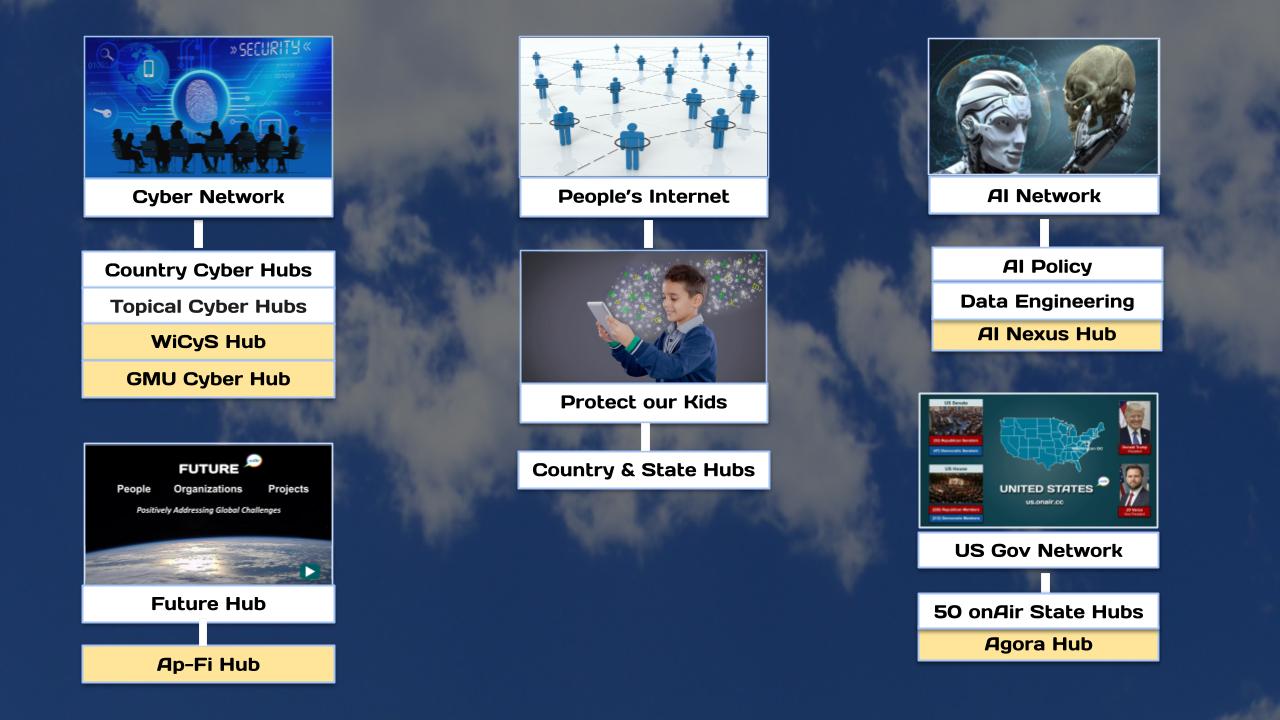
Current networks and hubs under development are primarily focused on tech-related topics such as the Cyber onAir and AI onAir networks and the People’s Internet Hub and Protect our Kids hubs. The US onAir network of 50 state government and politics related hubs were among some of the earlier hubs implemented using the onAir platform.

Each network has its own comment guidelines as well as its own Advisory Board.

Content

Any web user, on a laptop, desktop computer or smartphone connected to the internet, can easily access content on any onAir Network hub for free.

All topical posts in onAir networks Hub websites is under the Creative Commons Attribution- NonCommercial with the additional condition that nonprofit websites, apps, and social media pages do not have advertisers. This CC BY-NC-ND 4.0 license permits content sharing and adaptation as long as proper attribution is given to its author(s) and is used for non-commercial purposes.

All content in profile posts on people, organizations, and projects is copyrighted by default by a post’s lead author.

See Terms of Service for more information on how you can re-use Hub content and view Hub disclaimers.

Simply visiting a Hub does not expose your identity publicly nor will onAir Networks sell your information. See our Privacy Policy  to learn about how we don’t use cookies, track your usage, or sell your email address.

Comment guidelines can be found at the bottom of each Hub;s footer. We are dedicated to maintaining respectful, engaging and informative conversations.

onAir Membership

Becoming an onAir member is simple and free.  All that is required is your first and last name, your email address and your zipcode. You can also identify the issues you would like a hub’s curators and authors to address. When you submit your email address to become an onAir member, it is your option to have your address displayed. 

  Select the “Join” button in the site header of the hub you are interested in. 

  Becoming an onAir member will enable you to:

  • Comment on posts in any onAir Hub;
  • Curate and moderate public posts;
  • Author and moderate news posts and have sponsors so can earn money from your contributions;
  • Be able to follow posts and members and create your own My onAir user experience;
  • Qualify to be an onAir Chapter member;
  • Participate in aircasts (Aircasts are student-produced, livestreamed online discussions).
  • Have your own Member post that you can copyright and also have sponsors so can earn money from your contributions.

onAir Curation

Curating a post and administering a hub is simple and intuitive requiring no programming experience. Any onAir member, with guidance from hub administrators, can curate public posts on a hub. In addition, onAir members can also start and curate new posts, moderate forums, and produce aircasts as long as they adhere to a hub’s curation guidelines. OnAir members can also start and curate, for a fee, a post on themselves (like LinkedIn), their organization, and projects. These posts will be clearly identified and be copyrighted by their owner. 

If your university research center or department, association, or other nonprofits would like to help manage and curate an onAir hub, contact the network (see address in central network hub’s footer). 

Benefits for nonprofit organizations

  • Gain increased visibility and interaction with several audiences – both within and outside your organization
  •  Recruit new people to your organization
  • Attract new funding – from individuals, foundations, grants, corporate sponsors
  • Establish ongoing communication with audiences – via onAir posts, aircasts, post forums, and in person events
  • Can easily produce and monetize newsletters based on post content
  • Connect with and influence federal, state, and local policy makers

onAir Platform

onAir is a dynamic, web-based platform for Knowledge & Information Sharing (KISS). The onAir platform supports the development of public and custom onAir Hub websites that display posts curated by onAir members. All onAir public hubs are overseen by our 501c3 nonprofit onAir Networks and the nonprofits and universities we work with on each hub.

  • All onAir public Hubs are hosted on the “onair.cc” domain .
  • OnAir  Hubs aggregate and promote the best, publicly available knowledge about a topic and its related news, events, resources, people, and organizations. OnAir Hubs also provide a variety of tools for Hub member engagement including forums in each post and aircasts (livestreamed zoom discussions).
  • OnAir posts, by default, are under the CC-NC (Creative Commons-Non Commercial) license and can be shared with any other onAir Hub and automatically updated from the original post
  • OnAir Networks provides its Hub organizers and managers with the support and guidance to make their Hub the go to place for their topic. OnAir Hubs can be customized by their administrators. OnAir also provides whatever design, development, and content support that is required.
  • OnAir also develops and monitors the curation and moderation guidelines for the Hubs and manages the finances for each state hub. OnAir will share sponsor and other revenues with its hub administrative and curation partners.
  • OAir hubs on any topic can be easily created, administered, and curated without any programming knowledge.
  • OnAir Hubs have multiple ways of bringing together experts with each other, with students, and with the public to discuss best practices, new ideas, and innovative solutions. Every post has a forum that enables persistent, ongoing discussions on various topics as well as a place to ask questions and make suggestions, tell stories, and add endorsements.
  • In addition, onAir supports professionally produced, livestreamed Zoom interviews, panels, town halls, and other discussion formats without requiring video expertise and displayable in posts and social media. OnAir also provides students with training on how to coordinate in person events

Data Ownership

OnAir was founded by people and for people, so we built the platform from the ground up to give users agency over how their data is stored.

Our entire platform utilizes cryptographically-secure protocols to minimize data leaks and allow users to only share what they feel comfortable with sharing.

We stand by keeping our communities safe from paywalls, abusive algorithms, and intrusive ads to ensure people are free to communicate within the bounds of our guidelines uninterrupted

onAir Posts

The onAir POST is the key element of the onAir platform. Posts can have content about a topic, person, or organization.  Posts are stored and displayed within a public or custom HUB, aggregating the best content on a topic. Public hubs are overseen by the nonprofit onAir Networks and other nonprofits. To learn more about the onAir user experience, go to this post.

  • Posts are organized in categories and sub-categories in a hub’s site header and can appear in multiple categories within a hub as well as shared with other hubs;
  • Posts can have, in addition to having text and images, all types of media such as YouTube videos, Google Docs, PDFs, and Wikipedia entries;
  • Posts can also have news items embedded within them such as videos, articles, livestreams, and press releases;
  • Every post author can also have a comment section for Q&A, feedback, and forum discussion.
  • Posts can be shared via social media and email.
Skip to toolbar