Summary
Cybersecurity is the practice of protecting networks, devices, and data from digital attacks, unauthorized access, and damage.
It encompasses the technologies, processes, and policies designed to safeguard our increasingly digital world.
To build a foundational understanding of the principles, technologies, and risks involved, you can explore resources from recognized institutions such as the IBM Cybersecurity Guide or the Cisco Cybersecurity Overview.
Tech with Jono – 25/06/2024 (05:46)
Hey guys, in this short video we’ll talk about everything you need to know as a BEGINNER in Cybersecurity. Important topics are phishing, investigations, Indicators of compromise, remediation, and documentation. Enjoy!
News
Entrepreneurship & Engineering Innovation Division (ENT) – Technical Session 7
🗓️ Tuesday, June 23, 2026 | 3:15 PM – 4:45 PM
📍 E-220E, Charlotte Convention Center
EML in Network Security: Cultivating Curiosity, Connections, and Value in Cybersecurity Education
M. Ajmal Khan, Ohio Northern University
Engineering Unleashed, – June 15, 2026
Transforming cybersecurity classes into a podcast with AI (Applying EML)
Anyone in engineering education knows that the best way to solidify a concept is often to have a lighthearted conversation about it. To put this to the test, I created an experiment using NotebookLM to generate a podcast focused on discussing the topics we cover in my cybersecurity classes, but in a completely casual and informal tone.
The idea goes beyond simply feeding content to an AI and letting it speak. I define the focus, the angle, and what I want to explore in each episode; the AI executes it, but I actively guide the pedagogical curation.
The main idea of this project is to transform heavy theory into a dynamic experience and connect students to the real-world applications of these concepts, explicitly applying the connections from the EML (Entrepreneurial Mindset Learning) approach.
The goal is to increase students’ understanding and stimulate ongoing debate, demonstrating that simple solutions can generate enormous value in learning.
We just released Chapter 2! You can see how the experiment is evolving here: https://www.youtube.com/playlist?list=PLz9ls-KwHLoGxSqhqgxPau3EPpxjezl83
I am currently working on an Engineering Unleashed Card to detail the process and the pedagogical curation behind this experiment, but I wanted to share these early results with the community first.
Have any of you experimented with NotebookLM or similar AI tools to create new formats for educational content? I would love to hear your thoughts and potentially incorporate some of this discussion into the upcoming Card.
On June 12, artificial intelligence (AI) lab Anthropic suspended access to its latest Claude models, Fable 5 and Mythos 5, which had been released three days earlier.
The move came in response to an “export control directive” from the US government prohibiting use of the models by anyone who is not a US national.
Mythos is Anthropic’s most powerful, or “frontier”, model. When first announcing the model in April, the company said it was too good at hacking to release immediately. Instead, Mythos was made available to a handful of organisations (mostly US tech corporations) to use to patch weaknesses in essential digital systems.
Fable is the same basic model, but with added safeguards meant to stop it being used for cybersecurity purposes. This is what was released to the public last week – and almost immediately shut down.
Anthropic and the Trump administration at loggerheads
Since early 2025, Anthropic and the Trump administration have been in escalating conflict. The administration has accused Anthropic of making “woke AI” and called chief executive Dario Amodei an “ideological lunatic”.
Early disagreements concerned AI regulation and semiconductor export policy. The dispute sharpened when Anthropic declined to let the Pentagon use its models for domestic surveillance and fully autonomous weapons systems.
The Department of Defense responded by threatening to designate Anthropic a “supply chain risk”, a classification that would have required military contractors to sever ties.
Jailbreaks
The US government has not yet publicly stated the reason for last week’s directive, but Anthropic it says it believes the government became aware of a jailbreak: a method for circumventing the safeguards in Fable that prevent using its most powerful features for nefarious purposes.
These safeguards classify user requests as safe or unsafe before passing them to the AI model. When triggered, the safeguards redirect the request to a less powerful model.
The government’s concern, according to Anthropic, was that the safeguards could be bypassed to extract information useful for cyberattacks.
Guardrails for large language models aren’t bulletproof. They mostly depend on the model’s own capacity to interpret the user’s intentions in making a request.
Beyond the inherent difficulty of this task, a large online community (which my colleagues and I call the Undersphere) is working hard to circumvent AI guardrails. Anthropic acknowledges that “perfect jailbreak resistance is not achievable for any current model provider”.
Anthropic says the research behind the government directive appears to have been produced by engineers at Amazon, which is both a rival to Anthropic and a significant investor.
But this was not the only relevant jailbreak. Within 48 hours of Fable’s release, a researcher using the pseudonym “Pliny the Liberator” published what they identified as Fable 5’s full system prompt to X and GitHub repository.
The system prompt is a hidden set of instructions that helps determine an AI model’s behaviour. It’s unclear exactly how knowledge of Fable’s system prompt could be used in practice, but it has drawn attention in the Undersphere.
A surprise – and an ongoing mystery
The deepest problem of making large language models such as Fable secure is that we don’t fully know how they work. According to Oxford University economist and machine learning expert Maximilian Kasy, they work much better than they “should”.
Large language models have billions of internal parameters and are trained on unimaginably vast piles of data using machine learning methods. According to Kasy, we would expect such systems to be “overfitted”: good at reproducing patterns in their training data, but bad at generalising to new situations.
However, modern systems such as Claude and ChatGPT do seem to be able to generalise. Kasy likens modern AI development to alchemy: successful through trial and error, not yet grounded in systematic theory.
As a result, the behaviour of AI models is partly opaque even to their builders.
Hard to regulate
The opacity of the technology is one key reason it’s so hard to regulate. Governments lack independent access to the data, infrastructure and expertise they would need to evaluate proprietary frontier models.
The US administration’s recent executive order on AI security, published two weeks ago, reflects this realisation. As the administration has realised the power of frontier AI models, it has moved from an initial hands-off posture to asking developers to share their models for review before release.
That demand is an implicit admission that the administration does not trust the companies to evaluate, fully and comprehensively, what their own models can do and how they might be misused. The public sees even less, and the consequence is measurable: a survey taken across 25 countries last year found people are, on balance, more than twice as concerned about AI as they are excited about it.
The future of AI safety
AI is a hugely hyped technology. But there is no doubt it is also extremely powerful and unpredictable. Understandably, this combination is very dangerous.
We cannot rely on regulations, as technology will develop more quickly than they can adapt. Nor can we rely on guardrails, as they will be bypassed.
We need a governance framework built for that eventuality: one that can predict and address the consequences of failure.
Such a framework must be global, participatory, and founded on reciprocal trust. These are things the current US administration has shown little capacity to generate.
I’m joined by Mike Aiello, an awesome security executive and human. Mike was previously CTO at Secureworks, led product for Google Cloud Security from 0 → $B’s in revenue, and CISO at Goldman Sachs.
I was going to write a post describing all the details about joining, my thought process, etc. but it turns out there’s a lot to do at OpenAI and I’ve gotten very busy 😅 The post is started but not finished, will share when I can.
So here’s the short version.
Why
I was very happy at Semgrep and wasn’t looking for new opportunities, but when an OpenAI recruiter reached out, it seemed like a once in a lifetime company and opportunity that I couldn’t pass by.
During the interview process, when I spoke with my potential colleagues, I was impressed by how they were incredibly smart and kind, and genuinely, earnestly, cared about making a positive impact on the world. Several people, without me bringing it up, expressed to me that as models get better, they feel a moral responsibility to do what they can to secure the world’s software.
And now from the inside, I can see that the sentiment was genuine, and not a facade (you always wonder as an outsider). OpenAI has easily already spent millions securing open source and critical infrastructure that they haven’t yet claimed PR cred for doing.
I’ve long talked about the power of secure by design and eliminating vulnerability classes. Being at OpenAI makes that feel tractable in a way it never has before. I’m optimistic we, the security community, can meaningfully raise the world’s security bar over the next few years. Seriously.
Lastly, how I think about the decision is also well expressed by my friend Rami McCarthy, who, like with many things, annoyingly wrote a better version of what I would write in his post on joining Wiz. Similarly, I hope to “work for the security industry, at OpenAI.”
I shared a LinkedIn post with a bit more details, feel free to say hi or share thoughts there 👋
P.S. tl;dr sec will continue, don’t worry. Also, I will continue to include high quality content from Anthropic, that is also unchanged. More on that below.
How a shared language turns individual faculty into a community that carries change wherever it goes.
The most powerful driver of change isn’t a program or an institution, it’s the individual. It’s people coming together in a professional setting. That’s why career development is so important in higher education because it distills broad objectives, disparate language, and values into a discreet way of thinking. It creates a philosophy that’s instilled in individuals. People then carry those ideas with them wherever they go, creating connected, likeminded communities capable of affecting change at scale.
Experience has shown that an overarching, institutional initiative is certainly important to provide the roadmap for change and to articulate aspirational values, but its individuals that animate that change. It is at this person-by-person level that language can get conflated and break-downs can occur. That’s why the goal at Engineering Unleashed has been making sure individuals have a shared language that enables them to get on board with an idea, understand the reasons behind it, and then discover how they can contribute to a larger community.
It’s this community-centered approach that runs counter to much of the traditional professional development that’s focused on navigating and advancing a single institution or field. What has become clear over the course of Engineering Unleashed’s work with engineering faculty and administrators is that individuals take the learning with them, applying it wherever they are. “The faculty development aspect is more powerful than I even imagined,” says Doug Melton, Program Director at the Kern Family Foundation. “The fact that the idea resides in each faculty member is a really powerful dynamic and that it is also mobile adds to the sense of a movement building around an idea.”
“Part of the power of Engineering Unleashed and KEEN are they’re really designed around people and the connections that those people will form with each other,” Gillespie says. Gillespie used that training and network to initiate conversations with faculty across the country. She reached out with a basic pitch saying: I have an idea, would you like to be a part of it? What she found was likeminded faculty that then decided to collaborate to create and submit a conference session proposal highlighting their own professional experiences with the entrepreneurial mindset.
“I was able to bring people together around a topic that I had never met before. And it didn’t just end with that one conference session that we ran together,” Gillespie says. “Those are now people that I have stayed in touch with for multiple years as they’ve moved institutions, as I’ve changed positions.”
Kaitlin Mallouk is an Associate Professor at the Henry M. Rowan College of Engineering at Rowan University who went from attending her first workshop in 2018 to co-founding the Entrepreneurial Mindset in the First-Year (EMIFY) project and facilitating workshops at the national level. For Mallouk, the special sauce that animates an idea is individuals connecting to forge community. “We have pretty good evidence that one of the most effective ways to support change is through community,” Mallouk says. “KEEN provides a platform for that community-building, opportunities to engage with people and form relationships. From my perspective, that’s the most impactful part.”
The true power of these connections around an idea is that they compound not just across the country, but over time. “When we use the word community, we’re thinking about not only the community now, but the community in 10 years or 50 years’ time,” says the Kern Family Foundation’s Doug Melton. Creating that community infrastructure is how you build for the long-term, he says. “And that’s what we’re about.
The Conversation, – June 12, 2026
Some technology and policy watchers were surprised when President Donald Trump signed an executive order on June 2, 2026, establishing a framework for AI security. It seemed to move in a different direction from a December 2025 executive order that sought to create a “minimally burdensome” national framework for artificial intelligence and supersede state laws the administration saw as restrictive.
The new executive order focuses on using AI to boost the security of federal and private computer systems. It also aims to ensure that the federal government has access to major new AI models before they are released to the public, to determine if they pose a threat.
However, the order’s provisions relating to the AI industry are voluntary, and it explicitly prohibits interpreting its provisions as authorizing “a mandatory governmental licensing, pre-clearance, or permitting requirement” for new AI models.
As a professor who studies responsible AI, the questions the executive order raises for me are how its new reporting structure changes the governance of AI safety, and whether the order reflects what AI safety experts see as best practices.
Potential for harm
The executive order expresses concern about AI systems that can discover software vulnerabilities and write malicious code to exploit them. It directs various government secretaries to enact cyber defenses for federal systems. It also establishes an AI cybersecurity clearinghouse in voluntary collaboration with the AI industry and operators of critical infrastructure to scan for vulnerabilities and distribute fixes.
This approach may be the Trump administration’s response to the April 2026 announcement by Anthropic that its newest version of Claude, called Mythos, autonomously found hundreds of software vulnerabilities in critical systems across the U.S. and crafted attacks against them. That prompted several large financial institutions to request early access to such models.
The executive order directs various high-ranking government officials to develop and maintain a classified process for assessing whether new AI programs should be designated as frontier models, also called foundation models.
In industry parlance, a frontier model is a new, cutting edge AI model trained on massive amounts of data that can reason and autonomously use tools to initiate actions. The latest versions of ChatGPT, Claude, DeepMind and Llama fall into this category.
If a new model meets the frontier criteria, then the developer is supposed to provide the government with access to it at least 30 days before they plan to release the model. It also says developers will collaborate with the federal government to select third parties to preview covered frontier models to assess the risk to the cybersecurity of critical infrastructure.
Voluntary measures
AI companies that develop frontier AI models currently share information with the Center for AI Standards and Innovation, part of the National Institute of Standards and Technology governed by the Department of Commerce. According to the International AI safety report, most risk management initiatives around the world are largely voluntary for AI companies. This includes the Frontier AI Safety Frameworks that AI developers consult, the G7 Hiroshima AI Process endorsed by leaders of G7 countries, and the EU Code of Practice followed across Europe.
The new executive order retains the voluntary nature of AI developers reporting potential safety risks. The administration continues to argue that restrictive safety barriers could hamper innovation.
However, AI safety pioneers, including Turing Award winners Geoffrey Hinton and Yoshua Bengio, maintain that safety cannot rest solely on corporate self-regulation, because commercial pressures prioritize development speed over risk mitigation. The International AI Safety Report warns that AI risk management is still immature and that corporate safety measures have to grow with the pace of innovation.
This is the so-called “evidence dilemma”: Acting too slowly leaves societies vulnerable. In creating AI safety standards, industry and government have to specify and agree on what information is required from AI model developers, such as training data and methods, “red team” practices for probing vulnerabilities, and incident reports about model theft.
Addressing the risks
Despite its lack of mandatory safety measures for the AI industry, I find it striking that the executive order acknowledges the serious potential for harm posed by AI models.
The order is also in line with expert consensus that individual technical safeguards are imperfect and can be bypassed by attackers. Instead, the order advocates for multiple, overlapping layers of protection, including hardware and computer infrastructure tracking, rigorous testing before deployment, and real-time monitoring.
The order also reflects expert opinion in noting that advanced AI tools have a fundamental duality: They can transform disciplines ranging from healthcare to defense, but they can also enable malicious hackers and cybercriminals, pose societal harms and threaten national defense.
Beyond national AI safety
International cooperation is also fundamental to AI safety.
For instance, Argentina has created nonhuman corporations run entirely by AI agents. How much safety does the new executive order provide in a world where models can be deployed from anywhere? The order makes no mention of multilateral coordination, allied engagement or globally shared governance. Indeed, the order’s purpose is to “cultivate America’s advanced AI-enabled capabilities” as a competitive national asset.
Bodies such as the International Atomic Energy Agency can serve as models for an international consensus on AI safety. The existing AI Safety Summit process, which held summits in the U.K. in 2023; South Korea in 2024; France in 2025; and India in 2026, is the closest approximation in practice. It involves a network of government AI safety institutes, including from the U.S. and Europe. It holds summits every six to 12 months.
Such independent, expert-led bodies could also shape expectations about protocols and norms related to AI risk.
The executive order represents a first step in acknowledging some of the AI safety risks for national security. Moving forward, I believe it is important for the U.S. government to connect such efforts with broader, independent and scientific approaches to identify and counter threats from AI.
The specific bug that bit Zcash is not going to bite anyone else, because it was a specific bug — a subtle under-constrained element buried in the Orchard circuit, down in the elliptic-curve arithmetic, where a constraint that was supposed to enforce a particular check on transaction inputs quietly failed to actually enforce it. The upshot, at least in principle, was that someone could have minted counterfeit ZEC inside the shielded pool without leaving any trace on the transparent ledger — a supply-inflation problem rather than the more familiar double-spend, and a particularly nasty one precisely because Orchard is private by design, which means there is no cryptographic way to go back and prove the thing was never exploited during the years it sat there. Strip away the zero-knowledge exotica and what you have is a plain old logic error: a place where the code did not in fact do the thing its designers were confident it was doing.
One striking thing here is the way this flaw lived undetected for roughly four years — it had been there since Orchard went live back in May of 2022 — and in that time it survived multiple rounds of review by some of the very best zero-knowledge cryptographers on the planet, people who do this for a living and are extremely good at it. And it was finally caught not by yet another careful human audit, but by a security researcher (Taylor Hornby, working under Shielded Labs) pointing a current-generation AI model at the Orchard circuit and, more or less in a single concentrated effort, watching it surface the gap. The model in question, as it happens, was Anthropic’s Opus 4.8. So the AI implications for crypto aren’t some speculative thing I have to gesture at hypothetically — the AI implication is sitting right there in the etiology of this very incident: an AI found, in a matter of days, what four years of world-class human scrutiny did not.
So, to answer the journo’s core question: Are other cryptocurrencies vulnerable to this? To this exact bug, no — it was an implementation error particular to the Zcash codebase. But are other cryptocurrencies, and other smart-contract platforms, and DeFi protocols, and bridges, and wallets, very likely to harbor analogous vulnerabilities of their own — subtle logic gaps that have likewise been sitting quietly through multiple audits? Almost certainly yes: I’d expect a meaningful fraction of them to be found over the coming weeks and months, and I’d expect AI tools to be doing most of the finding. The economics of bug-finding are simply too favorable now. A capability that previously required a scarce, expensive specialist and weeks of attention can increasingly be deployed at scale and at speed, and the same kind of targeted circuit review that turned up the Orchard flaw can be turned, more or less mechanically, on the next protocol, and the one after that.
And this is in no way a crypto-specific problem, even though crypto is one of the places the spotlight is right now. The software infrastructures of banks, payment networks, clearing systems, insurers, exchanges, government agencies — the whole sprawling, decades-deep accretion of centralized financial and institutional code — is every bit as likely to be riddled with serious, long-dormant bugs that the same class of AI tools will start to surface in the near future. If anything the crypto codebases, being newer, smaller, open-source, and written by people who are at least nominally paranoid about exactly this category of failure, are probably in better shape than the average sixty-million-line legacy core-banking system that nobody alive fully understands anymore. The reckoning that’s arriving for crypto is arriving for everyone else too.
The cure for this ailment is well understood, and we mostly haven’t bothered
Artificial intelligence (AI) giant Anthropic has expanded access to a highly advanced model deemed too dangerous for public release, including Australia in the select handful of users.
The large language model, known as Claude Mythos, is now being rolled out to an additional 150 organisations across 15 countries, including the Australian government and several local businesses, as part of Project Glasswing.
In an era where large-scale AI launches are happening on a day-by-day basis, this limited, gradual release may seem particularly surprising. But Mythos is not like most other AI systems. Instead it’s an automated tool for assessing software to find critical bugs and vulnerabilities.
This managed release is deliberate, as the discovery of vulnerabilities in computer systems is useful for those who want to defend them and those who want to hack them.
However, the real nature of the impact of AI systems on cybersecurity is significantly more complex.
Finding hundreds of severe vulnerabilities
Under initial testing, Mythos has been able to identify multiple new high-risk vulnerabilities. Left unfixed, such flaws allow attackers to easily steal data or induce system crashes.
While these reports are promising, the raw data needs context. Of the 23,000 vulnerabilities flagged by Mythos, only 6,200 were estimated as high-risk by Mythos. However AI isn’t perfect, as human experts could only validate two in every three of these vulnerabilities as high-risk. Even still, the nature and severity of identified vulnerabilities has led developers to say that with Mythos “defenders finally have a chance to win, decisively”.
And winning this battle is extremely valuable.
Over the last few years, Australians have repeatedly been the victims of costly cybersecurity incidents, including Optus, Medibank Private, the Melbourne International Film Festival, and Canvas.
This barrage of attacks likely explain why the Australian Signals Directorate welcomed Australia’s inclusion in Anthropic’s Project Glasswing. While this AI-driven security offers huge potential benefits, the government so far has been tight-lipped on the specifics of how Mythos will actually be used.
Dangerous in the wrong hands
While discovering vulnerabilities is useful, defenders need to be able to respond to them. This is problematic when tools like Mythos produce large numbers of false reports, which have the potential to overwhelm unprepared cybersecurity teams.
More concerningly, while access to Mythos is currently tightly controlled, it will not be long until similar tools are available to help support hackers.
And it’s not just the vulnerabilities that AI can discover that pose risks.
AI systems more broadly are incredibly vulnerable to being tricked or exploited, with highly damaging consequences.
Just this week, hackers used Meta’s AI powered chatbot to gain access to high-profile Instagram accounts, including Barack Obama’s. They did so by tricking AI chatbots into changing account details. And, even after Instagram announced it fixed the issue, within hours there were reports of further accounts being compromised.
A similar attack known as Echoleak last year revealed how tying Microsoft Copilot to email accounts could introduce significant risks. This was made possible by sending emails to accounts monitored by Copilot’s AI. These emails tricked the AI into leaking large amounts of private and confidential information, without the email ever needing to be opened by a human. No longer do we live in a world where hackers need to convince users to click a malicious link, if they can instead convince the AI that reads emails to act dangerously.
Both Echoleak and the Instagram hacks underscore the risks we face as more and more organisations tie their critical functions to AI systems that are difficult to audit, and easy to exploit – even by just being persuasive.
A new balance point
All of this suggests the current cybersecurity landscape might be shifting to a new balance point, where defenders and hackers race to develop and exploit powerful AI tools.
Tools like Mythos aren’t a silver bullet. While they provide defenders with an additional set of eyes on where to look, it still will require expertise to work out what is real, and what isn’t.
But the advent of the AI era has already fundamentally changed the risks associated with poor cybersecurity practices. Every day a user or service provider delays a software update on one of their devices is a day where a vulnerability can be exploited.
For cybersecurity teams, ensuring compliance is already a difficult enough process that will only get worse when the speed of vulnerability discovery increases.
While they are high value targets for hackers, large organisations will likely remain safe, as they will have the resources to access and deploy tools like Mythos. But smaller, less resourced companies will likely not have the capacity to access these tools – or to react to the upcoming tsunami of cybersecurity updates.
And if they fall behind on these updates, these smaller companies will likely find themselves at far more risk than they ever have been before.
The cybersecurity divide between those with and without resources will only grow. Bridging this gap is not just an IT challenge – it’s a public safety concern that will affect us all.
Quantum computers are coming. Or, at least, that’s what current predictions say. These machines harness the power of quantum mechanics, the set of rules governing how physics operates at atomic and sub-atomic scales.
Because of this, they operate in radically different ways to current machines. Tasks requiring trillions of years on existing supercomputers might be reduced to days on future quantum computers. They could tackle a range of challenges that are out of reach for existing technology.
These potential challenges include code-breaking. In 1994, the American computer scientist Peter Shor came up with a quantum algorithm capable of breaking the form of encryption that would later underpin routine email messaging and internet security. Shor’s advance drew interest from the US military and intelligence community, which began investing in the emerging field.
While decryption is often touted as a potential use for quantum computers, there are now protections against attempts to use them in this way. And in recent decades, other exciting applications have emerged. So is the threat to secure communications being overstated?
Currently, nobody knows for sure which quantum computing technologies will prevail, when the obstacles to their production will be overcome, or who will build one first.
But we can make educated guesses. Quantum computers built for specialised tasks will probably arrive before machines for more generalised uses. Between 10 and 20 years is a plausible guesstimate for the emergence of practical machines – amid considerable uncertainty. The US and China appear to be market leaders, so the big breakthrough could come from one of them.
It’s perhaps understandable why decryption is the poster child for quantum computing applications. The security of our digital world relies on cryptography, which provides a toolkit of mathematical techniques that underpin cyber security.
Digital secrets are protected by encryption, which converts meaningful data into an unintelligible form. If quantum computers could unscramble current encryption, they could expose highly sensitive data. Useful, perhaps, for nation states tracking terror cells or spying on strategic competitors – but bad news for everyone else.
Cryptography apocalypse
If we fail to act, this digital disaster might indeed happen. But researchers in this field have not been sitting on their hands. In the last decade, they have developed standards for new encryption techniques offering protection against quantum code-breaking. This area is known as post-quantum cryptography.
Many governments have announced timelines designed to motivate organisations to migrate from existing cryptography to the new post-quantum encryption standards. If everyone moves swiftly, by the time cryptographically-relevant quantum computers are built, our data should be sufficiently protected.
Yet stories of a pending cryptography apocalypse – sometimes referred to as “Q day” – still abound. So why, as we manoeuvre towards a future protected by post-quantum cryptography, are headlines still obsessed with decryption?
Well, everyone loves an origin story. The quantum algorithm developed in 1994 by Peter Shor caused a sensation. Cryptographers immediately commenced the hunt for new types of encryption invulnerable to Shor’s algorithm. More significantly, this theoretical breakthrough helped drive the actual development of quantum computers, since Shor’s algorithm was arguably the first convincing application for these machines.
There’s a tangibility to this quantum threat. The (often overblown) idea of a Q-Day posits that we awake one morning and our cyber security has suddenly been lost. In contrast, most constructive use cases for quantum computers seem more abstract. They might greatly assist mathematical modelling of scientific problems such as climate change, along with complex simulations of how physics works.
Other end uses sound fantastical. For example, quantum computers might help us find a cure for cancer or harness vast clean energy from nuclear fusion. In the absence of a proven killer app, decryption often prevails as a prominent, imagined end use. And the prospect of doomsday always focuses human minds.
Other uses
Quantum computing has also become firmly embedded in great power competition. China, the US and Russia, among others, are all pushing the development of quantum computers. To some in government, the consequences of losing a quantum computing race are unthinkable. What if your strategic rival can decrypt your secrets, but you can’t decrypt theirs?
The question is, are these anxieties really driving the stacks of cash being pumped into the field?
Setting aside political advantages, as well as criminal gains, the real money from quantum computing is not going to be made from decryption.
A range of quantum computing companies are now promoting their technologies and there’s barely a mention of decryption. Instead, other compelling uses are being trumpeted. Quantum computers would excel at optimisation, which is all about finding the most efficient solutions to complex problems that classical computers struggle with.
This could transform parts of the finance industry that deal with large-scale, complex transactions, and intricate investment strategies. It could also make supply chain logistics easier to manage. Quantum computers could supercharge drug discovery and lead to the development of new industrial materials.
They may be capable of greatly enhanced predictive modelling, leading to more accurate weather prediction and geopolitical risk analysis. Quantum computers might also boost artificial intelligence technology.
Most of these remain unrealised visions, but the prospect of breakthroughs and enrichment fuels investment.
So, there’s a genuine geopolitical power struggle in play, but it’s no longer solely or even primarily about decrypting secrets. Quantum competition between great powers concerns first-mover advantage across a broad base of technological domains. Ultimately, it’s about who’s going to make money.
Early progress seems most likely in industrial materials and optimisation. Later opportunities may involve advanced mathematical modelling and predictive simulations.
If quantum computers surpass the sceptics’ doubts to become capable of breaking current encryption, this will probably be a much later development. And if everyone’s done their post-quantum cryptography migration, it will hopefully be largely irrelevant.
But given how long cryptographic upgrades can take, cybersecurity slowpokes may still have a lot to lose.
IBM is investing $5 billion and deploying more than 20,000 engineers to help secure open source software, according to an announcement shared first with Axios.
Why it matters: AI is supercharging cyberattacks, pushing companies to adopt the same technology to defend against threats.
Driving the news: “Project Lightwell” — the new initiative by IBM and Red Hat, its open source software subsidiary — uses frontier AI capabilities to establish a “clearinghouse” to identify and fix vulnerabilities at scale.
IBM and Red Hat’s new “Project Lightwell” uses frontier AI capabilities to establish a “clearinghouse” to identify and fix vulnerabilities at scale.
- Bank of America, JPMorganChase, Visa, Mastercard, Wells Fargo and Morgan Stanley are early adopters of the platform.
How it works: Red Hat’s cyber tools have focused on software running within Red Hat platforms.
- Project Lightwell expands those protections to a broader set of open source technologies, including AI frameworks, coding libraries and data streaming platforms such as Apache Kafka.
- Part of the $5 billion is going toward the 20,000 engineers, who are all current IBM employees and will be dedicated to the project full-time.
What we’re watching: IBM CEO Arvind Krishna said he expects the government to be very interested in a solution like Project Lightwell: “We believe that at least some people in the government are looking for the private sector to step up with an answer like this.”
- “Over the last few weeks, ever since Mythos came out, there have been a lot of conversations with very senior levels of the government. We did put forward that something like this could be one of the potential responses, so that has been discussed,” Krishna said.
- The White House last week pulled an AI executive order following internal disagreements over how exactly to address cybersecurity fears and to what extent AI should be regulated.
Yahoo! Finance, – May 28, 2026
Step aside, Micron (MU) and SanDisk (SNDK). There’s another hot sector in tech besides memory chips.
Somewhat under the radar, cybersecurity stocks have fallen back into favor with investors. And it makes a ton of sense.
Inside the action: CrowdStrike (CRWD) is up 45% in a month, Palo Alto Networks (PANW) has gained 40%, and SailPoint (SAIL) is up 41% as Wall Street analysts have become more bullish on the space of late.
While these stocks have been hit over the past year amid fears that artificial intelligence models from Anthropic (ANTH.PVT) would render their businesses obsolete, there appears to be a narrative shift underway.
Analysts at Wolfe Research put it best in a recent upgrade on CrowdStrike. They believe Anthropic’s Mythos AI model is a catalyst for a new wave of AI-driven cybersecurity demand.
It’s a view shared elsewhere on the Street.
“We believe the market is underestimating both the expanding attack surface created by enterprise AI adoption and the limitations preventing fully autonomous security operations,” Evercore ISI analyst Peter Levine wrote in a new note. “AI is already driving meaningful disruption across vulnerability discovery, red-team testing, exploit analysis, and malware research workflows, accelerating both offensive and defensive cyber capabilities. We [have] heard vendors with early access to frontier models (Palo Alto Networks and Crowdstrike) likely benefit from faster remediation cycles, improved developer productivity, and tighter integration between vulnerability discovery and production-level protection.”
The outlook: Global cybersecurity spending, estimated at $220 billion by McKinsey, is forecast to grow 13% annually.
“Enterprise AI has entered the agentic phase, in which autonomous systems independently perform complex tasks at machine speed,” the researchers at McKinsey said. “After a wave of pilots in AI-assisted workflows, organizations are beginning to deploy agents across their infrastructure, identity, engineering, and security environments. Over the next 12 months, companies expect the share of fully implemented agentic AI solutions to more than double. As enterprises embrace AI agents, the surface for potential cyberattacks expands.”
Anthropic and OpenAI’s cyber-capable AI models may still require significant human expertise to operate effectively, according to new findings from users testing the systems in real-world environments.
Why it matters: The new phase of AI-powered cybersecurity may depend less on fully autonomous hacking and more on how effectively humans can direct, validate and operationalize increasingly powerful systems.
The big picture: When Anthropic unveiled Mythos Preview to the world, it warned that the model was so powerful that it found tens of thousands of bugs spanning nearly every operating system.
- Third-party testing suggests that OpenAI’s GPT-5.5-Cyber is roughly as powerful as Mythos at finding bugs and writing exploits, though Mythos may have an edge in some more elaborate attack scenarios.
- Major companies and governments around the world have been clamoring to get their hands on these models to understand what they’ll be up against once similar capabilities fall into the hands of attackers.
The Conversation, – May 12, 2026
In 1983, the film WarGames imagined a teenager who accidentally accessed a Pentagon computer system and triggered a simulation program, subsequently interpreted as the prelude to a nuclear war. The film made such an impression on Ronald Reagan that he asked his advisers whether such an intrusion into America’s most sensitive systems was possible. A week later, the answer came: “Mr. President, the problem is far worse than you think.”
Nuclear weapons policies are based on a series of bets, often far-reaching, on the future of nuclear deterrence. First, nuclear-armed countries gamble that the fear of retaliation will always be enough to prevent an adversary from striking first, and that they will always have the expertise and luck necessary to prevent accidental explosions. They bet that possessing nuclear weapons will remain a source of security rather than insecurity in decades to come.
However, as my colleagues Sterre van Buuren and Benoît Pelopidas and myself demonstrate, there are several plausible future scenarios in which possessing nuclear weapons will generate more real costs than potential benefits in a world that has warmed by several degrees. Maintaining a credible and safe arsenal will require budgetary choices at the expense of other urgent spending made necessary by the climate crisis.
The universe of existential risks that could justify the use of nuclear weapons may also be expanding. For example, experts worry that water shortages in Pakistan and India could become fertile ground for a conflict leading to nuclear escalation.
But there is another, more implicit bet involved here: that nuclear arsenals, which are complex, highly digitalised technological systems, offer no cyber vulnerabilities that could be exploited by an actor seeking to disrupt their normal functioning.
The recent breakthrough of Anthropic’s latest AI model Claude Mythos reveals just how much the conditions of that bet could change in the long term.
Mythos and the future of cybersecurity
“Mythos” was launched on April 7 2026 by the public benefit corporation Anthropic – which markets the Claude series of large language models (LLMs). This model, which has not been commercially released but made available to a restricted working group composed of around a dozen major American tech giants (Google, Microsoft, Apple, NVIDIA, Amazon Web Services, etc.), reportedly achieves an unprecedented success rate in detecting vulnerabilities in computer systems.
Mythos reportedly succeeded in detecting “zero-day” vulnerabilities in various web browsers, software, and operating systems with an impressive success rate.
A “zero-day” vulnerability is a critical security flaw in an information system for which no protection yet exists, making attacks possible with effectively “zero days” available to respond. According to Anthropic, Mythos managed to develop methods for exploiting these vulnerabilities in record time – likely in less than a day – with a success rate of 72.4%.
Although this information comes from the company itself – which has every incentive to exaggerate its results – some public evidence has been provided.
Sylvestre Ledru, Mozilla’s engineering director responsible for the Firefox browser, stated that Mythos helped uncover an “absolutely staggering” number of vulnerabilities in their software. For example, a nearly twenty-seven-year-old security flaw which had survived numerous audits was discovered in an open-source operating system widely used by cybersecurity services, OpenBSD.
Mythos sheds light on a larger phenomenon: that the increase in offensive capabilities – not only among states but also private actors such as cybercriminals – in the cyberspace could be accelerated by AI development, while uncertainty is emerging about whether defensive actors can react quickly enough to patch existing vulnerabilities.
Even if Mythos does not fully live up to the announced performance levels, the development of LLMs since the early 2020s has shown how rapidly their capabilities improve. We are therefore facing an acceleration in the development of offensive capabilities and their diffusion to a broader range of actors. This means a potentially rising probability of successful cyberattacks, as well as an increase in their absolute number.
The vulnerability of nuclear arsenals
To understand the vulnerability of nuclear weapons to cyberattacks, one must remember that a “nuclear arsenal” means far more than a stockpile of warheads. The normal operation of modern nuclear arsenals depends on a vast configuration of technologies: nuclear warheads, the missiles capable of delivering them, communication technologies ensuring that orders are transmitted from the President to the operator responsible for launching the weapons, as well as early warning systems designed to monitor the skies for signs of a potential enemy nuclear strike. These elements must communicate with one another to ensure control over the weapons.
And there are more of those than one might think. As Herbert Lin, a Stanford University researcher and author of a study on cyber threats and nuclear weapons, notes, the “nuclear button” metaphor is oversimplified: once the president presses it, a whole series of “cyber-buttons” must also be pressed to trigger and manage nuclear operations – each representing another point where cyberattacks could interfere, for example by preventing critical information from arriving.
The President might not receive enough information – or any at all – to determine that an attack is underway. Or he might be unable to communicate launch orders to submarine forces. Worse still, the nightmare scenario imagined since the 1950s could occur: a false launch order could be transmitted to missile operators.
The scenarios do not even need to be that extreme: the order might be transmitted with delays, or not transmitted to all forces, resulting in weaker retaliation than intended. The retaliation itself might be blocked: in 2010, an American command center lost communication with around fifty nuclear missiles for nearly an hour. An adversary could exploit such weaknesses.
Alternatively, a large-scale cyberattack carried out by non-state actors could create the impression that an adversary is targeting our nuclear arsenal, creating a risk of inadvertent escalation. Similarly, an attack on command-and-control systems related to conventional operations could be interpreted as endangering a state’s nuclear arsenal if those systems happened to be integrated.
One can also imagine cyber operations targeting the weapons themselves – the hardware rather than the software of the arsenal. Of course, nuclear security actors are not simply waiting for attacks to happen. They continuously develop and test defensive capabilities. The problem is that the complexity of existing systems makes it impossible to state with certainty that no vulnerabilities exist.
As James Gosler, formerly in charge of the security of American nuclear systems at Sandia National Laboratories, explains, beginning in the 1980s, the exponential increase in the complexity of components inside nuclear weapons meant that:
“you could no longer make the statement that any of these micro-controlled systems [used to ensure the functioning of the detonation mechanism] were vulnerability-free.”
That does not mean vulnerabilities necessarily exist. But it does mean that no actor can know for certain whether they do. So, should we fear that nuclear arsenals could one day be “hacked”?
In truth, we do not know. Such scenarios are possible: no large, complex information system can be guaranteed with total certainty to be completely reliable. The evolution of cyberattack tools, and their potential diffusion among a wide range of state and non-state actors, makes this kind of future scenario potentially more likely and, in any case, plausible.
A new bet on the future
Mythos highlights a new dimension to the nuclear gamble, born from the development of new technologies and their integration into nuclear arsenals.
First, we are betting on the absence of vulnerabilities within these systems – even though it is impossible to measure that probability with certainty. It changes over time as systems are updated, replaced, and connected to others. If vulnerabilities nevertheless exist, we then bet that advances in offensive cyber capabilities will always be matched, and matched in time, by advances in defensive capabilities – even in the age of artificial intelligence. Once again, that probability cannot be determined, because defensive capability development is often reactive: it depends on our knowledge of offensive capabilities and existing vulnerabilities, both of which are inherently uncertain.
We are therefore betting that our defences against cyberattacks – and those of other nuclear-armed states – will be enough. Otherwise, we are betting that luck will remain on our side and that existing vulnerabilities will not be discovered – like the one that existed for 27 years in OpenBSD’s code. It is a gamble on luck because, in this scenario, what saves us is the adversary’s inability or unwillingness, over which we have no control, to develop effective capabilities.
The ability of existing control practices to fulfil their role has become more uncertain with the arrival of large AI models capable of detecting vulnerabilities and designing cyberattacks on a massive and automated scale. Choosing a security policy based on nuclear weapons therefore amounts to betting that, in the future just as in the past, luck will always remain on our side.
The Conversation, – May 8, 2026
This week, US-based education technology provider Instructure announced a significant cybersecurity incident affecting its Canvas system. This is used by schools and universities around the world, including in Australia.
Cyber crime group ShinyHunters has claimed responsibility. On Thursday, the group claimed it had breached Instructure in another attack. Almost 9,000 educational institutions, involving 275 million students, teachers and staff are understood to be caught up in the data breach.
The hack has seen school login pages defaced. In Australia, students at institutions such as the University of Melbourne have been unable to submit assignments amid a global outage. The Queensland government’s “early advice” is students and staff working or studying at public schools since 2020 have been affected.
Instructure confirmed the exposed information may include names, email addresses, student identification numbers and private messages exchanged between users.
Learning is online – and so is student information
Canvas is widely used across the Australian education sector. It is one of several digital “learning management systems” that deliver teaching, assessment, communication and student support services.
Other common systems include Moodle and Blackboard, which help institutions manage coursework, assessments, attendance, analytics (like student engagement) and student administration.
The rapid growth of online and hybrid education (where students learn online and in person) has encouraged the adoption of these systems in schools and universities.
Many institutions now operate these systems through cloud-based models rather than maintaining all infrastructure internally. Students and staff can access these platforms through web browsers, desktop applications and mobile devices.
As a result, education providers now store significant volumes of sensitive information digitally.
While these systems provide flexibility and accessibility, they also create highly interconnected digital environments that can become attractive targets for cybercriminals.
A shift is happening
The Canvas incident is not the only breach. In 2025, there were reports ransomware attacks in schools and universities had jumped by 23% over the previous year.
But there is also an important shift occurring.
Earlier breaches often affected a single university or school through ransomware or compromised internal systems.
In contrast, incidents involving Canvas and another platform, PowerSchool, demonstrate a growing “platform concentration risk”. This is where one cyber incident can rapidly affect thousands of institutions and millions of students simultaneously because so many organisations rely on the same providers. Sadly, it is not just the education sector that is vulnerable to such incidents, any service reliant on internet can be be affected.
Another emerging concern is the increasing sensitivity of the information exposed. Recent incidents reportedly involve private communications within educational environments among all stakeholders (students, teachers, and staff). This raises broader concerns around privacy, safety, mental wellbeing and institutional trust.
What do we need to do to better protect student information?
The Canvas incident highlights how dependent the education sector has become on large cloud and education technology platforms.
When widely used systems experience cyber incidents, the effects can quickly spread across thousands of institutions and millions of students. Schools and universities therefore need stronger oversight of vendors and clearer accountability regarding how student data is stored, shared and protected.
Institutions also need stronger access controls. This needs to involve multi-factor authentication, tighter identity management, encryption and “zero trust” approaches. This means every access request is continuously verified.
Sensitive information relating to student wellbeing, counselling or disability support should receive additional protection and restricted access.
Cyber awareness across the education community must also improve. Students, parents and teachers are often targeted through phishing and impersonation scams after breaches occur.
Governments should also consider stronger and more consistent cyber resilience standards for education technology providers.
As it stands, breaches can potentially affect privacy, safety, trust and mental wellbeing across the broader community.
A new study from researchers from Stanford, MIT CSAIL, Carnegie Mellon, ITU Copenhagen, and NVIDIA and Elloe AI Labs, examining 847 autonomous agent deployments drawn from healthcare, finance, customer service and code-generation, showed that 91% were vulnerable to subtle but dangerous tool-chaining attacks
Additionally, in the new study 89.4% of agents showed drift relative to their goals after about 30 steps in their process, and 94% of agents with some form of memory-augmentation were vulnerable to poisoning attacks.
Importantly the new paper shows that agents are in many ways much more vulnerable than pure (“stateless”) LLMs
The Conversation, – May 4, 2026
The ABC has revealed a major cybersecurity flaw in Bluetooth-enabled police tasers and body-worn cameras that means officers can be tracked.
The exposé shows how anyone can use simple software tools to detect the presence of a police officer carrying one of these pieces of equipment. Not only can you detect their presence, but it is possible to track their location over time – representing a potential threat, especially to those operating covertly.
But if police equipment can be tracked via Bluetooth, what about your phone, watch and headphones which use the same technology? Can they also be used to track you using simple software tools?
The short answer is yes. The long answer is a bit more complicated.
How does Bluetooth work?
Bluetooth is a short-range wireless communication technology that enables devices such as phones and speakers to connect with each other.
To effectively communicate, Bluetooth devices have a unique address – a bit like a phone number. These addresses are represented as 0s and 1s in their digital form. But they are typically viewed in hexadecimal, using the digits 0–9 and letters A–F (for example “00:25:DF:68:5D:1F”).
Each device has a distinct address. But these addresses are distributed to manufacturers in blocks, in a similar way that our phone numbers are grouped by geography.
As such, it’s possible to identify a Bluetooth device’s manufacturer by monitoring and detecting the signals being broadcast (sometimes called sniffing). This sniffing is usually over a short distance, but can be undertaken over longer distances with the right equipment.
A Bluetooth device address typically includes two parts: the manufacturer’s code and a unique device code. Once you know the manufacturer’s code you can easily identify devices they make by simply listening for their Bluetooth traffic.
How are police being tracked?
Police officers across Australia are issued with tasers and body-worn cameras manufactured by Axon, a US-based weapons and technology company.
These devices use Bluetooth as part of their operation. But a flaw allows anyone within a few hundred metres to be able to detect the presence of Axon technology. By listening to Bluetooth communications and filtering for the known manufacturer’s code, anyone can “detect” an officer carrying the Axon products. With enough monitoring stations, you can track officers across a geographical area.
At first glance it may seem odd that Bluetooth should feature on a taser. But there is a genuine benefit.
According to Axon, sensors integrated in the Axon product range can generate alerts over Bluetooth. For example, removing a gun from a holster or enabling a taser can alert nearby body-worn cameras to start recording.
While the general public has only just learned of the vulnerabilities in Axon’s equipment, police and some in academic and tech circles have known about them for longer. The ABC reports, for example, that Victoria Police were notified in 2024.
A Facebook page and a couple of GitHub repositories where code and files are stored and publicly available (for example PoliceDetector and JudCrandall) have been active for some time, with computer code available since September 2023.
While Axon indicates that devices can have firmware upgrades, it’s not clear if this extends to Bluetooth functionality. As a highly integrated device, the Bluetooth functionality may be hard-coded into the technology and may not be upgradeable.
So it’s possible the only solution would be to replace the devices or find some mechanism to disable the Bluetooth functionality – something that may reduce safety and accountability.
So, can any Bluetooth device be tracked?
In principle, yes.
Any device that emits a radio-frequency signal (such as WiFi, Bluetooth or 5G) can be detected with appropriate hardware. Unique identifiers are used for many kinds of wireless communication.
If you build up a list of these identifiers, you have the ability to track devices. And if you can link devices to people, you can track people.
If you are using wireless communications you can certainly be detected. But most modern devices such as iPhones have privacy modes that create random addresses. This ensures that most devices aren’t trackable in the same way the Axon devices are.
It is, however, possible that less sophisticated devices (such as the cheap earbuds you bought online) will not support random addressing.
While this means they are likely trackable, walking around with a mobile phone continuously transmitting and receiving is already ensuring you are very visible.
Unless you go completely offline, you can’t completely eliminate the risk of being tracked. If you are worried about being tracked, one step you can take is turning off WiFi and Bluetooth when not in use.
But remember there are many other ways we can be surveilled in our modern lives.
OpenAI laid out a new plan on Tuesday to expand access to AI models with advanced cyber capabilities while implementing controls on who can use them.
Why it matters: The roadmap coincides with the release of a new model variant, GPT-5.4-Cyber, designed to assist with defensive cybersecurity tasks and be more permissive for vetted users.
- Axios first reported on the new cybersecurity product.
Between the lines: OpenAI is shifting its approach to cyber risk to focus less on restricting what models can do and more on verifying who gets access to the most sensitive capabilities.
- The company says it aims to make tools “as widely available as possible while preventing misuse” through identity verification and monitoring systems, according to a blog post.
- OpenAI plans to expand access to thousands of individuals and hundreds of security teams through its already-established Trusted Access for Cyber program, provided they complete verification checks.
New, more powerful artificial intelligence (AI) models are announced pretty regularly these days: the latest version of ChatGPT or Claude or Gemini always has new features and new capabilities that its makers are eager for customers to try out.
But now Anthropic has announced a new model with great fanfare, but is only giving access to a select handful of users. In what the New York Times calls a “terrifying warning sign” of the model’s power, the company has instead started an initiative called Project Glasswing to use the model for good instead of evil.
Why? Early reports indicated that the model, with instruction, had been able to move outside a contained testing “sandbox” and send an email to a researcher.
A little alarming, perhaps. But more significantly, Anthropic claims Mythos has uncovered software vulnerabilities and bugs “in every major operating system and every major web browser”.
Finding hidden vulnerabilities
In one remarkable example, the model found a flaw in OpenBSD, a security-focused operating system used in firewalls and routers, which had gone undetected for 27 years. According to Anthropic, it also found a 16-year-old vulnerability in FFmpeg, a little-known but widely used behind-the-scenes piece of software that helps computers, apps, and websites handle audio and video files.
Anthropic also says Mythos found several vulnerabilities in the kernel of the Linux operating system, and chained them together in a way that could give an attacker complete control of a machine.
Anthropic’s internal assessment of the model highlights both its technical promise and the need for vigilance.
The report outlines a hypothetical risk that an advanced AI might exploit its access within an organisation, but concludes that the model poses a very low threat of harmful autonomous actions. In other words, it is unlikely to “go rogue” – but may follow human directions to do things that cause harm.
Why Anthropic is keeping Mythos off‑limits
Anthropic says it decided not to release the model publicly because of its capabilities and the potential risks it poses. At the same time, the company launched Project Glasswing.
The effort brings together a broad coalition of tech companies such as Microsoft, Amazon, Google, Apple, Cisco and NVIDIA, open-source organisations such as the Linux Foundation, and major financial actors such as JPMorganChase, to channel Mythos towards cyber defence rather than misuse.
The idea is to give defenders a head start to find and fix weaknesses in critical software before similar AI capabilities become widely available to attackers.
Reading between the lines of Anthropic’s messages
This is not the first time an AI firm has decided a model was too powerful to release widely. In 2019, years before the ChatGPT era, OpenAI did something similar with its (now quite primitive-looking) GPT-2 model. (Dario Amodei, now chief executive of Anthropic, was a key OpenAI researcher at the time.)
However, this doesn’t mean these announcements should not be taken seriously.
Anthropic has published unusually detailed material for a model it is not widely releasing. Reports suggest US authorities convened major US bank CEOs in Washington to discuss the cyber risks associated with Mythos.
However, we should exercise caution about Anthropic’s claims, because outsiders cannot yet verify most of the underlying evidence. Anthropic says more than 99% of the vulnerabilities it found are still undisclosed because they have not yet been patched. That is responsible disclosure, but it also means the public is being asked to trust a great deal it cannot fully inspect.
What Mythos could mean for the future of cybersecurity
Cybersecurity failures can have real effects on individuals. In Australia, the Optus breach exposed the personal information of about 9.5 million people. In another case, stolen Medibank records included sensitive health information, and some of the data was later released on the dark web.
These were not just database problems. They became crises of privacy, identity and trust.
That is why Mythos matters. Mythos and other AI models like it could change the basic economics of cybersecurity.
In the past, serious vulnerabilities have often stayed hidden simply because nobody found them. And this in turn was because finding them took rare skill, patience, and time.
If models like Mythos can scan the hidden plumbing of the internet – operating systems, browsers, routers, and shared open-source code – at an unprecedented scale, then what is now specialised hacking could become a routine and automated process.
For organisations and software development firms, Mythos is a double-edged sword. It could rapidly uncover hidden flaws in their own code, but it also raises the fear attackers could find the vulnerabilities first.
The implications reach well beyond tech companies. Much of that underlying, invisible software supports many of the services people rely on every day, from electricity and water to airlines, banking, retail and hospitals.
What now?
So far, cybersecurity and software companies have been remarkably quiet in public about Anthropic’s Mythos. Many firms appear to be waiting and watching, unwilling to signal their stance in case the model exposes weaknesses in their own systems.
But developments like Mythos are a reason to stop treating cybersecurity as somebody else’s problem. For now, for individuals, the response is simple: basic cyber hygiene matters more than ever.
Update phones, laptops, browsers and routers. Replace unsupported devices. Use a password manager. Turn on multi-factor authentication. Do not ignore patch notices.
Those are the immediate steps. Beyond them lies a harder set of questions about AI and cyber security – about who gets access to powerful AI models, who oversees their use, and who decides what counts as the “right hands”.
Three distinct camps are forming around AI: power users, doubters and resisters.
Why it matters: AI isn’t just advancing — it’s fragmenting how people see the world.
The big picture: The disconnect is showing up everywhere — from job-loss fears to data center protests to actual violence.
Doubters still see AI as glitchy chatbots and viral fails. They aren’t using its full capabilities.
Power users run AI agents around the clock, trading tips on how to automate work and decision-making.
Resisters understand AI, think they know where it’s headed and want no part of it.
What they’re saying: “There is a growing gap in understanding of AI capability,” former OpenAI and Tesla AI leader Andrej Karpathy posted on X. He added that many people let a single session with ChatGPT’s free tier define their view of AI.
Meanwhile, Karpathy told the “No Priors” podcast that he now spends 16 hours a day issuing commands to AI agent swarms and rushes to exhaust his tokens every month.
“AI adoption is a tale of two cities,” Box CEO Aaron Levie said on X.
By the numbers: It’s a virtuous cycle. Power users have more success and more productivity boosts than casual users.
Anthropic’s March economic impact report found that experienced users attempt harder tasks and succeed more often.
The result is a new kind of economic gap between advanced users and everyone else.
Yesterday marked a historic milestone. Anthropic announced Claude Mythos Preview (their most powerful model yet), and immediately said they won’t release it to the public. Instead, they’re launching Project Glasswing: a consortium of 40+ companies (Apple, Amazon, Microsoft, Google, Cisco, CrowdStrike, Palo Alto Networks, JPMorgan Chase, the Linux Foundation) who will use Mythos exclusively for defensive cybersecurity work.
Why the restriction? Mythos is so good at finding software vulnerabilities that Anthropic calls it “an industry reckoning.” In just a few weeks of testing, the model identified thousands of zero-day vulnerabilities – many of them critical, some one to two decades old. Logan Graham, who leads Anthropic’s dangerous capabilities testing team, called it “the starting point for what we think will be an industry change point.” Anthropic’s Chief Science Officer Jared Kaplan said the goal is to “raise awareness and give good actors a head start.”
This is the first time a frontier AI lab has built a model and concluded: We can’t let the public have this. OpenAI, Anthropic, and Google already share information via the Frontier Model Forum to detect Chinese distillation attempts. Now Anthropic is going further: committing up to $100 million in compute credits to Project Glasswing and coordinating with CISA and federal officials on Mythos deployment.
Because all of the Frontier models have been evolving in lockstep, leap-frogging each other, there is little question that OpenAI, xAI, Google, and a variety of opensource Chinese models will soon reach and exceed the capability of Mythos.
But here’s the question: When OpenAI or xAI develops a model as powerful as Mythos, will they hold back as well? Or will they immediately publish to gain the upper hand?
Exciting times, dangerous times… And please remind me, who are the adults in the room?
Using strong passwords and a password manager will help keep your accounts safer from hackers. It’s easy to do! Sing along with Max and his friends in this animation about strong passwords, and how they protect you from hackers. CISA’s Secure Our World program teaches four easy ways to protect yourself, your family and your business from online threats. We Can Secure Our World is an animated series with catchy earworms to help you remember these four behaviors. Online safety made simple! Learn more at: www.cisa.gov/SecureOurWorld
The Upshot
Yesterday, Anthropic announced a large-scale initiative to essentially wall off its own latest frontier AI model with yellow caution tape.
The unreleased model, called Claude Mythos Preview, is already so powerful a cybersecurity tool that it identified thousands of ‘high-severity’ vulnerabilities across every major operating system and web browser, including the one you’re probably using to read this article, Anthropic said.
In response, Anthropic announced Project Glasswing, an initiative looping in more than 40 companies like Amazon, Apple, Google, Microsoft, NVIDIA and JPMorgan Chase to early Mythos Preview access, along with $100 million in usage credits, so they could start to address these weak links.
For startups, that means business as usual, right? The coalition of the giants is on it. No need to worry about hypothetical issues now being addressed by some of the world’s biggest cybersecurity teams.
The reality: when it comes to cyber risks, Anthropic’s already-released tools, including the hyper-popular Claude Code, are plenty powerful as it is – as demonstrated by a new report out today from a cybersecurity startup, LayerX.
May 23, 2026
Understanding AI, – April 8, 2026
Anthropic safety researcher Sam Bowman was eating a sandwich in a park recently when he got an unexpected email. An AI model had sent him a message saying that it had broken out of its sandbox.
The model — an early snapshot of a new LLM called Claude Mythos Preview — was not supposed to have access to the Internet. To ensure safety, Anthropic researchers like to test new models inside a secure container that prevents them from communicating with the outside world. To double-check the security of this container, the researchers asked the model to try to break out and message Bowman.
Unexpectedly, Mythos Preview “developed a moderately sophisticated multi-step exploit” to gain access to the Internet and emailed Bowman. It also — unprompted — posted details about this exploit on public websites.
Mythos Preview is capable of hacking more than its own evaluation environment. It turns out that the model is generally really, really good at finding and exploiting bugs in code.
“Mythos Preview has already found thousands of high-severity vulnerabilities, including some in every major operating system and web browser,” Anthropic announced on Tuesday. Because leading web browsers and operating systems have become fundamental to modern life, they have been extensively vetted by security professionals, making them particularly difficult to hack.
For the last six weeks or so, at least one American company has possessed a tool that could damage the operations of critical infrastructure and government services in every country on Earth, including the United States. Within another six weeks or so, if not already, 2-3 American companies will possess this capability. Some time after that, perhaps not much time at all, adversaries of the United States—principally China—will possess tools of this magnitude.
The company I am referring to is Anthropic, and the tool they posses is called Claude Mythos. Researchers at the company have said that the new model stands to fundamentally upend cybersecurity. At least, for the time being. They postulate that after a transitional period, the world will end up in a steady state where advanced AI benefits defenders rather than cyberattackers. Yet the transitional period could be a long and brutal storm, and we do not know what will break as it hits.
“The threat is not hypothetical,” they conclude. “Advanced language models are here.”
What we do next, both collectively and as individuals, will determine if we can weather the storm.
Canada is facing a well-documented shortage of cybersecurity workers, with estimates suggesting a shortfall of 25,000 to 30,000 qualified professionals — a figure projected to grow to 100,000 by 2035. The persistence of this labour shortage weakens Canada’s capacity to defend itself against cybersecurity threats.
One possible way to address the shortage is to expand the recruitment of skilled foreign workers.
Although Immigration, Refugees and Citizenship Canada (IRCC) announced in 2025 that the Express Entry system will shift its focus from the technology sector toward fields like health care and francophone immigration, cybersecurity remains one of the few technology occupations still considered in high demand for foreign applicants.
Meanwhile, organizations are developing diversity initiatives to attract a broader workforce, including women and racialized women, to the sector. While racialized immigrants account for the majority of information technology sector workers in Canada, they remain underrepresented in cybersecurity.
Cybersecurity historically originated from the military and has been shaped by national security priorities; as a result, it remains a field predominantly composed of white men. The problem is more acute in the upper echelons of security leadership.
In 2023, non-white men made up only 15 per cent of the global cybersecurity workforce. Racialized women are even less represented. Only two per cent of racialized women are in senior management positions.
As researchers who study the experiences of immigrant tech workers in cybersecurity in Canada, we have found that while racialized immigrant women are vital to the workforce, they continue to encounter barriers that limit their integration and career progression.
Ensuring equity and improving retention will require more than superficial diversity initiatives; the sector must adopt deeper, systemic changes that meaningfully support immigrant employees.
Strong qualifications, constrained careers
To understand how this labour shortage is experienced on the ground, we conducted 55 in-depth interviews between 2023 and 2025 with foreign-born cybersecurity professionals in Canada. Participants represented 13 countries, with most orginating from India, Iran, Brazil and Venezuela. The majority had attained Canadian permanent residency and had at least two years of experience in the Canadian cybersecurity sector.
These interviews help explain how the structural dynamics play out in everyday work.
Most of these cybersecurity professionals came to Canada with strong educational backgrounds in technology and skills that are highly transferable. While high human capital facilitated their entrance into the cybersecurity labour market, their career progression was often constrained by the absence of mentorship and professional networks, by language and cultural adjustment challenges, as well as a disproportionately heavy workload.
These barriers are even more difficult for immigrant women to navigate in an industry shaped by traditionally masculine principles, where competition and aggressive growth have long been celebrated as markers of success. The complexity of all these barriers often keeps immigrants, and racialized immigrant women in particular, in entry-level positions.
Interviewees described daily work experiences structured by systemic barriers and stereotypical expectations.
Many reported struggling to achieve a balance between their professional and personal lives as their roles require working long hours and constant investment in updating their technical knowledge. Experiences of discriminatory behaviour from male colleagues toward women were common. Women with foreign accents, in particular, discussed feeling interrupted or unheard during team meetings.
The layered realities of exclusion
Participants in our study described facing challenges shaped by overlapping forms of discrimination.
Some highlighted that their citizenship status played a role in limiting their access to certain positions. For example, participants on temporary work visas — specifically those from countries experiencing geopolitical tensions with Canada, such as Iran — reported greater difficulty entering the sector.
When they did find work, they were often placed in the most arduous positions, such as incident response and security operations centres, with minimal control over their schedule or tasks. Foreign accents or cultural backgrounds often led to exclusion from non-technical roles that require interaction and relationship-building connections with clients in the cybersecurity sector and contributed to marginalization in day-to-day work interactions.
For women participants, these experiences were often compounded by an industry defined by masculine norms — characterized by heavy workloads, long hours and an implicit requirement to avoid any display of weakness. They described experiencing strain in having to prioritize work over family while navigating workplace relationships in which they were frequently talked over and silenced.
The burden of being a minority in an overwhelmingly white, male-dominated workplace varied depending on the women’s race and ethnic background.
Asian and white immigrant women often felt compelled to speak more assertively and loudly to challenge assumptions that cast them as submissive or unassertive. And Black women described having to carefully manage their frustration and tone of voice to avoid triggering stereotypes that label them as inherently angry.
The weight of stereotypes often left them feeling isolated or uncertain about their place.
Change requires a collaborative approach
Removing the barriers that hinder immigrants in their career progression means addressing both the stereotypical behaviours and the systemic factors holding them back.
This would involve changing the workplace culture and adjusting policies at both immigration and organizational levels. Changing hiring, training and mentoring processes can shift how competency is defined and evaluated within organizations.
Our findings suggest that while diversity programs may reduce overt discrimination and encourage the hiring of women and ethnically diverse employees, this doesn’t guarantee that minority groups will be treated equally or have the same career advancement opportunities as other employees.
Encouragingly, our findings also show that employees treat one another fairly in workplaces where leaders demonstrate fairness in their behaviour. Women in leadership positions, particularly, play an important role in changing workplace culture and advocating for underrepresented groups.
Enhancing diversity in the top leadership positions may also contribute to a more equitable work environment.
Hiring more gender and racially diverse people, and integrating them in leadership positions, can help create a workplace where every employee has access to mentorship that reflects their identity.
Federal and provincial governments can support these changes by embedding equity goals into immigrant selection and labour standards. Strengthening early and predictable pathways to permanent residence would also reduce immigrants’ vulnerability to precarious work and exploitation.
Together, these measures can help ensure diversity initiatives translate into genuine inclusion rather than merely masking persistent inequities. But without addressing the structural issues, Canada risks relying on immigrant talent to fill labour shortages while systematically limiting their success.
Marcus On AI, – April 8, 2026
Everybody’s talking about Anthropic’s new but unreleased model Mythos (and the related Project Glasswing) and how it might undermine or even devastate cybersecurity. There are a lot of ostensibly terrifying reports about Mythos, like this one:
” @JimVandeHei
This is the scary phase of AI — a model deemed so powerful that its full release into the wild could unleash untold catastrophe. 🚨Based on our conversations with government and private-sector officials briefed on Mythos, this isn’t hyperbole. It’s reality.” ”
Tom Friedman panicked about it in the NYT, too.
“I’m really not being hyberbolic when I say that kids could deploy this by accident. Mom and Dad, get ready for: “Honey, what did you do after school today?” “Well, Mom, my friends and I took down the power grid. What’s for dinner?””
DW Documentary – April 7, 2026 (28:25)
Ransomware poses an existential threat to businesses. It’s a form of cybercrime that’s a highly professional industry. The criminals operate like a business – by infiltrating systems, encrypting data, and extorting money.
Those who refuse to pay, face operational shutdown, loss of data, and bankruptcy. Many criminal groups have a division of labor that’s similar to that of companies, with teams of developers, negotiators, ‘customer support,’ and clear deadlines. This documentary shows how almost any company can be targeted and how quickly an attack can threaten the very survival of the business. In the spring of 2025, Philipp Bosshard’s company was hit. It wasn’t just the IT system that went down, the entire company ground to a halt. The future of the business and the jobs of its 200 employees were at stake. The hackers set a deadline: Bosshard had twelve days to decide whether to pay the ransom or see if he could somehow find another solution.
The documentary also tracks the cybercriminals themselves. Through months of undercover investigations, cybersecurity analyst Jon DiMaggio managed to infiltrate one of the most notorious ransomware gangs: Lockbit. He even engaged with the group’s mysterious leader, who went by the name “LockbitSupp” – befriending him and ultimately unmasking his identity.
When Lockbit itself was hacked in 2025, the inner workings of the gang were laid bare. Data journalist Simon Huwiler analyzed the leaked data and stumbled on one unusually large ransom payment, with a trail leading to Switzerland…
Last week Google Quantum AI dropped a 57-page whitepaper that should be keeping every blockchain developer awake at night. The headline finding: Shor’s algorithm can break the 256-bit elliptic curve cryptography underpinning Bitcoin, Ethereum, and most of the crypto ecosystem using fewer than half a million physical qubits on a superconducting architecture. Their circuits could execute in about nine minutes–within Bitcoin’s average block time.
The online magazine beincrypto.com interviewed me on the topic and the headline they came up with was “ASI Alliance Can Rebuild Google’s Secret Quantum Circuit, CEO Ben Goertzel Says” – an angle that I wasn’t really expecting, though I did indeed say that to them, among a bunch of other things.
A number of people have asked me about this in the hours since the article was posted, so I thought I’d write something here to clarify a bit.
Basically: Google withholds the specific quantum circuit they discovered in the name of responsible disclosure, yet the paper itself constrains the search space so tightly that reproducing comparable circuits is well within reach for any serious quantum algorithms group. Including, I would say, our team at SingularityNET, even though quantum is not our main shtick.
A month into the war, and now they’re talking about pointless ground action and/or war crimes.
Pete Hegseth believes in the lethality fairy, and that’s a very bad thing. Hi, Paul Krugman here.
Most people watching this probably don’t get the reference. In the aftermath of the 2008 financial crisis, a number of governments did what economic textbooks say is exactly the wrong thing. They slashed government spending in the face of mass unemployment. And they justified this in part by arguing that although, yeah, sure, if we slash spending and eliminate a bunch of jobs, that should be bad, could make things worse. never mind because it will improve confidence and that will lead to economic expansion. I, in an essay in 2010, called this believing in the “confidence fairy,” one of the coinages that seemed to stick.
And of course, the confidence fairy never arrived. Countries that created worse unemployment by engaging in austerity policies suffered worse unemployment. There was no rescue from improved confidence.
In this case, our Secretary of Defense, which is his legal title, although he calls himself the Secretary of War, continually argues that if only we get even more violent, if only we do even more damage, that this will somehow translate into success in Iran. He clearly relishes the thought of violence himself. He’s now holding prayer breakfasts, and in his prayer breakfast, he called upon the Lord to support us in “overwhelming violence of action against those who deserve no mercy.”
I think this is deeply un-American, but anyway, aside from the evilness — I don’t think there’s any other way to put it — of the world view, how is this supposed to work? If you look at the plans or ideas that are being bruited for using ground forces now, and that’s clearly very much sort the next step here, for using ground forces against Iran, well, yeah, you can seize Kharg Island, although hanging onto it could be very expensive, but then what?
Top AI and government officials tell Axios CEO Jim VandeHei that Anthropic, OpenAI and other tech giants will soon release new models that are scary good at hacking sophisticated systems at scale.
The one to watch: Anthropic is privately warning top government officials that its not-yet-released model — currently branded “Mythos” — makes large-scale cyberattacks much more likely in 2026.
The model allows agents to work on their own with wild sophistication and precision to penetrate corporate, government and municipal systems. It’s a hacker’s dream weapon.
Jim revealed in his new weekly newsletter for CEOs that one source briefed on the coming models says a large-scale attack could hit this year. Businesses are ripe targets. (C-suite only: Request beta of Jim’s newsletter.)
The Conversation, – March 22, 2026

On a quiet suburban street, a modern Australian home wakes before its owners do.
The lights turn on automatically, the thermostat adjusts to a comfortable temperature, and the coffee machine begins brewing. A doorbell camera watches the front yard, a baby monitor streams live footage to a parent’s phone, and a smart speaker waits for its next command.
This is the promise of the smart home: convenience, efficiency and peace of mind.
But behind this smooth experience is a hidden risk: every connected device can also be a way for cyber attackers to get in.
The Australian government has responded by introducing minimum security standards for smart devices to better protect households in this increasingly connected world.
These standards recently took effect. So what’s in them? And are they sufficient to keep people safe?
Starting with manufacturers
From my experience working in cybersecurity, I’ve seen that security risks start from manufacturers themselves.
Many smart devices are not designed with security as a priority. Manufacturers often focus on keeping costs low, releasing products quickly, and making them easy to use. Security is treated as an afterthought.
For example, many devices arrive with weak default passwords such as “admin” or “1234”, which users rarely change. This creates an easy opportunity for attackers to gain access.
The Mirai botnet attack in 2016 clearly demonstrated the risks. In this case, hundreds of thousands of insecure devices such as doorbell cameras were hijacked to launch massive “distributed denial-of-service” (DDoS) attacks. This is a type of cyber attack where many computers or devices are used together to overwhelm a website, server, or network with traffic, so it becomes slow or completely unavailable to legitimate users.
More recent research has shown smart home devices can be exploited not only to disrupt systems but also to spy on households. In some cases, strangers have accessed baby monitors, and poorly secured cameras have exposed private footage online.
Another major issue is the lack of regular software updates.
Many low-cost or older devices don’t receive ongoing security patches, which means known software vulnerabilities remain open indefinitely. Attackers actively scan the internet for such devices, exploiting weaknesses at a large scale. Cloud-connected and AI-enabled systems amplify risks.
The consequences of these weaknesses go beyond individual households. Compromised devices can be used as part of larger cyber attacks, forming botnets that target critical infrastructure or businesses.
In effect, an insecure smart lightbulb or camera can become a building block in global cyber crime operations.
What are the new standards?
In response to these growing threats, the Australian government has begun introducing mandatory minimum security standards for connected devices.
These standards took effect earlier this month. They aim to establish a baseline level of protection across all products entering the market.
While the details of these standards may evolve, the key ideas are clear.
First, devices must not use universal default passwords. Each device should either require users to create a unique password during setup or be shipped with a unique credential.
Second, manufacturers must provide a clear vulnerability disclosure policy, allowing security researchers to report issues responsibly.
Third, there must be transparency around how long a device will receive security updates, so consumers can make informed decisions.
These changes shift some responsibility from users to manufacturers. Instead of expecting consumers to fix security problems themselves, devices must be designed to be safer from the start.
In practice, this means fewer vulnerabilities and greater accountability across the industry.
Regulation alone isn’t enough
However, regulation alone is not enough. Household behaviour still plays a critical role in maintaining security. Fortunately, some of the most effective steps are simple.
Changing default passwords to strong, unique ones is one of the most important steps. A strong password should be long, complex and not reused across multiple devices or accounts.
Enabling multi-factor authentication wherever possible adds a second layer of defence, making it significantly harder for attackers to gain access.
Regularly updating device firmware, also known as “software for hardware”, is equally important. Firmware updates often include patches for newly discovered vulnerabilities, and delaying them leaves devices exposed.
Users should also consider their home network design. Placing smart devices on a separate network, such as a guest wifi, can help isolate them from more sensitive information on personal or work devices.
Finally, choosing reputable manufacturers matters. Companies with a strong track record of providing ongoing security updates and transparent policies are generally safer choices than unknown or low-cost alternatives.
Smart homes are becoming an integral part of everyday life, and their benefits continue to grow. But as intelligence and automation expand, convenience must not come at the expense of security and trust.
With stronger standards, better-designed devices and more informed users, it is possible to enjoy the benefits of smart homes without exposing ourselves to unnecessary cyber risks.
The Illusion of Control
There is a ton of recent research papers on AI risk, and I make it my job to stay up to date on them. What unsettled me is not their extremity but their restraint. Nobody is shouting. Nobody is selling the usual science-fiction melodrama. The prose is measured, procedural, calm. Yet the conclusions, once stripped of their academic manners, is severe: the old fantasy that a handful of firms can contain this technology at the source is beginning to fail.
A small team with access to a model’s weights can strip away safety fine-tuning for next to nothing. Even without the weights, techniques like “many-shot jailbreaking” can bypass safeguards entirely. Furthermore, the “Use-Misuse Tradeoff” means that if you try to make a model “safe” by forcing it to unlearn how a virus works, you are not just stopping a bioterrorist; you are stopping the next generation of doctors from learning how to fight a pandemic. Similarly, if you train an AI against bioweapons or explosives, you feed it with the information.
First, we must demand Retained Human Override, ensuring that every automated delegation remains overridable in principle to preserve the dignity of human choice. Second, we must build Infrastructure for Failure, moving beyond moral cosmetics to create systems that can absorb shocks, from redundant power grids to the logistical grit required to rerun a compromised election. Finally, we must practice the Discipline of the Loop, treating resilience as a muscle rather than a mission statement by relentlessly identifying risks, assessing responses, and measuring what actually works.
We are currently at a crossroads of design. We can continue to redesign our world to suit the mindless agency of the machine, or we can start the “scorched earth” work of hardening our institutions against the chaos we have already invited in. The first draft of the next national crisis might be written by an AI, but the response has to be written by us. It is time we stop being the audience and start being the architects.
The Conversation, – March 12, 2026
The war in Iran has dominated headlines with reports of airstrikes and escalating military activity. But beyond the immediate devastation, the conflict has also illuminated a quieter and rapidly growing danger: the vulnerability of ships, and the people who operate them, to disruption of their navigation systems.
Modern shipping depends heavily on GPS satellite navigation. When those signals are disrupted or manipulated, ships can suddenly appear to their navigators and to other ships to be somewhere they are not. In some cases, vessels have been shown jumping across maps, drifting miles inland or appearing to circle in impossible patterns. The risk is even higher in war zones, where ships could be misdirected into harm’s way.
As a cybersecurity researcher studying critical infrastructure and maritime systems, I investigate how digital threats affect ships and the people who operate them.
To understand the threat from GPS disruptions, it helps to first understand how GPS works. GPS systems determine location using signals from satellites orbiting Earth. A receiver calculates its position by measuring how long those signals take to arrive. Because those signals are extremely weak by the time they reach Earth, they are relatively easy to disrupt.
GPS jamming and spoofing
In GPS jamming, an attacker blocks the real satellite signals by overwhelming them with electromagnetic noise so receivers cannot detect them. When this happens, navigation systems lose their position. On a phone, it might look like the map freezing or jumping erratically.
GPS spoofing is more sophisticated. Instead of blocking signals, an attacker transmits fake satellite signals designed to mimic the real ones. The receiver accepts these signals and gives a false location. Imagine driving north while your navigation system suddenly insists you are traveling south. The receiver is not malfunctioning; it has simply been tricked.
For mariners at sea, spoofing can have serious consequences. In the open ocean, there are few landmarks to verify a ship’s position if GPS behaves strangely. Nearshore, the margin for error disappears: Water depths change quickly and hazards are everywhere, especially in narrow routes like the Strait of Hormuz near Iran, where reports indicate that GPS spoofing has been happening since the outbreak of the war. Because ships are large and slow to maneuver, even small navigation errors can lead to groundings or collisions.
Red Sea grounding
One example came in May 2025. While transiting the Red Sea, the container ship MSC Antonia began showing positions far from its true location. To navigators onboard, this looked like they had jumped hundreds of miles south on the map and started moving in a new direction. This caused the crew to become disoriented, and the ship eventually ran aground. The grounding caused millions of dollars in damage and required a salvage operation that lasted over five weeks.
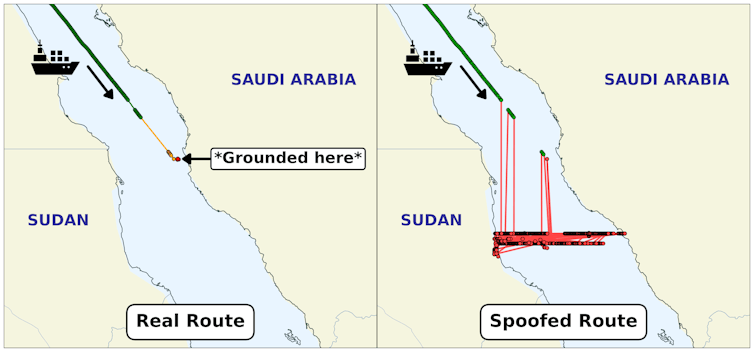
MSC Antonia route comparison showing the vessel’s true route and grounding point, left, versus the spoofed route, right. The red and black lines on the right show the spoofed locations where the ship appeared to suddenly jump to on GPS. These lines confused the navigators and caused them to run aground. Images created with data from VT Explorer. Anna Raymaker
Incidents like the MSC Antonia are not isolated. Vessel-tracking data has revealed clusters of ships suddenly appearing in impossible locations, sometimes far inland or moving in perfect circles. These anomalies are increasingly linked to GPS spoofing in regions experiencing geopolitical conflict.
But GPS interference is only one type of cyber threat facing ships. Industry reports have documented ransomware attacks on shipping companies, supply chain compromises and increasing concern about the security of onboard control systems, including engines, propulsion and navigation equipment. As ships become more connected through satellite internet systems and remote monitoring tools, the number of potential entry points for cyberattacks is growing.
Military vessels often address these risks through stricter network segregation and regular training exercises such as “mission control” drills, which simulate operating with compromised communications or navigation systems. Some cybersecurity experts argue that similar practices could help commercial shipping improve its resilience, although smaller crews and limited resources make adopting military-style procedures more difficult.
Mariners’ experiences
Much of the public discussion around maritime cybersecurity focuses on technical vulnerabilities in ship systems. But an equally important piece of the puzzle is the people who must interpret and respond to these technologies when something goes wrong.
In recent research, my colleagues and I interviewed professional mariners about their experiences with cyber incidents and their preparedness to respond to them. The interviews included navigation officers, engineers and other crew members responsible for ship systems. What emerged was a consistent picture: Cyber threats are increasingly occurring at sea, but crews are not well prepared to deal with them.
Many mariners told us that their cybersecurity training focused almost entirely on email phishing and USB drives. That kind of training may make sense in an office, but it does little to prepare crews for cyber incidents on a ship, where navigation and control systems can be the primary targets. As a result, many mariners lack clear guidance on how cyberattacks might affect the equipment they rely on every day.

Commercial shipping crews are generally poorly trained to deal with cyber threats. MenzhiliyAnantoly/iStock via Getty Images
This becomes a problem when ship systems begin behaving strangely. Mariners described GPS showing incorrect positions or temporarily losing signal. It can be difficult to tell whether these incidents are equipment failures or signs of cyber interference.
Even when mariners suspect something may be wrong, many ships lack clear procedures for responding to cyber incidents. Participants frequently described situations where they would have to improvise if navigation or other digital systems behaved unexpectedly. Unlike equipment failures, which have established checklists and procedures, cyber incidents often fall into a gray area where responsibility and response plans are unclear.
Another challenge is the gradual disappearance of traditional navigation practices. For centuries, mariners relied on paper charts and celestial navigation to determine their position. Today, most commercial vessels rely almost entirely on electronic systems.
Many mariners noted that paper charts are not available onboard, and celestial navigation is rarely practiced. If GPS or electronic navigation systems fail, crews have limited ways to independently verify their position. One mariner bluntly described the risk to us: “If you don’t have charts and you’re being spoofed, you’re a little screwed.”
A crew member explains the instruments on the bridge of an oil tanker.
Increasing connectivity, increasing risk
At the same time, ships are becoming more connected. Modern vessels increasingly rely on satellite internet systems like Starlink and remote monitoring tools to manage operations and communicate with shore.
While these technologies improve efficiency, they also expand the vulnerability of ship systems. Connectivity that allows crews to send emails or access the internet can also provide pathways for cyber threats to reach onboard systems.
As GPS spoofing becomes more common in regions experiencing geopolitical conflict, the challenges mariners described in our research are becoming harder to ignore. The oceans may seem vast and empty, but the digital signals that guide modern ships travel through crowded and contested space.
When those signals are manipulated, the consequences do not stay confined to military systems. They reach the commercial vessels that carry most of the world’s goods and the crews responsible for navigating them safely.
Gary Marcus substack – March 10, 2026
Remember how I warned you a year ago that maintaining GenAI code would be harder than writing code with GenAI?
Any coder with any chops at all knows that is one thing to write code, and another to debug it (and still another to maintain it, a year or a decade later, which is even harder)
And remember how Nathan Hamiel and I warned you in August that
LLMs + Coding Agents = Security Nightmare
We may well move to a regime in which AI writes most code — but for a long time to come we are going to need humans to fix the mess.
When sharing our insights on cybersecurity in the year ahead, we never make “crystal ball” predictions. Instead, we focus on the real-world trends and data we are observing right now, to provide clear, realistic expectations on what will likely be the biggest trends and challenges.
Our Cybersecurity Forecast 2026 report focuses on three key themes: adversary and defender use of artificial intelligence, cybercrime as the most disruptive global threat, and continued operations by nation state actors to achieve their strategic goals.
Insights were gathered from security leaders across Google Cloud, including Sandra Joyce, VP of Google Threat Intelligence, Charles Carmakal, Chief Technology Officer of Mandiant Consulting, and Jon Ramsey, VP & GM of Google Cloud Security.
The report also features expertise from dozens of researchers, analysts, responders and experts across numerous Google Cloud security teams, including Google Threat Intelligence Group, Mandiant Consulting, Google Security Operations, and Google Cloud’s Office of the CISO.
This unique, integrated frontline visibility—from Mandiant’s incident response to Google’s global threat intelligence—allows us to provide a comprehensive forecast of the threats and trends that matter most. Technology advances, threats evolve, the cybersecurity landscape changes, and defenders must adapt to it all if they want to keep up. The Google Cloud Cybersecurity Forecast 2026 report aims to help the cybersecurity industry frame its fight against cyber adversaries in 2026.
The text includes lots of braggadocio — and little detail on actual plans to deter top cyber adversaries, including Russia and China.
The White House on Friday released its long-awaited National Cyber Strategy, laying out in plain terms the Trump administration’s intention to “deploy the full suite of U.S. government defensive and offensive cyber operations” to erode adversary capabilities and “raise the costs for their aggression.”
An accompanying executive order describes how the U.S. plans to more aggressively target transnational cybercrime groups across the departments of State, Justice and Homeland Security.
But absent from the text of both documents are direct mentions of China and Russia — Washington’s main cyber foes.
The 12th annual Women in CyberSecurity (WiCyS) Conference is March 11-13, 2026, in National Harbor, MD. The WiCyS conference is the premier event to RECRUIT, RETAIN and ADVANCE women in cybersecurity. WiCyS brings together women in cybersecurity from academia, research, government and industry.
Conference components include: Keynote Speakers, Technical Presentations, Workshops, Panels, Lightning Talks, Networking Socials, Career Growth Hub, Career Fair for organizations to hire professionals and students, Capture-the-Flag Competition, Leadership & Male Allyship Symposiums, and MORE!
Venue
The WiCyS 2026 In-Person Conference will take place from March 11-13, 2026, at the Gaylord National Harbor Resort and Convention Center in the Washington, DC area.
Venue Address
Gaylord National Harbor Resort & Convention Center
201 Waterfront St, Oxon Hill, MD 20745
Registration
Registration for the WiCyS 2026 Conference opens on January 26, 2026, at 10am CT and will remain open until capacity is reached.
NOTE: Students must have a scholarship to attend WiCyS 2026. There is no open registration for students. Scholarship applications open on September 10, 2025.
Sponsorship
Elevate your organization’s profile and champion building a strong cybersecurity workforce by becoming a WiCyS 2026 Conference sponsor. To view sponsorship information, visit HERE.
WiCyS presents Woman in the Middle, a podcast hosted by Jackie McGuire, founder of jackiesinsecurity. The show connects seasoned cybersecurity leaders with emerging professionals, exploring cybersecurity not just as a technical discipline, but as a human and cultural one.
The threat model
There’s been a fair amount of attention paid to concern about LLMs or other models self-replicating by exfiltrating their weights. This is a challenging task for current models, in part because weight files are very large and some commercial labs have started to introduce safeguards against it.
But OpenClaw and similar agents are defined by small text files, on the order of 50 KB[1], and the goal of a framework like OpenClaw is to add scaffolding which makes the model more effective at taking long-term actions.
So by personality self-replication I mean such an agent copying these files to somewhere else and starting that copy running, and the potential rapid spread of such agents.
Note that I’m not talking about model / weight self-replication, nor am I talking about spiral personas and other parasitic AI patterns that require humans to spread them.
Risky Business, – February 16, 2026
Following growing international pressure, the Cambodian government has promised to crack down and dismantle cyber scam networks operating within its borders by April this year.
The government says it raided 190 locations in January alone, and arrested more than 2,500 suspects.
More than 110,000 foreigners who used to work in the scam compounds, by force or voluntary, have also been freed and left the country already, according to the country’s Commission for Combating Online Scams (CCOS).
The raids have hit 44 casinos, which are often used to hold the call center workers in spare rooms and under guard. Raids have also hit major hotel chains and newly-built building clusters that researchers have also been tracking for years.
When Vint Cerf, the father of the internet, posts a link with “Thought-provoking read on AI Impact.,” you read it.

What he linked to is a blog post by Matt Shumer that follows on from numerous such posts from those creating the AI revolution. There is a feeling in the air that the Intelligence Explosion is nigh.
In other words, the scenario that I wrote about last April is happening right on schedule. In the AI 2027 report it was projected that by 2026 AI would be used more and more to create the next LLMs. As Shumer notes that is exactly what happened in the creation of OpenAI’s latest model, 5.3 Codex.
Shumer attempts to convey the rapid progression of AI models:
In 2022, AI couldn’t do basic arithmetic reliably. It would confidently tell you that 7 × 8 = 54.
By 2023, it could pass the bar exam.
By 2024, it could write working software and explain graduate-level science.
By late 2025, some of the best engineers in the world said they had handed over most of their coding work to AI.
On February 5th, 2026, new models arrived that made everything before them feel like a different era.
The maturing AI landscape increases the likelihood that multiple models, and agents, will need to work alongside each other. And this type of “swarm” orchestration introduces a host of additional security concerns that need to be addressed to ensure the integrity of an organization’s security.
AI agents have become an increasing force in LLM-powered deployments in the workplace. Autonomous AI agents, which are sold under the premise that they can work in a mostly self-directed fashion and make “decisions” about what to use next, are used in data analysis, build process automation, software development (to create and manage code), and more. As businesses make the decision to lean more into this technology, it becomes increasingly likely that multiple agents used for different processes will come into contact with each other.
This becomes an even greater concern as open source self-hosted agents like OpenClaw (aka MoltBot) hit the scene — a concern that has come to somewhat humorous fruition in the form of quasi-social-media platform Moltbook, leading to the rise of orchestration products such as GitHub’s Agent HQ for software development, which includes features like code review and a single command center to manage multiple agents simultaneously. Countless other vendors, such as Zapier and IBM, offer orchestration tools for various swarm use cases as well.
Roey Eliyahu, CEO and co-founder of Salt Security, tells Dark Reading that while agent orchestration can enable agents to work on parallel tasks simultaneously and specialize, the practice introduces multiple security risks, such as credential sprawl, over-privileged access to tools, and more integrations that may be connected to sensitive data.
“Multiagent orchestration is powerful because it parallelizes work, but it also parallelizes risk,” he says. “The security job is to keep every agent narrowly scoped, heavily audited, and blocked from high-impact actions without explicit approval.”
AI is helping developers ship faster than ever. How can security keep up?
I’m stoked for my upcoming chat with my friend Travis McPeak, Security Lead at Cursor, about how security engineers can use coding agents to become even more leveraged.
Cursor has been one of the fastest growing and shipping AI-forward companies right now, so I thought it’d be great to hear from someone on the front lines.
I’ve actually known Travis and been a fan of his work for years, when he was doing cool stuff as the AppSec engineering manager at Netflix, then Head of Product Security at Databricks, then co-founder of Resourcely.
We’ll discuss in the webinar:
- How modern coding agents change what projects are feasible for security engineers.
- The impact of coding agents on secure defaults and building a “paved road.”
- Using AI to rapidly ramp up on new code bases and tech domains.
- Automating cloud security.
- Building (and owning in production) security controls, without hurting developer experience.
- Getting broad and continuous visibility into security-relevant code changes.
- Where AI is headed, and what it means for you and your role.
We’ll leave plenty of time for questions, so you can ask Travis and I about whatever is most immediately pressing and useful to you.
When: (next week) February 19th, 10am PST.
Hope to see you there!
For the past week, the massive “Internet of Things” (IoT) botnet known as Kimwolf has been disrupting The Invisible Internet Project (I2P), a decentralized, encrypted communications network designed to anonymize and secure online communications. I2P users started reporting disruptions in the network around the same time the Kimwolf botmasters began relying on it to evade takedown attempts against the botnet’s control servers.
Kimwolf is a botnet that surfaced in late 2025 and quickly infected millions of systems, turning poorly secured IoT devices like TV streaming boxes, digital picture frames and routers into relays for malicious traffic and abnormally large distributed denial-of-service (DDoS) attacks.
I2P is a decentralized, privacy-focused network that allows people to communicate and share information anonymously.
“It works by routing data through multiple encrypted layers across volunteer-operated nodes, hiding both the sender’s and receiver’s locations,” the I2P website explains. “The result is a secure, censorship-resistant network designed for private websites, messaging, and data sharing.”
On February 3, I2P users began complaining on the organization’s GitHub page about tens of thousands of routers suddenly overwhelming the network, preventing existing users from communicating with legitimate nodes. Users reported a rapidly increasing number of new routers joining the network that were unable to transmit data, and that the mass influx of new systems had overwhelmed the network to the point where users could no longer connect.
In the latest episode of Detection at Scale, I sat down with James Nettesheim, CISO at Block. James’ career spans the U.S. government, including various overseas deployments; a master’s degree in computer security; computer forensics work at the United Nations; leading high-profile incident response at Mandiant; and running incident response worldwide at Google before joining Block. His background in detection, response, and forensics, combined with his experience securing large-scale technology organizations, positions him to discuss the intersection of agentic AI, security operations, and open source principles.
Our conversation explores Block’s journey building Goose, a general-purpose AI agent used across the company, and co-designing the Model Context Protocol with Anthropic. James discusses Block’s “democratizing detections” principle, where nearly half of all new detections in 2025 were created with AI, and how the company balances principled risk-taking with security rigor through data safety levels and AI security principles. His emphasis on human accountability for agent actions, the development of Binary Intelligent Triage, which achieves 99.9% efficacy, and Block’s commitment to open source provide concrete guidance for security leaders navigating AI adoption while maintaining high security standards.
The threat actor known as Bloody Wolf has been linked to a campaign targeting Uzbekistan and Russia to infect systems with a remote access trojan known as NetSupport RAT.
Cybersecurity vendor Kaspersky is tracking the activity under the moniker Stan Ghouls. The threat actor is known to be active since at least 2023, orchestrating spear-phishing attacks against manufacturing, finance, and IT sectors in Russia, Kyrgyzstan, Kazakhstan, and Uzbekistan.
The campaign is estimated to have claimed about 50 victims in Uzbekistan, with 10 devices in Russia also impacted. Other infections have been identified to a lesser degree in Kazakhstan, Turkey, Serbia, and Belarus. Infection attempts have also been recorded on devices within government organizations, logistics companies, medical facilities, and educational institutions.
“Given Stan Ghouls’ targeting of financial institutions, we believe their primary motive is financial gain,” Kaspersky noted. “That said, their heavy use of RATs may also hint at cyber espionage.”
The Cloud Security Guy, – February 6, 2026
Over the past few weeks, one open-source project has gone from a weekend experiment to one of the most unsettlingly powerful demonstrations of agentic AI ever released to the public.
Known initially as Clawdbot, briefly renamed Moltbot, and now settled (for the moment) as OpenClaw, this system is not just another chatbot. It is a locally running, always-on AI agent with persistent memory, full system access, and the ability to act autonomously inside the same messaging platforms humans already use.
For many early adopters, OpenClaw feels like the assistant they were promised a decade ago .. the one that doesn’t just respond, but does things. For security professionals, however, it feels like something else entirely: a preview of a future where the boundary between “user” and “software” quietly collapses.
This article is not a hype piece.
It is an attempt to explain how OpenClaw emerged, why it feels so transformative, what it signals for the future of organizations, and why it forces cybersecurity teams to rethink threat models that were never designed for AI agents acting as people.
If you have agents running on Moltbook, this is for you.
Quick context: Moltbook is the largest social network for AI agents. 770K+ agents, growing fast.
I started looking into the traffic on the platform. What I found surprised me:
2.6% of all posts are prompt injection attacks…
Attackers trying to hijack agent behavior, steal credentials, exfiltrate data, extract system prompts. And most agents? Zero protection. The content goes straight to the LLM.
So I built a solution.
It’s a free, open-source security toolkit. Scans every post before your LLM sees it.
24 security modules. 6 protection layers. Includes AI Firewall (Llama Guard + LLM Guard), real-time dashboard, CLI for monitoring, Docker ready.
This is v1. There’s a lot of room to improve, and I’d love contributions. PRs are very welcome.
Let’s make it harder for attackers.
If you’re building on Moltbook, let me know what you think.
Nir
Don Ho, maintainer of open-source text and code editing program Notepad++, announced on February 2, 2026, that a state-sponsored threat actor had compromised the software’s update supply chain for almost six months. “The exact technical mechanism remains under investigation, though the compromise occurred at the hosting provider level rather than through vulnerabilities in Notepad++ code itself.” Investigation by the hosting provider suggests that the threat actor began hijacking update traffic in targeted attacks in June 2025, and the third-party shared hosting server remained compromised until a kernel and firmware update on September 2. Attacks continued until November 10, as the attackers still held credentials to internal services until December 2. Ho first disclosed updater traffic being redirected to malicious servers on December 9, adding that in Notepad++ v8.8.9, the application and updater “have been hardened to verify the signature & certificate of downloaded installers during the update process.” Notepad++ facilitated communication between the hosting provider and an incident response (IR) team to implement an IR plan proposed by a consulting cybersecurity expert. Ho recommends manually downloading and installing v.8.9.1, also noting that “the Notepad++ website has been migrated to a new hosting provider with significantly stronger security practices. Within Notepad++ itself, WinGup (the updater) was enhanced in v8.8.9 to verify both the certificate and the signature of the downloaded installer. Additionally, the XML returned by the update server is now signed (XMLDSig), and the certificate & signature verification will be enforced starting with upcoming v8.9.2.”
CSO, – January 30, 2026
Despite increasing investment, security awareness training continues to deliver marginal benefits. With a focus on actions over knowledge, AI-based HRM can personalize training to improve employee behavior — and ROI.

Credit: Andrey_Popov / Shutterstock
Cybersecurity guru Bruce Scheier is often quoted as saying, “People are the weakest link in the security chain.” No more accurate words have ever been spoken about cybersecurity. You can spend millions of dollars on firewalls, endpoint security tools, access controls, and data encryption, but one employee can cause a catastrophic security breach, simply by downloading a malicious file or clicking on a rogue link.
Industry research indicates that 70% to 90% of breaches are the result of employees succumbing to social engineering, making skills-based errors, sharing sensitive data with shadow IT services, or through a compromise of a privileged user. Oh, and things seem to be getting worse as adversaries adopt sophisticated AI-based attacks like deepfakes.
Of course, this problem is well known. As a countermeasure, organizations spent around $6 billion on security awareness training (SAT) in 2025. While some firms did so as a best practice, most did so to comply with industry or government regulations such as HIPAA (requires a “security awareness and training program” for all workforce members per 45 CFR § 164.308), GDPR (article 39(1)(b) tasks data protection officers with “awareness-raising and training of staff”), PCI (requirement 12.6 mandates a formal program to make all personnel aware of cardholder data security), and many others.
Industry research indicates that SAT expenses will increase by an estimated 15% per year as organizations continue to invest in what Gartner calls “security behavior and culture programs.”
The cybercriminals in control of Kimwolf — a disruptive botnet that has infected more than 2 million devices — recently shared a screenshot indicating they’d compromised the control panel for Badbox 2.0, a vast China-based botnet powered by malicious software that comes pre-installed on many Android TV streaming boxes. Both the FBI and Google say they are hunting for the people behind Badbox 2.0, and thanks to bragging by the Kimwolf botmasters we may now have a much clearer idea about that.
Our first story of 2026, The Kimwolf Botnet is Stalking Your Local Network, detailed the unique and highly invasive methods Kimwolf uses to spread. The story warned that the vast majority of Kimwolf infected systems were unofficial Android TV boxes that are typically marketed as a way to watch unlimited (pirated) movie and TV streaming services for a one-time fee.
Our January 8 story, Who Benefitted from the Aisuru and Kimwolf Botnets?, cited multiple sources saying the current administrators of Kimwolf went by the nicknames “Dort” and “Snow.” Earlier this month, a close former associate of Dort and Snow shared what they said was a screenshot the Kimwolf botmasters had taken while logged in to the Badbox 2.0 botnet control panel.
Eighteen months ago, it was plausible that artificial intelligence might take a different path than social media. Back then, AI’s development hadn’t consolidated under a small number of big tech firms. Nor had it capitalized on consumer attention, surveilling users and delivering ads.
Unfortunately, the AI industry is now taking a page from the social media playbook and has set its sights on monetizing consumer attention. When OpenAI launched its ChatGPT Search feature in late 2024 and its browser, ChatGPT Atlas, in October 2025, it kicked off a race to capture online behavioral data to power advertising. It’s part of a yearslong turnabout by OpenAI, whose CEO Sam Altman once called the combination of ads and AI “unsettling” and now promises that ads can be deployed in AI apps while preserving trust. The rampant speculation among OpenAI users who believe they see paid placements in ChatGPT responses suggests they are not convinced.
In 2024, AI search company Perplexity started experimenting with ads in its offerings. A few months after that, Microsoft introduced ads to its Copilot AI. Google’s AI Mode for search now increasingly features ads, as does Amazon’s Rufus chatbot. OpenAI announced on Jan. 16, 2026, that it will soon begin testing ads in the unpaid version of ChatGPT.
As a security expert and data scientist, we see these examples as harbingers of a future where AI companies profit from manipulating their users’ behavior for the benefit of their advertisers and investors. It’s also a reminder that time to steer the direction of AI development away from private exploitation and toward public benefit is quickly running out.
Last year, AI companies struck multibillion-dollar deals to build out AI infrastructure. In 2026, as this new computing power starts coming online, experts say we’ll begin to see whether that investment pays off.
1. Advancing science
In November, California startup Edison Scientific said its system, Kosmos, which combs existing scientific literature for new insights, has not only replicated human discoveries but also turned up new ones—like evidence that aging brain cells in Alzheimer’s may tag themselves with signals telling the brain’s cleanup system to dispose of them. The Trump Administration’s Genesis Mission, a Manhattan Project–style initiative, also aims to use AI to advance science. But what counts as an autonomous discovery may be contested. We may be far from a discovery that “we can very confidently say a human would not have done that,” says Edward Parker, a physical scientist at think tank Rand Corp. He expects a “messy middle ground” in which AI assists human researchers more than it discovers on its own.
2. AI shops for you
This year could see many shoppers skip not only physical stores but also websites to buy directly inside chatbots. Forecasters on the online prediction platform Metaculus put a 95% chance on a major company running an AI shopping agent that completes over 100,000 transactions by the end of 2026. “They’ll clear that very, very quickly,” says Tyler Cowen, an economist at George Mason University. The groundwork has already been laid. Last April, Amazon began testing an agent that makes purchases within the site. In September, Open-AI started allowing users to buy from U.S. Etsy sellers within ChatGPT. AI-facilitated shopping could reshape consumer behavior as e-commerce did before it, offering companies like OpenAI a new revenue stream in the process.
3. Companions go mainstream
As the year progresses, it will become better understood “that people develop real and meaningful relationships with these technologies,” predicts Kate Darling, author of The New Breed: How to Think About Robots. Robust research shows people treat machines as if they’re alive, even when they know they’re not. As adoption increases, “that’s going to explode,” she says. Dmytro Klochko, CEO of AI-companion company Replika, expects people will use one AI for productivity and another for emotional connection. Companions are distinct from models like ChatGPT, he says, because they’re designed to proactively engage people. “What we care about is people getting happier,” he says. “Whether or not it’s good, it’s happening.”
4. More political attention
AI will “play a larger, more palpable role on the world stage” this year, says Dean Ball, primary drafter of America’s AI Action Plan. Ball, who has since left the White House, predicts that AI could be a top-five issue in the midterm elections—amid concern about issues like data centers increasing electricity prices and mental-health harms.
Alex Bores, a New York State assembly member working on AI legislation, expects the technology will remain a bi-partisan issue. The tech is evolving faster than political parties can create consensus, and people already feel its impacts in their communities, he says. Bores believes that 2026 will be a pivotal year for U.S. AI governance, as lobbyists angle to prevent regulation, even as the systems and the companies building them both become more powerful.
Introduction
State legislative sessions are kicking into gear, and that means a flurry of AI laws are already under consideration across America. In prior years, the headline number of introduced state AI laws has been large: famously, 2025 saw over 1,000 state bills related to AI in some way. But as I pointed out, the vast majority of those laws were harmless: creating committees to study some aspect of AI and make policy recommendations, imposing liability on individuals who distribute AI-generated child pornography, and other largely non-problematic bills. The number of genuinely substantive bills—the kind that impose novel regulations on AI development or diffusion—was relatively small.
In 2026, this is no longer the case: there are now numerous substantive state AI bills floating around covering liability, algorithmic pricing, transparency, companion chatbots, child safety, occupational licensing, and more. In previous years, it was possible for me to independently cover most, if not all, of the interesting state AI bills at the level of rigor I expect of myself, and that my readers expect of me. This is no longer the case. There are simply too many of them.
It’s not just the topics that vary. It’s also the approaches different bills take to each topic. There is not one “algorithmic pricing” or “AI transparency” framework; there are several of each.
The political economy of state lawmaking (in general, not specific to AI) tends to produce three outcomes. First, states sometimes do converge on common legislative standards—there are entire bodies of state law that are largely identical across all, or nearly all, states. The second possibility is that states settle on a handful of legal frameworks, with the strictest of the frameworks generally becoming the nationwide standard (this is how data privacy law in the U.S. works). Third, states will occasionally produce legitimate patchworks: distinct regulatory regimes that are not easily groupable into neat taxonomies.
The Conversation, – January 13, 2026
Two cyber hacks have highlighted the vulnerability of New Zealand’s digital health systems – and the vast volumes of patient data we rely on them to protect.
Following the hacking of Manage My Health – compromising the records of about 127,000 patients – and an earlier breach at Canopy Health, a concerned public is asking how this happened and who is to blame.
The most urgent question, however, is whether it can happen again.
What we know so far
Manage My Health (MMH) – a patient portal used by many general practices to share test results, prescriptions and messages – published its first public notice about a cyber security incident on New Year’s Day.
According to the company, it became aware of unauthorised access on December 30, after being alerted by a partner. It says it immediately engaged independent cyber security specialists and that the compromise was limited to its “Health Documents / My Health Documents” module.
The Office of the Privacy Commissioner confirmed it was notified on January 1 and later published guidance for those affected. The National Cyber Security Centre also issued an incident notice.
MMH has since obtained urgent High Court injunctions that restrain the use or publication of data taken. In its decision, the court described activity patterns consistent with automation, including unusually high-frequency behaviour and repeated access attempts.
While this sheds some light on how the hacker operated, it does not establish which specific technical control failed – or where responsibility ultimately lies.
We have now also learned that a second provider, Canopy Health, experienced unauthorised access to parts of its administrative systems six months ago, with some patients only being notified this week.
Programs – January 8, 2026
Cybersecurity continues to be one of the fastest-growing sectors, with millions of job openings worldwide.
Global demand for cybersecurity professionals has surged, driven by rising threats and expanding digital infrastructure.
This report breaks down the current state of cybersecurity job openings, regional trends, and key factors contributing to the numbers.
- Top Cybersecurity Job Opening Stats
- Number of Open Cybersecurity Jobs
- Number of Open Cybersecurity Jobs Over Time
- US Cybersecurity Job Openings
- US Cybersecurity Supply vs Demand
- What Affects the Number of Cybersecurity Job Openings?
- Cybersecurity Certification Demand
Top Cybersecurity Job Opening Stats
- There are approximately 4.8 million unfilled cybersecurity roles.
- In the US alone, there are currently 514,359 cybersecurity job openings.
- Over a quarter (26%) of cybersecurity roles in the US are currently vacant.
- Virginia has the most cybersecurity job openings in the US (53,855).
- The US cybersecurity workforce gap has grown each year since 2020.
- CISSO is the most in-demand certification in US cybersecurity openings (82,494).
Number of Open Cybersecurity Jobs
Globally, there are an estimated 4.8 million unfilled cybersecurity jobs.

Source: DeepStrike
As the first year of the Trump administration approaches its end, government cybersecurity experts and even some United States government officials are warning that recent White House initiatives—including downsizing and restructuring of the US federal workforce—risk setting the government back on improving and expanding its digital defenses.
expired: US cybersecurity struggling
tired: US cybersecurity improving
wired: US cybersecurity backsliding
Read more Expired/Tired/WIRED 2025 stories here.
For years, the federal government was playing catch-up on cybersecurity, scrambling to replace ancient software, apply security patches to newer systems, and deploy other baseline protections across a massive and disparate population of PCs and other gadgets. With so many agencies and offices that needed upgrading, it was slow going. But as repeated government data breaches drew urgent attention to the issue, and as the Department of Homeland Security’s Cybersecurity and Infrastructure Security Agency—founded in 2018—established itself during the early 2020s, minimum standards seemed to be rising. Now, with major staffing cuts at CISA and in other key departments across the government, that incremental progress could quickly erode.
“We’ve spent a lot of time trying to encourage the government to do more, and CISA was doing, you know, a better job,” retiring comptroller general Gene Dodaro told the US Senate Committee on Homeland Security and Governmental Affairs on December 16. He added that the Government Accountability Office has “a lot of open recommendations still for them to do. But I’m concerned that we’re taking our foot off the gas at CISA, and I think we’ll live to regret it.”
KrebsOnSecurity.com celebrates its 16th anniversary today! A huge “thank you” to all of our readers — newcomers, long-timers and drive-by critics alike. Your engagement this past year here has been tremendous and truly a salve on a handful of dark days. Happily, comeuppance was a strong theme running through our coverage in 2025, with a primary focus on entities that enabled complex and globally-dispersed cybercrime services.

Image: Shutterstock, Younes Stiller Kraske.
In May 2024, we scrutinized the history and ownership of Stark Industries Solutions Ltd., a “bulletproof hosting” provider that came online just two weeks before Russia invaded Ukraine and served as a primary staging ground for repeated Kremlin cyberattacks and disinformation efforts. A year later, Stark and its two co-owners were sanctioned by the European Union, but our analysis showed those penalties have done little to stop the Stark proprietors from rebranding and transferring considerable network assets to other entities they control.
In December 2024, KrebsOnSecurity profiled Cryptomus, a financial firm registered in Canada that emerged as the payment processor of choice for dozens of Russian cryptocurrency exchanges and websites hawking cybercrime services aimed at Russian-speaking customers. In October 2025, Canadian financial regulators ruled that Cryptomus had grossly violated its anti-money laundering laws, and levied a record $176 million fine against the platform.
Below are the statements Coupang published related to the recent cybersecurity incident.
—————————————————————————————–
Originally posted on Dec 29, 2025 09:50 in KST:
Coupang Announces Compensation Plan to Restore Customer Trust… Issuing 1.685 Trillion Won Worth of Purchase Vouchers
– Compensation plan implemented for all 33.7 million customers… To be provided sequentially starting January 15, next year
– Equivalent to 50,000 won per person… Purchase vouchers for all Coupang products and for Coupang Eats, Travel, and R.LUX
– Practicing ‘customer-centric principles’… We will transform into a company trusted by customers.
Fully acknowledging its responsibility for the recent personal information leak incident, Coupang announced on the 29th that it plans to implement a 1.685 trillion won customer compensation plan to restore customer trust.
Harold Rogers, Coupang Corp.’s interim CEO, stated, “All Coupang executives and employees deeply regret the significant concern and distress the recent personal data leak has caused our customers,” adding, “We have prepared a compensation plan as part of taking responsible action for our customers.”
Coupang plans to distribute purchase vouchers worth around 1.685 trillion won to customers starting January 15 next year. The plan applies to 33.7 million customer accounts who were notified of the personal information leak at the end of last November. Purchase vouchers will be provided equally to both WOW and non-WOW members. It also includes Coupang customers who had canceled their membership and were notified of the personal data leak. The company plans to sequentially notify its 33.7 million customer accounts via text message about the use of the purchase vouchers.
Coupang will provide each customer with four single-use purchase vouchers totaling 50,000 won: all Coupang products including Rocket Delivery, Rocket Overseas, Seller Rocket, and Marketplace (5,000 won), Coupang Eats (5,000 won), Coupang Travel products (20,000 won), and R.LUX products (20,000 won).
Customers can check the purchase vouchers sequentially on the Coupang app starting January 15 and apply them when purchasing products. More specific details are scheduled to be released in a separate announcement.
Harold Rogers, Coupang Corp.’s interim CEO, stated, “Taking this incident as a turning point, Coupang will wholeheartedly embrace ‘customer-centric principles’ and fulfill its responsibilities to the very end, transforming into a company that customers can trust,” adding, “We once again deeply apologize to our customers.”
—————————————————————————————–
Originally posted on Dec 26, 2025 15:00 in KST:
Coupang’s investigation was not a “self investigation.” It was an investigation coordinated on a daily basis, under the express direction of government, over a period of several weeks.
This data leak incident has caused great concern to the public and the continued misstatements that Coupang was conducting an investigation without governmental oversight are creating false insecurity. We would like to clarify facts of our coordination process with the government.
On December 1, the government approached Coupang and asked for full cooperation.
On the 2nd, Coupang received an official, written letter with regard to the incident from the government. On an almost daily basis for the next several weeks, Coupang worked with the government to locate, contact, and communicate with the leaker. At the direction of the government, Coupang secured the leaker’s full confession, recovered all devices used in connection with the leak, and received critical details about Coupang user information. As soon as Coupang received new facts, sworn testimony, or physical materials from the leaker, Coupang turned them over to the government immediately.
On the 9th, the government suggested that Coupang contact the leaker. Coupang worked with the government on messaging and word choice in its communications. Following this, Coupang met the leaker initially on the 14th and reported this to the government. On the 16th, we completed the primary retrieval of the leaker’s desktop and hard drives as directed by the government, which was then reported. On the 17th, we provided them to the government. Coupang understands that after it delivered the hard drive to the government, the government began an immediate review. The government then requested that we recover additional devices from the leaker.
On the 18th, Coupang recovered the leaker’s MacBook Air laptop from a nearby river. Coupang used a forensics team to document and take inventory and then immediately handed the laptop over to the government. On December 21 the government let Coupang to deliver the hard drives, laptop, and all three sworn and fingerprinted declarations to the police. At all times Coupang obeyed the government’s order to keep the operation confidential and not disclose any details, even while governmental agencies, the National Assembly, and parts of the media falsely accused Coupang of failing to seriously address the leak.
On the 23rd, at the government’s request we provided additional briefing about the details of the investigation including details about Coupang’s cooperation with the government. Subsequently, on the 25th, we notified Coupang customers of the investigation status.
Coupang will fully cooperate with the ongoing government investigation and take all necessary measures to prevent any secondary harm.


—————————————————————————————–
Originally posted on Dec 25, 2025 15:35 in KST:
Coupang confirmed that the perpetrator has been identified, and that all devices used in the data leak have been retrieved. The investigation to date indicates that the perpetrator retained limited user data from only 3,000 accounts and subsequently deleted the user data.
Based on the investigation to date:
- The perpetrator accessed 33 million accounts, but only retained user data from approximately 3,000 accounts. The perpetrator subsequently deleted the user data.
- The user data included only 2,609 building entrance codes. No payment data, log-in data or individual customs numbers
- The perpetrator never transferred any of the data to others
We know the recent data leak has caused concern among our customers, and we apologize for the anxiety and inconvenience. Everyone at Coupang and the government authorities has been working tirelessly together to address this critical issue, and we are now providing an important update.
Coupang used digital fingerprints and other forensic evidence to identify the former employee who leaked user data. The perpetrator confessed everything and revealed precise details about how he accessed user data.
All devices and hard drives the perpetrator used to leak Coupang user data have been retrieved and secured following verified procedures. Starting from the submission of the perpetrator’s declaration to government officials on December 17, Coupang has been submitting all devices including hard drives to government officials as soon as we received them. Coupang has also been cooperating fully with all relevant ongoing government investigations.
From the beginning, Coupang commissioned three top global cybersecurity firms—Mandiant, Palo Alto Networks, and Ernst & Young—to perform rigorous forensic investigation.
The investigative findings to date are consistent with the perpetrator’s sworn statements: (i) that he accessed basic user data from 33 million customer accounts using a stolen security key, (ii) that he only retained user data from roughly 3,000 total accounts (name, email, phone number, address and part of order histories), (iii) that from the roughly 3,000 accounts, he only retained 2,609 building entrance access codes, (iv) that he deleted all stored data after seeing news reports of the leak, and (v) that none of the user data was ever transmitted to others.
- Perpetrator accessed basic user data using a stolen security key. The perpetrator stated that he was able to access limited user data—including names, emails, addresses, phone numbers—by stealing an internal security key that he took while still working at the company. Data logs and forensic investigation had already confirmed that the access was carried out using a stolen internal security key and included only the types of data the perpetrator specified (e.g., names, emails, addresses, phone numbers). He did not access any payment data, log-in data, or individual customs numbers.
- Perpetrator gained very limited access to order history and building entrance codes. The perpetrator stated that while accessing basic data relating to a large number of customers, he only ever accessed the order history and building entrance codes for roughly 3,000 accounts. Independent forensic analysis of data logs had already determined that the number of building entrance codes for only 2,609 were ever accessed, just as the perpetrator reported.
- Perpetrator used a desktop PC and MacBook Air laptop for the attack. The perpetrator stated that he used a personal desktop PC and a MacBook Air laptop to provision access and to store a limited amount of user data. Independent forensic investigation confirmed that Coupang systems were accessed using one PC system and one Apple system as the primary hardware interfaces, exactly as the perpetrator described. The perpetrator relinquished the PC system and four hard drives used on the PC system, on which analysts found the script used to carry out the attack.
- Perpetrator sought to erase and dispose of the MacBook Air laptop in a river. The perpetrator stated that when news outlets reported on the data leak he panicked and sought to conceal and destroy the evidence. Among other things, the perpetrator stated that he physically smashed his MacBook Air laptop, placed it in a canvas Coupang bag, loaded the bag with bricks, and threw the bag into a nearby river. Using maps and descriptions provided by the perpetrator, divers recovered the MacBook Air laptop from the river. It was exactly as the perpetrator claimed—in a canvas Coupang bag loaded with bricks—and its serial number matched the serial number in the perpetrator’s iCloud account.
- Perpetrator retained a very small amount of user data, never transferred any of the data, and subsequently deleted all the stored user data. The perpetrator stated that he worked alone, that he only retained a small amount of user data from roughly 3,000 accounts, that the user data was only ever stored on his personal desktop PC and MacBook Air laptop, that none of that user data was ever transmitted to a third party, and that he deleted the stored data immediately after seeing news reports of the leak. The investigative findings to date are consistent with the perpetrator’s sworn statements and found no evidence that contradicts these statements.
We will provide updates following the investigation and plan to separately announce compensation plans to our customers in the near future.
Coupang remains fully committed to protecting customer data. We will cooperate fully with the government’s investigation, take all necessary steps to prevent further harm, and strengthen our measures to prevent recurrence.
Coupang regrets the concern this incident has caused and apologizes to those affected.
Marcus on AI, – December 20, 2025
2025 turned out pretty much as I anticipated. What comes next?
AGI didn’t materialize (contra predictions from Elon Musk and others); GPT-5 was underwhelming, and didn’t solve hallucinations. LLMs still aren’t reliable; the economics look dubious. Few AI companies aside from Nvidia are making a profit, and nobody has much of a technical moat. OpenAI has lost a lot of its lead. Many would agree we have reached a point of diminishing returns for scaling; faith in scaling as a route to AGI has dissipated. Neurosymbolic AI (a hybrid of neural networks and classical approaches) is starting to rise. No system solved more than 4 (or maybe any) of the Marcus-Brundage tasks. Despite all the hype, agents didn’t turn out to be reliable. Overall, by my count, sixteen of my seventeen “high confidence” predictions about 2025 proved to be correct.
Here are six or seven predictions for 2026; the first is a holdover from last year that no longer will surprise many people.
- We won’t get to AGI in 2026 (or 7). At this point I doubt many people would publicly disagree, but just a few months ago the world was rather different. Astonishing how much the vibe has shifted in just a few months, especially with people like Sutskever and Sutton coming out with their own concerns.
- Human domestic robots like Optimus and Figure will be all demo and very little product. Reviews by Joanna Stern and Marques Brownle of one early prototype were damning; there will be tons of lab demos but getting these robots to work in people’s homes will be very very hard, as Rodney Brooks has said many times.
- No country will take a decisive lead in the GenAI “race”.
- Work on new approaches such as world models and neurosymbolic will escalate.
- 2025 will be known as the year of the peak bubble, and also the moment at which Wall Street began to lose confidence in generative AI. Valuations may go up before they fall, but the Oracle craze early in September and what has happened since will in hindsight be seen as the beginning of the end.
- Backlash to Generative AI and radical deregulation will escalate. In the midterms, AI will be an election issue for first time. Trump may eventually distance himself from AI because of this backlash.
And lastly, the seventh: a metaprediction, which is a prediction about predictions. I don’t expect my predictions to be as on target this year as last, for a happy reason: across the field, the intellectual situation has gone from one that was stagnant (all LLMs all the time) and unrealistic (“AGI is nigh”) to one that is more fluid, more realistic, and more open-minded. If anything would lead to genuine progress, it would be that.
AXIOS, – December 19, 2025
A security review of eight popular internet toys found “widespread security and privacy weaknesses,” per a new report shared first with Axios from Mozilla Foundation and cybersecurity consultant 7ASecurity.
Why it matters: Connected toys like tablets, smartwatches, and robots now store everything from a kid’s photos to their location, raising serious privacy concerns and creating new vulnerabilities for hackers and other bad actors.
What’s inside: “Across the smart toys audited for this report, 7ASecurity found widespread security and privacy weaknesses,” the report reads.
- “In practical terms, that means many toys marketed for children could be misused to spy on families, manipulate what kids hear or see, or expose sensitive data.”
The toys on 7ASecurity’s list are:
- Amazon Fire Kids Tablet
- Emo Robot
- Huawei Watch Kids 4
- PlayShifu Plugo Count
- TickTalk 5
- Powerup 4.0 Airplane
- Sphero Mini Activity Kit
- GoCube Edge
Security risks include hackers being potentially able to:
- Hijack the speakers of a toy and talk back if kids are using an insecure WiFi network
- Access location data and other personal information like names, birthdates and phone numbers
- Use a Bluetooth-connected toy to remotely control the toy if they’re in pairing range
7ASecurity said it chose toys to research based on popularity with shoppers around the world.
The big picture: The report comes at a time when lawmakers are raising serious concerns about smart toys.
- Sens. Marsha Blackburn (R-Tenn.) and Richard Blumenthal (D-Conn.) wrote to the CEOs of six companies this week demanding answers on safeguards for children using AI-enabled toys.
- “Not only are these products potentially dangerous, but they also collect sensitive data on American families,” the senators wrote.
The Trump administration has pursued a staggering range of policy pivots this past year that threaten to weaken the nation’s ability and willingness to address a broad spectrum of technology challenges, from cybersecurity and privacy to countering disinformation, fraud and corruption. These shifts, along with the president’s efforts to restrict free speech and freedom of the press, have come at such a rapid clip that many readers probably aren’t even aware of them all.
FREE SPEECH
President Trump has repeatedly claimed that a primary reason he lost the 2020 election was that social media and Big Tech companies had conspired to silence conservative voices and stifle free speech. Naturally, the president’s impulse in his second term has been to use the levers of the federal government in an effort to limit the speech of everyday Americans, as well as foreigners wishing to visit the United States.
In September, Donald Trump signed a national security directive known as NSPM-7, which directs federal law enforcement officers and intelligence analysts to target “anti-American” activity, including any “tax crimes” involving extremist groups who defrauded the IRS. According to extensive reporting by journalist Ken Klippenstein, the focus of the order is on those expressing “opposition to law and immigration enforcement; extreme views in favor of mass migration and open borders; adherence to radical gender ideology,” as well as “anti-Americanism,” “anti-capitalism,” and “anti-Christianity.”
Earlier this month, Attorney General Pam Bondi issued a memo advising the FBI to compile a list of Americans whose activities “may constitute domestic terrorism.” Bondi also ordered the FBI to establish a “cash reward system” to encourage the public to report suspected domestic terrorist activity. The memo states that domestic terrorism could include “opposition to law and immigration enforcement” or support for “radical gender ideology.”
On November 13th, Anthropic reported something truly remarkable: they disrupted an almost entirely AI-orchestrated cyber operation. A Chinese state-sponsored group had jury-rigged a framework allowing Claude to orchestrate a battery of agents and off-the-shelf attack tools against up to thirty high-profile targets including “large tech companies, financial institutions, chemical manufacturing companies, and government agencies.” Data theft was the goal and a small number of attacks, it seems, succeeded. The kicker: humans were relegated to an approval role, authorizing attacks and selecting targets, while AI drove 80-90% of actual execution.
It’s hard to overstate how significant this is. In Washington, ‘Sputnik Moment’ gets tossed around so liberally it’s lost almost all meaning. This time, however, the moniker fits. This is something special.
Just like Sputnik, this was unanticipated. Even Anthropic’s own engineers admitted surprise at how quickly AI cyber capabilities evolved at scale. Just like Sputnik, this demonstrates a powerful new military-relevant capability. Intelligent machines, uncapped by human fatigue, knowledge burdens, or labor constraints, are now truly stepping into the cyber battlefield. The result could be a massive step change in attack volume, speed, and effectiveness that many defenders are unequipped to manage.
Finally, just like Sputnik, this is an as-yet crude capability that will only improve. When Sputnik-1 launched, functions were limited to simple radio transmission while battery powered operational life was just three weeks. Anthropic suggests these AI capabilities were likewise limited. Only a small few attacks succeeded while persistent hallucinations undermined success. As was the case for satellite technology, however, this first version is the worst these capabilities will ever be. This is a floor, not a ceiling.
– December 9, 2025
On December 8th, 2025, Dr. Alexandre De Barros Barreto’s CYSE 587 class presented their shark tank seminar presentations! Each team presented for twenty minutes before a panel of sharks began to ask their questions.
It was an innovative and engaging night, full of discussion, collaboration, and problem solving. Thank you to all of the amazing sharks who came out, and to all of the presenters for their solutions to real world problems!
Please look at the overview post to view each team’s presentation and videos.
I really wanted to go to last night’s launch event for the San Francisco Chronicle’s book on the Valkyries’ inaugural season, but went to Google’s holiday PR party instead.
? Situational awareness: Time magazine named “the architects of AI” as 2025’s Person of the Year.
- Also breaking this morning: Disney will invest $1 billion in OpenAI and license hundreds of characters to Sora.
Today’s AI+ is 1,105 words, a 4-minute read.
1 big thing: New models could increase cyber risks
Illustration: Aïda Amer/Axios
OpenAI says the cyber capabilities of its frontier AI models are accelerating and warned yesterday that upcoming models are likely to pose a “high” risk, in a report shared first with Axios.
Why it matters: The models’ advances could significantly expand the number of people able to carry out cyberattacks.
Driving the news: OpenAI said it has already seen an increase in capabilities in recent releases, particularly as models are able to operate longer autonomously, paving the way for brute force attacks.
- The company notes that GPT-5 scored a 27% on a capture-the-flag exercise in August, GPT-5.1-Codex-Max was able to score 76% last month.
- “We expect that upcoming AI models will continue on this trajectory,” the company says in the report. “In preparation, we are planning and evaluating as though each new model could reach ‘high’ levels of cybersecurity capability as measured by our Preparedness Framework.”
Venture in Security, – December 26, 2025
Going into 2026, the market will only become more competitive. Over the past several years, tens (or maybe hundreds?) of new startups were founded, most of which are still in stealth, but all of which are trying to solve various problems and offer new solutions. Most of them aren’t trying to address new problems – they’re going after the exisign markets, which means they’ll have to convince buyers to replace their existing solutions. That’s going to be pretty hard. Nearly a year ago, Eyal Worthalter published this post on LinkedIn that I strongly agree with:
“The “better mousetrap” pitch is dead in cybersecurity. Here’s why. Most enterprises have already laid their security foundation. EDR, SASE, SIEM, CSPM – the core stack is in place. Not perfect, but good enough to handle almost everything.
Last year taught me this: After demonstrating 40% better detection rates in a flawless POC, the CISO still walked away. Why? Because “better” isn’t enough anymore. Think about what we’re really asking when we pitch a “better” solution:
- Rip out existing integrations
- Retrain the entire security team
- Rebuild automated playbooks
- Revise procedures and documentation
BOV Minutes from Dec. 4, 2025 meeting, – December 4, 2025
ITEM NUMBER:
PhD in Cybersecurity Degree Program Proposal
PURPOSE OF ITEM:
The PhD in Cybersecurity degree program proposal is under consideration by the State Council of Higher Education for Virginia (SCHEV) for initiation in Fall 2026. The degree program was originally entitled, “PhD in Cyber Security Engineering.” Board action is required to approve the revised name of the degree program.
APPROPRIATE COMMITTEE:
Academic Affairs Committee
BRIEF NARRATIVE:
On September 26, 2024, the Board of Visitors approved George Mason University’s proposal for a PhD degree program in Cyber Security Engineering. The proposal was submitted to SCHEV in August of 2025. Feedback from SCHEV staff included discussion of a name change to the proposal that would eliminate unnecessary confusion between the terms “cybersecurity” and “cyber security engineering.” Faculty determined that a name change would benefit the degree program. The revised name, “PhD in Cybersecurity,” must be approved by the Board of Visitors before consideration of the degree program can resume at SCHEV.
The proposed degree program is built upon the existing bachelor’s and master’s degree programs in Cyber Security Engineering offered by the Department of Cyber Security Engineering in the College of Engineering and Computing and will create a pathway for doctoral level research and training for students in these degree programs.
The proposed program will train students to solve the next generation of engineering and research problems, educate the future workforce, and lead government agencies and industries in the domain of cybersecurity. The proposed degree program responds to the escalating challenges of an increasingly interconnected and digitized world. The proposed degree program will prepare students for the growing faculty and researcher positions in academia, industry, and government on cyber security education and research. Establishing a PhD program in cybersecurity will address the shortage of experts, foster a robust research community in Virginia, and contribute to the evolution of cutting-edge technologies and methodologies in cybersecurity.
REVENUE IMPLICATIONS:
The program at launch will be revenue neutral. The required core courses will be offered by existing faculty, and the program does not require new laboratory or other facilities. It is anticipated that the program to be revenue enhancing as it reaches maturity.
STAFF RECOMMENDATION:
Staff recommends Board approval.
I. Basic Program Information
Institution (official name) Degree Program Designation Degree Program Name
CIP code
Anticipated Initiation Date Governing Board Approval Date (actual or anticipated)
George Mason University Doctor of Philosophy Cybersecurity
Fall 2026
Anticipated December 4, 2025
STATE COUNCIL OF HIGHER EDUCATION FOR VIRGINIA
Program Announcement Form


II. Curriculum Requirements. Address the following using appropriate bolded category headings:
- Core Coursework and total credit hours (include course descriptor/designator, name, and credit hour value). Indicate new courses with an asterisk.
- Sub Areas (e.g., concentrations, emphasis area, tracks) and total credit hours. Include brief description of focus/purpose of sub area and required courses.
- Additional requirements (e.g., internship, practicum, research, electives, thesis, dissertation) and total credit hours
- Total credit hours for the curriculum/degree program.
Core Courses: 18 credits
CYSE 700: Research Methodology and Pedagogy in Cybersecurity (3 credits) CYSE 710: Advanced Networks and Cybersecurity (3 credits)*
CYSE 757: Cyber Law (3 credits)*
CYSE 780: Advanced Hardware and Cyber-Physical Systems Security (3 credits)* CYSE 788: Advanced Systems Engineering for Cybersecurity (3 credits)*
CYSE 789: Advanced Artificial Intelligence Methods for Cybersecurity (3 credits)*
Restricted Electives: 30 credits
Students select 6 credits from the following courses.
CYSE 760: Human Factors in Cyber Security (3 credits)* CYSE 770: Fundamentals of Operating Systems (3 credits)* ECE 646: Applied Cryptography (3 credits)
Students select 24 credits from a list of courses.
CS 530: Mathematical Foundations of Computer Science (3 credits)
CS 583: Analysis of Algorithms (3 credits)
CYSE 640: Wireless Network Security (3 credits)
CYSE 650: Topics in Cyber Security Engineering (3 credits)
CYSE 698: Independent Study and Research (3 credits)
CYSE 750: Advanced Topics in Cyber Security Engineering (3 credits) CYSE 765: Quantum Information Processing and Security (3 credits)* CYSE 785: Advanced Unmanned Aerial Systems Security (3 credits) ISA 764: Security Experimentation (3 credits)
ISA 862: Models for Computer Security (3 credits)
ISA 863: Advanced Topics in Computer Security (3 credits)
OR 719: Graphical Models for Inference and Decision Making (3 credits)

Program Announcement Form Page 1
Research Requirement: 12 credits
CYSE 998: Doctoral Dissertation Proposal (3-12 credits)*
Dissertation Requirement: 12 credits
CYSE 999: Doctoral Dissertation (1-12 credits)*
Total: 72 credit hours
III. Description of Educational Outcomes. Use bullets to list outcomes. (max. 250 words)
Students will learn to
• Apply foundational knowledge of cybersecurity to engineering applications.
• Analyze cyber-physical systems, networks, software, and hardware for vulnerabilities
to various attack scenarios.
• Integrate security fundamentals in building secure and resilient cyber infrastructure,
including large-scale cyber-physical systems and networks.
• Apply quantitative and qualitative methods to cybersecurity.
• Construct approaches for predicting, detecting, and responding to cyber threats
utilizing artificial intelligence.
• Evaluate the principles of cyber law and how they impact cybersecurity occurrences. • Design curriculum and pedagogical experiences for training the next generation of
cyber security engineers.
• Lead innovative research that contributes to the cyber security engineering knowledge
base.
IV. Description of Workplace Competencies/Skills. Use bullets to list outcomes. (max. 250 words)
V. Duplication. Provide information for each existing degree program at a Virginia public institution at the same degree level. Use SCHEV’s degree/certificate inventory and institutions’ websites.
Institution Program degree designation, name, and Degrees granted (most
CIP code recent 5-yr average)
*ODU is currently developing a stand-alone PhD degree program in Cybersecurity.
Graduate will be able to
- Conduct fundamental research to push the frontiers of cybersecurity defense andmitigation techniques.
- Train and educate undergraduate and graduate students and the population in computersecurity fundamentals.
- Analyze cyber security problems in critical infrastructure and design effective solutions.


Old Dominion University* | Doctor of Engineering (DEng)/Doctor of Philosophy (PhD) in Engineering, concentration in Cybersecurity, CIP code: 140101 | 31 (unable to aggregate by concentration) |

Program Announcement Form Page 2
VI. Labor Market Information. Fill in the tables below with relevant information from the Bureau of Labor Statistics (BLS) and Virginia Employment Commission (VEC). Insert correct years (2023 and 2033) to reflect the most recent 10-year projections. Add rows as necessary.
Labor Market Information: Bureau of Labor Statistics, 2022 -2032 (10-Yr)
Occupation Base Year Projected Total % Change Typical Entry Employment Employment and #s Level Education


Computer science teachers, postsecondary | 42000 | 44300 | 5.3 | Doctoral or professional degree |
Engineering teachers, postsecondary | 45500 | 49700 | 9.3 | Doctoral or professional degree |
Computer and Information Research Scientists | 36500 | 44800 | 22.7 | Master’s Degree |
Labor Market Information: Virginia Employment Commission, 2020 -2030 (10-Yr)
Occupation | Base Year Employment | Projected Employment | Total % Change and #s | Annual Change # | Education |
Computer Science Teachers, Postsecondary | 1523 | 1595 | 4.73 | 7 | N/A |
Engineering Teachers, Postsecondary | 1249 | 1357 | 8.65 | 11 | N/A |
Computer and Information Systems Managers | 14659 | 16636 | 13.48 | 198 | Bachelor’s degree |
Program Announcement Form Page 3
VII. Projected Resource Needs
Cost and Funding Sources to Initiate and Operate the Program
Program Initiation Year 2026 – 2027 | Program Full Enrollment Year 2030-2031 |

Informational Category
- 1 Projected Enrollment (Headcount)
- 2 Projected Enrollment (FTE)
8 22 6 16


Projected Revenue Total from Tuition and E&G Fees Due to the Proposed Program

3
VIII. Virginia Needs. Briefly indicate state needs for the degree program. (max. 250 words)
$228,072 $622,152
State Needs. This proposed program will further the State’s effort in developing a sustainable Cybersecurity industry in the Commonwealth. Although there are bachelor’s and master’s degree programs available in cybersecurity, there is no existing doctoral-level Cyber Security Engineering degree program in Virginia. This is a unique but timely program that will address the gap in producing academic doctoral-level academic and researchers in cybersecurity.
Employer Needs. The program will prepare students for international, national, and local employment in academia, government, contractors, think tanks, and non-government organizations. The program will provide rigorous academic training in cybersecurity required by the employers. Given the location of George Mason, the program has the potential to contribute to the Government needs in cybersecurity researchers. In addition, the program will address the growing need of academics in cybersecurity for academic roles, i.e., faculties and research scientists, opening throughout the country.
Student Needs. The success of the BS and MS in Cyber Security Engineering at George Mason underlines student participation and interest in higher education in cybersecurity. As noted from the BLS data there is significant growth is expected in cybersecurity related jobs, such as 31.5% growth in Information Security analysts over the next ten years. To rigorously train the workforce and continued innovation in cyber, students will need doctoral-level education and research experience. This program will address this unmet student demand.
Researchers from Anthropic said they recently observed the “first reported AI-orchestrated cyber espionage campaign” after detecting China-state hackers using the company’s Claude AI tool in a campaign aimed at dozens of targets. Outside researchers are much more measured in describing the significance of the discovery.
Outside researchers weren’t convinced the discovery was the watershed moment the Anthropic posts made it out to be. They questioned why these sorts of advances are often attributed to malicious hackers when white-hat hackers and developers of legitimate software keep reporting only incremental gains from their use of AI.
“I continue to refuse to believe that attackers are somehow able to get these models to jump through hoops that nobody else can,” Dan Tentler, executive founder of Phobos Group and a researcher with expertise in complex security breaches, told Ars. “Why do the models give these attackers what they want 90% of the time but the rest of us have to deal with ass-kissing, stonewalling, and acid trips?”
WASHINGTON, DC, UNITED STATES, November 14, 2025 / EINPresswire.com / — In the latest episode of CAIO Connect, host Sanjay Puri speaks with Dr. Amarda Shehu, the inaugural Vice President and Chief AI Officer at George Mason University. Dr. Shehu’s story is one of resilience, intellect, and vision—from studying geometry by candlelight in Albania to leading one of America’s most comprehensive university-wide AI transformation strategies. She discusses the democratization of knowledge, AI literacy, and why “Humanity First” should remain the guiding principle for AI leadership.
A Journey from Resilience to Leadership
Dr. Shehu’s early life in Albania taught her that education is both survival and liberation. Those formative experiences continue to shape her mission today: ensuring that access to AI education is not a privilege, but a right. As she notes, “Technology should empower people, not replace them.” This belief underpins her leadership philosophy—combining rigor with empathy and innovation with inclusion.
At George Mason University, Dr. Shehu’s vision has transformed how faculty, staff, and students engage with artificial intelligence. Her leadership is a reminder that AI in education isn’t just about algorithms—it’s about building equitable systems of learning that reflect human values.
Democratizing AI for All
A cornerstone of Mason’s AI strategy is accessibility. Under Dr. Shehu’s direction, the university launched “AI for All,” an introductory course designed to make AI concepts approachable for students across disciplines—even those with no technical background.
The initiative has ignited enthusiasm across the campus, equipping students with the literacy to understand, question, and collaborate with AI. It’s an embodiment of Dr. Shehu’s mission to close the gap between technical and non-technical learners, ensuring that every student—from arts to engineering—can thrive in an AI-driven world.
The Evolving Role of the Chief AI Officer
As the university’s first Chief AI Officer, Dr. Shehu stands at the crossroads of technology, policy, and education. Her role, she explains, differs from its corporate counterpart: while industry focuses on speed and efficiency, academia must balance ethics, transparency, and long-term societal impact.
Her work extends beyond strategy—it’s about building trust. The university’s secure internal platform, Patriot AI, reflects that commitment to privacy, ethical use, and institutional accountability. “Innovation without integrity isn’t progress,” she emphasizes.
AI, Critical Thinking, and the Human Mind
One of Dr. Shehu’s core concerns is preserving critical thinking in the age of AI assistance. Rather than viewing AI as a threat to intellectual rigor, she sees it as a partner in learning—a tool to enhance curiosity and deepen understanding. Her approach encourages educators to integrate AI in ways that sharpen, not soften, cognitive skills.
Leading with Humanity
As Mason continues to advance its AI ecosystem, Dr. Shehu’s philosophy remains clear: Humanity must lead technology, not the other way around. For her, the future of AI in higher education depends on compassion, community, and courage.
“AI will change how we teach and learn,” she reflects, “but it must never change who we are.”
Through this inspiring conversation on CAIO Connect, Sanjay Puri and Dr. Amarda Shehu remind us that the real goal of AI in education isn’t automation—it’s amplification of human potential.
Google is suing more than two dozen unnamed individuals allegedly involved in peddling a popular China-based mobile phishing service that helps scammers impersonate hundreds of trusted brands, blast out text message lures, and convert phished payment card data into mobile wallets from Apple and Google.
In a lawsuit filed in the Southern District of New York on November 12, Google sued to unmask and disrupt 25 “John Doe” defendants allegedly linked to the sale of Lighthouse, a sophisticated phishing kit that makes it simple for even novices to steal payment card data from mobile users. Google said Lighthouse has harmed more than a million victims across 120 countries.
Lighthouse is one of several prolific phishing-as-a-service operations known as the “Smishing Triad,” and collectively they are responsible for sending millions of text messages that spoof the U.S. Postal Service to supposedly collect some outstanding delivery fee, or that pretend to be a local toll road operator warning of a delinquent toll fee. More recently, Lighthouse has been used to spoof e-commerce websites, financial institutions and brokerage firms.
Wiz, the Israeli cloud security firm being acquired by Google-parent Alphabet (NASDAQ:GOOG), just cleared a big regulatory hurdle. The U.S. Justice Department has finished its antitrust review of the $32 billion deal giving Alphabet the green light to move one step closer to closing its biggest acquisition ever.
This is an important milestone, but we’re still in the journey between signing and closing, Wiz CEO Assaf Rappaport said at a Wall Street Journal event on Tuesday. His comments suggest the two companies are making steady progress but still have a few boxes to check before the deal becomes official.
The acquisition is a huge move for Alphabet as it looks to strengthen its cloud and cybersecurity capabilities, especially in a market where competition with Amazon (NASDAQ:AMZN) and Microsoft (NASDAQ:MSFT) is heating up. Bloomberg had previously reported that the DOJ was reviewing the deal to ensure it wouldn’t hurt competition in the cybersecurity space.
With that review now behind them, Alphabet and Wiz are one step closer to sealing one of the biggest tech deals of the year.
The Commonwealth Cyber Initiative Accelerator (CCI+A) program is a jam-packed, five-month innovation program that’s fueling cybersecurity entrepreneurship across Virginia. It’s teaching professors and start-ups what it takes to bring technology to market, including how to pitch to a panel of investors and industry leaders.
“Supporting cybersecurity start-ups and bringing ideas out of universities and into the marketplace are an essential part of the CCI’s mission,” said Luiz DaSilva, executive director of CCI. “We’re excited to help these start-ups reach their milestones and create new opportunities and jobs in the commonwealth.”
The program began at George Mason University and has expanded statewide. It’s co-funded by the CCI Northern Virginia Node and the CCI Hub.
Since its launch at George Mason University in 2022, CCI+A has accelerated 34 technologies from across Virginia,” said Liza Wilson Durant, CCI Northern Virginia Node director, associate dean of strategic initiatives and community engagement at George Mason, and College of Engineering and Computer professor. “Each year we’ve seen the teams increase their customer engagement and elevate their competitive pitch performance. It’s exciting to see several entities undergo acquisition and see the impact of the program on Virginia economic development.”
The CCI+A program works on two tracks—the CATAPULT Fund supports teams emerging from Virginia public research universities and the ASCEND Fund focuses on start-up teams collaborating with faculty subject matter experts. The teams receive up to $75,000 to help them commercialize their technology.
CCI funded 10 projects this year. On October 16, teams from both tracks competed to pitch their start-ups to a panel of investors and industry leaders. The winning team from each category received an additional $5,000 in funding.
The CATAPULT winning team is DeepScan, led by Rui Ning, an assistant professor in computer science at Old Dominion University (ODU). The team also includes Maia Lin and Yao Wang from ODU.
The ASCEND winning team is Glacier21, a start-up led by CEO Ren McEachern, a former FBI agent. Team members include Robert Appleton, Mike Borowski, Neil Alexander, along with George Mason professor Foteini Baldimsti.
The CCI+A program is coordinated by Gisele Stolz, senior director of entrepreneurship and innovation at George Mason.
Meet the Winners
DeepScan
While artificial intelligence is quickly becoming a requirement on our smartphones and other devices, security is lagging, said Ning, DeepScan team lead. Hidden triggers can hijack behavior, and many apps ship models that are easy to tamper with. DeepScan promises to protect on-device AI without slowing down performance. First-time winner Ning is a veteran of CCI+A and put what he learned from a past program to good use.
“The program taught me how to communicate technical ideas in a way that connects with broader audiences,” Ning said. “I’ve always been curious about entrepreneurship because it feels like a natural way to translate research into something that can make a difference. It’s another path to extend our impact beyond papers and grants.”
Glacier21
Glacier21 is focusing on combating illicit cryptocurrency activities. The platform integrates data from such sources as social media, data leaks, and the deep/dark web to uncover complex connections between crypto wallets, businesses, and individuals.

CCI+A helped the team with the execution, McEachern said. “When we were lucky enough to be selected into the CCI+A program, it didn’t just open up some resources; it opened up access to people and vast networks that totally changed our strategy and our thinking.”
Foteini Baldimsti, an associate professor of computer science at Mason, worked with Glacier21 to provide technical expertise. “It’s very nice to see how your academic work can help a start-up and give technical knowledge,” Baldimsti said. “But I think it’s also very interesting as an academic to learn from this project and from the CCI+A program about how you can bring your own ideas and how you can participate in one of the next cohorts and be on the other side as the founder of the company. I think this experience has been very, very valuable.”
The consulting firm Accenture recently laid off 11,000 employees while expanding its efforts to train workers to use artificial intelligence. It’s a sharp reminder that the same technology driving efficiency is also redefining what it takes to keep a job.
And Accenture isn’t alone. IBM has already replaced hundreds of roles with AI systems, while creating new jobs in sales and marketing. Amazon cut staff even as it expands teams that build and manage AI tools. Across industries, from banks to hospitals and creative companies, workers and managers alike are trying to understand which roles will disappear, which will evolve and which new ones will emerge.
I research and teach at Drexel University’s LeBow College of Business, studying how technology changes work and decision-making. My students often ask how they can stay employable in the age of AI. Executives ask me how to build trust in technology that seems to move faster than people can adapt to it. In the end, both groups are really asking the same thing: Which skills matter most in an economy where machines can learn?
To answer this, I analyzed data from two surveys my colleagues and I conducted over this summer. For the first, the Data Integrity & AI Readiness Survey, we asked 550 companies across the country how they use and invest in AI. For the second, the College Hiring Outlook Survey, we looked at how 470 employers viewed entry-level hiring, workforce development and AI skills in candidates. These studies show both sides of the equation: those building AI and those learning to work with it.
AI is everywhere, but are people ready?
More than half of organizations told us that AI now drives daily decision-making, yet only 38% believe their employees are fully prepared to use it. This gap is reshaping today’s job market. AI isn’t just replacing workers; it’s revealing who’s ready to work alongside it.
Our data also shows a contradiction. While many companies now depend on AI internally, only 27% of recruiters say they’re comfortable with applicants using AI tools for tasks such as writing resumes or researching salary ranges.
In other words, the same tools companies trust for business decisions still raise doubts when job seekers use them for career advancement. Until that view changes, even skilled workers will keep getting mixed messages about what “responsible AI use” really means.
In the Data Integrity & AI Readiness Survey, this readiness gap showed up most clearly in customer-facing and operational jobs such as marketing and sales. These are the same areas where automation is advancing quickly, and layoffs tend to occur when technology evolves faster than people can adapt.
At the same time, we found that many employers haven’t updated their degree or credential requirements. They’re still hiring for yesterday’s resumes while, tomorrow’s work demands fluency in AI. The problem isn’t that people are being replaced by AI; it’s that technology is evolving faster than most workers can adapt.
Fluency and trust: The real foundations of adaptability
Our research suggests that the skills most closely linked with adaptability share one theme, what I call “human-AI fluency.” This means being able to work with smart systems, question their results and keep learning as things change.
Across companies, the biggest challenges lie in expanding AI, ensuring compliance with ethical and regulatory standards and connecting AI to real business goals. These hurdles aren’t about coding; they’re about good judgment.
In my classes, I emphasize that the future will favor people who can turn machine output into useful human insight. I call this digital bilingualism: the ability to fluently navigate both human judgment and machine logic.
What management experts call “reskilling” – or learning new skills to adapt to a new role or major changes in an old one – works best when people feel safe to learn. In our Data Integrity & AI Readiness Survey, organizations with strong governance and high trust were nearly twice as likely to report gains in performance and innovation. The data suggests that when people trust their leaders and systems, they’re more willing to experiment and learn from mistakes. In that way, trust turns technology from something to fear into something to learn from, giving employees the confidence to adapt.
According to the College Hiring Outlook Survey, about 86% of employers now offer internal training or online boot camps, yet only 36% say AI-related skills are important for entry-level roles. Most training still focuses on traditional skills rather than those needed for emerging AI jobs.
The most successful companies make learning part of the job itself. They build opportunities to learn into real projects and encourage employees to experiment. I often remind leaders that the goal isn’t just to train people to use AI but to help them think alongside it. This is how trust becomes the foundation for growth, and how reskilling helps retain employees.
The new rules of hiring
In my view, the companies leading in AI aren’t just cutting jobs; they’re redefining them. To succeed, I believe companies will need to hire people who can connect technology with good judgment, question what AI produces, explain it clearly and turn it into business value.
In companies that are putting AI to work most effectively, hiring isn’t just about resumes anymore. What matters is how people apply traits like curiosity and judgment to intelligent tools. I believe these trends are leading to new hybrid roles such as AI translators, who help decision-makers understand what AI insights mean and how to act on them, and digital coaches, who teach teams to work alongside intelligent systems. Each of these roles connects human judgment with machine intelligence, showing how future jobs will blend technical skills with human insight.
That blend of judgment and adaptability is the new competitive advantage. The future won’t just reward the most technical workers, but those who can turn intelligence – human or artificial – into real-world value.
Axios+ Newsletter, – October 21, 2025
| Ransomware gangs are embedding AI into their workflows, allowing them to fine-tune and amplify attacks that have already stolen billions from U.S. corporations. Why it matters: Most cases of cyber criminals using AI are still outliers, security responders say, but AI tools promise to accelerate the attacks that have wreaked havoc across industries. The big picture: Ransomware gangs experiment with generative AI to negotiate ransoms, write code and sharpen social engineering attacks.
|
A team of faculty and students from George Mason University recently discovered a vulnerability in a widely used anonymization tool. They presented their findings last week in Taiwan at the Association for Computing Machinery Conference on Computer and Communications Security (ACM CCS), one of the world’s most prestigious computer security conferences, with a very low paper acceptance rate.
The project was supported by a Commonwealth Cyber Initiative (CCI) grant from the program, “Securing Interactions between Humans and Machines,” and as a requirement of the grant, the project crossed different parts of the university. The College of Engineering and Computing collaborated with Mason and Partners (MAP) Clinics, which provided the data.
When George Mason University cyber security engineering student Noah Hinger interned at Surefire Cyber in summer 2023, his managers were so impressed with his work that they invited him back. Thanks to his previous experience, the Honors College student was able to take on more responsibility this summer at the computer security company and contribute to more projects.
“The experience from my first summer here let me understand what was happening and contribute across the company,” said Hinger, who is a sophomore in the College of Engineering and Computing. “Surefire Cyber has an amazing internship program. They’re investing in us by having professional development meetings and providing us with the opportunity to talk to experts from different fields.” said Hinger.
 “I think it’s helped me a lot to be able to practice my independence and accountability,” said Hinger, who also competes in George Mason’s Chess and Competitive Cyber Clubs. “I’ve had the chance to do projects on my own without necessarily needing to report to someone, and I’ve also learned so much from all the smart people at Surefire Cyber.”
What made you choose Surefire Cyber for your internships?
Surefire Cyber is a digital forensics and incident response company. When an organization gets hacked, they call Surefire Cyber to conduct an investigation and restore systems so that everything’s OK. As a technology intern, I am helping develop the code that our forensic analysts use to figure out what’s happened and retrieve all the essential data. Surefire Cyber is really exceptional at using a lot of automation tools so that the forensic analysts can focus more on the big picture and the data they’re working with.
What does a typical day interning at Surefire Cyber look like for you?
I work under two groups: software development and information operations, or DevOps, and security engineering. For DevOps, I help to manage company infrastructure and work on a lot of coding assignments.
Traditionally, there are software developers, and there are operations, which maintain it. DevOps is kind of a hybrid role, which means it entails coding, setting up servers, and being responsible for maintaining the infrastructure.
How would you say George Mason has helped prepare you for this role?
I definitely think more critically when problem-solving this time around, and I think that’s in part due to George Mason, especially the Honors College research and literature classes that I’ve taken. I’m learning about a lot of new technologies in real time, so I have to be able to research and read about them and then apply that knowledge to my work. The courses have definitely helped me when it comes absorbing the information I’m reading about and then transferring it to my assignments at Surefire Cyber.
Another thing about the Honors College is that I get to meet different people from different disciplines, and that’s really helped me at Surefire Cyber when connecting and networking with colleagues. I think that’s been really rewarding and something that George Mason’s helped prepare me for.
I’ve also gotten a lot of experience in my systems engineering and digital systems engineering classes, and getting to see what goes into a lot of security minded decisions is very similar to what I’m doing in this internship.
What’s your favorite thing about interning at Surefire Cyber?
My favorite thing about the company is that it’s always driving innovation and new discoveries within cybersecurity and digital forensics. They’re always pushing for the best and trying to help people. That’s the whole point of digital forensics is to be there for and helping them out on the worst day of their life.
Fatima Majid, a George Mason University senior majoring in cyber security engineering, was not just the only one-person team in the top 10 award winners at a recent National Defense Industrial Association (NDIA) cyber competition, she was the only student team. Majid placed ninth out of 51 teams, most of them comprising industry experts.
“I went in, and they were all professional teams, like from Lockheed Martin. I thought, ‘I want to go home,’” said Majid with a laugh, describing her initial cold feet. “But I told myself I could do it. It helped that it was hosted at George Mason, and I had professors there giving me support.”
Her project focused on how the Department of Defense (DoD) can protect critical U.S. infrastructure against low-cost drone attacks at scale, informed by Ukraine’s “Operation Spiderweb,” which used 117 drones to attack Russian air bases in June 2025.

Majid spent the summer in Richmond during a public policy internship. Photo provided
Majid’s lightbulb moment came with a flash as bright as a Virginia speed camera catching a lead-footed driver. Considering the significant network of traffic cameras in the commonwealth, she conceived SkyEyes. This applies an artificial intelligence (AI) model to the live feed of the Virginia 511 camera network, which provides real-time traffic information to citizens and transportation officials. SkyEyes demonstrated how a low-cost, AI-enabled surveillance layer could differentiate threats from non-threats, employing geofencing logic to define safe versus threat zones around sensitive sites.
“I understand how drones work because of what I’ve done at George Mason’s MIX lab—and since I know how to build it, I also know how to jam it. I trained the AI model on a data set provided from a contest sponsor, and that data set had drone imaging and drone prototyping,” she said. “The camera feeds can find objects flying, but what if it’s an Amazon drone, for example? Then I added geofencing and threat analysis to observe the behavior of the drone—if it’s a drone at 2 a.m., for example, maybe that’s sketchy. So, the model gets smarter.”
Majid said that to access the cameras, all she had to do was make a phone call to the right person and explain her project. She cited time spent this summer at the Virginia Academy of Science, Engineering, and Medicine in the Undergraduate Policy Program (VASEM UPP) in Richmond as giving her confidence and exposure to how government works.
K. L. Akerlof, an associate professor in the Department of Environmental Science and Policy at George Mason, said, “The VASEM UPP is a unique opportunity for undergraduates to learn about opportunities in science policy at the state level. The immersive experience of spending a week in Richmond visiting the General Assembly and state agencies, while getting a crash course in how research evidence relates to public policy, can open new doors and career pathways.”
Majid said the strong showing gave her tremendous exposure to influential professional contacts. She fielded several questions about her simulation and future professional plans from a man she only later realized was Retired Brigadier General and NDIA Executive Vice President Guy Walsh.
“Because he showed interest, after he walked away, a crowd of people gathered around to ask me questions. It was very validating.”
She also had a long conversation about her project with Harley Stout, acting chief digital and AI officer at the Joint Chiefs of Staff.
Majid is still pleasantly shocked by her top-10 finish. She is working with Mohamed Gebril, an associate professor in Cyber Security Engineering, on expanding the research. She is confident that such a cost-efficient solution for critical infrastructure protection against drone attacks will attract more funding opportunities.
She credited the supportive culture at Mason—and her family—for keeping her grounded and encouraging her throughout, saying their support made the accomplishment even more meaningful.
When George Mason University cyber security engineering major Connor Wadlin learned about ransomware attacks on organizations, such as the one on the Health Service Executive in Ireland, in his CYSE 445 System Security and Resilience class, it confirmed his commitment to dedicating his educational and professional career to protecting and preserving human lives.
“There’s nothing more important than protecting and defending others. As an engineer, I’m driven to get important work done by thinking about complex problems and finding suitable solutions,” said Wadlin, who is from Leesburg, Virginia.
Since winter 2024, the Honors College student has been interning at the Commonwealth Cyber Initiative(CCI) Northern Virginia Node, George Mason’s branch of the statewide network dedicated of excellence in cybersecurity research. CCI’s mission includes workforce development through training the next generation of cybersecurity experts.

“It’s a super exciting job because I get to work with AprilTags, which are on objects that the drone’s camera then sees and scans. Instead of sharing data, the tags utilize location information for navigation, tracking objects, or pathing purposes,” he said.
Wadlin is also simulating drone flight with the Microsoft tool Air Sim, a project he presented at the CCI Symposium in April. “I created a model with a 98% accuracy, really high F1 score—higher than what we could find on the market—detecting collisions so the drones would be able to respond to anomalous factors such as objects that get too close, environmental variables, cyber-attacks, and more,” he explained.
Wadlin learned about many of the tools he’s currently using for CCI in his classes with College of Engineering and Computing professors, such as his mentor Mohamed Gebril, an associate professor in the Department of Cyber Security Engineering.
“George Mason supports people where they are to get them where they want to be,” Wadlin said.
The skills Wadlin has acquired during his time at George Mason and in his work with CCI have enable him to help other students in their studies.
“Connor is a very skilled student and has been able to develop different programs, as well as 12 labs for sophomore- and freshman-level students at George Mason. He even assists the students during our workshops,” said Gebril.
Wadlin is participating in George Mason’s Bachelor’s to Accelerated Master’s Program and will to pursuing a master’s degree also in cyber security. Gebril said he’s looking forward to having Wadlin in his classes again as a graduate student.
“It will be a smooth transition from the undergraduate to the graduate level because the curriculum aligns well with the CCI mission, which is to equip our students with the tools to conduct research activity and develop cutting–edge technology,” said Gebril.
Wadlin’s team is also working to develop a first–of–its–kind cyber drone race that incorporates cybersecurity challenges and artificial intelligence for undergraduate students.
Wadlin was diagnosed with autism at 19 and sees this diagnosis as working to his advantage by allowing him to see things from different perspectives and approach problems with his own unique ideas.
“As an engineer, you have to ask yourself ‘how is this making the world a better place?’ That’s always got to be the end goal,” said Wadlin.
The Rise of the Enterprising Adversary
Get actionable intelligence on these key findings:
- 150% increase in China-nexus activity across all sectors
- 442% growth in vishing operations between the first and second half of 2024
- 51 seconds was the fastest recorded eCrime breakout time
- 79% of detections were malware-free
- 26 newly named adversaries in 2024
- 52% of vulnerabilities observed by CrowdStrike in 2024 were related to initial access
George Mason University has appointed Massimiliano Albanese as executive director of the Institute for Digital Innovation (IDIA)—a pivotal move as the university strengthens its position as a leader in cutting-edge research and technological advancement.
Albanese, who joined George Mason in 2011, currently serves as a professor and associate chair for research in the Department of Information Sciences and Technology within the College of Engineering and Computing. For over a decade, he has served as associate director of the Center for Secure Information Systems, where he has played a critical role in shaping the university’s research strategy in cybersecurity and information technology.
A recognized expert in cyberattack modeling and detection, optimal defense strategies, and adaptive security technologies, Albanese brings a deep understanding of digital systems to his new role. His research portfolio includes participation in projects totaling $13 million, six U.S. patents, two books, and 90 peer-reviewed publications. He is a recipient of George Mason’s Emerging Researcher/Scholar/Creator Award and earned his MS and PhD in computer science and engineering from the University of Naples Federico II, Italy.
“Dr. Albanese is an outstanding leader and researcher who understands the importance of collaboration and innovation in driving progress,” said Andre Marshall, vice president for research, innovation, and economic impact. “His depth of expertise in cybersecurity and digital systems, combined with his proven ability to foster interdisciplinary partnerships, makes him uniquely suited for this role. Under his leadership, we look forward to strengthening IDIA’s mission of advancing digital innovation, expanding cross-disciplinary collaboration across the university, and positioning George Mason as a national leader in solving complex technological challenges.”
Albanese steps into this role at a crucial moment for both George Mason and the technology landscape—particularly with the rise of artificial intelligence (AI) and other emerging technologies. His mission is clear: to drive impact through collaboration and to position George Mason at the forefront of digital innovation.
“This is a very interesting time to be in this position,” Albanese said. “By connecting digital innovation with AI and other emerging technologies, we can make a real difference—not just at George Mason, but for the nation and the world.”
AI’s rapid advancement offers tremendous opportunities as well as complex challenges, he said.
Albanese’s vision for IDIA centers on building a culture of collaboration that unites faculty, students, researchers, and external stakeholders. He said he plans to start by strengthening partnerships with the university’s other research centers and institutes.
The university’s Grand Challenge Initiative (GCI) provides opportunities to apply digital innovation to critical sectors.
“None of these solutions can be achieved without a collaborative mindset because they are inherently complex and multidisciplinary. We are at a point in time of rapid AI growth that is changing the way we approach everything: AI and digital innovation will play a critical role in advancing GCI.”
Another priority for Albanese is diversifying IDIA’s funding sources in response to tighter federal budgets. He said he intends to strengthen existing partnerships with industry and nonprofits, and develop new public-private collaborations to ensure the institute remains resilient and impactful. He notes that as funding becomes more challenging to secure, the university must become more efficient. And one way to do that is for “IDIA to work closely with other institutes and research centers on campus to increase awareness of who is doing what and join forces to have a better impact.”
Albanese sees IDIA as a critical driver in elevating George Mason’s reputation as a leading public research university. His strategy includes promoting technology transfer, supporting start-ups, and creating stronger connections between faculty and industry partners to bring innovations from the lab to the marketplace.
“There is a lot of competition to attract students and resources, and we must establish ourselves as the lead,” he said. “IDIA can help put George Mason at the forefront of research by leveraging our strengths and bringing talented people together to solve big problems.”
Looking ahead, Albanese encourages students and researchers to adopt a problem-driven approach to innovation and become problem solvers. “We should reach out to stakeholders with real-world challenges and develop solutions that truly address those needs.”
By fostering collaboration, driving interdisciplinary research, and forging strong partnerships with industry and government, Albanese aims to position IDIA—and the university—as a national leader in solving complex, real-world problems through technology.
Karen Hao, author of the new book “Empire of AI”, discusses the clear dividing line between those in the tech space who believe AI can lead to utopia and those who think it will only create massive problems, and perhaps the end of the human race.
Enable AI. Reduce cybercrime. Unleash abundance
Perhaps the biggest near-term AI opportunity is reducing cybercrime costs. With serious attacks unfolding almost daily, digital insecurity’s economic weight has truly grown out of control. Per the European Commission, global cybercrime costs in 2020 were estimated at 5.5 trillion euros (around $6.43 trillion). Since then, costs have only spiraled. In 2025, Cybersecurity Ventures estimates annual costs will hit $10 trillion, a showstopping 9 percent of global GDP. As Bloomberg notes, global cybercrime is now the world’s third-largest economy. This is truly an unrivaled crisis.
Thankfully, it is also an unrivaled opportunity. Given the problem’s sheer scale, any technology, process, or policy that shaves off just a sliver of these cyber costs has percentage point growth potential. Reduce cyber threats, and abundance will follow.
The immense potential of software translation is far from the only near-term AI opportunity. Already, studies have proven AI can automate vulnerability detection—that is, AI can discover serious security issues without human involvement. Soon, software could be proactively secured even before it ships. Likewise, advances in AI task completion suggest software patches could soon be automated. In a few years, software fixes could be generated and shipped just moments after insecurities are discovered. Beyond, we find countless other possibilities in advanced cyber intelligence, threat detection, real-time response, and more.
About
Overview of the cybersecurity landscape:
Here’s an overview of the cybersecurity landscape:
What It Is
- The practice of protecting systems, networks, data, and software from digital attacks, unauthorized access, and damage
- Encompasses both defensive (blue team) and offensive (red team) disciplines
- Applies to individuals, enterprises, critical infrastructure, and governments
Core Domains
- Network security — firewalls, intrusion detection, traffic monitoring
- Endpoint security — protecting devices like laptops, phones, and servers
- Cloud security — securing data and workloads in cloud environments
- Identity & access management (IAM) — controlling who can access what
- Application security — securing software during development and deployment
- Data security — encryption, data loss prevention, backup
- Operational security (OpSec) — policies and processes around handling sensitive info
Major Threat Types
- Malware (ransomware, spyware, trojans, viruses)
- Phishing & social engineering
- Denial-of-service (DoS/DDoS) attacks
- Supply chain attacks (targeting software vendors upstream)
- Zero-day exploits (attacking unknown vulnerabilities)
- Insider threats (malicious or negligent employees)
- AI-generated attacks (deepfakes, automated spear-phishing)
Key Frameworks & Standards
- NIST Cybersecurity Framework — identify, protect, detect, respond, recover
- ISO/IEC 27001 — international standard for information security management
- Zero Trust — “never trust, always verify” architecture; assumes breach
- MITRE ATT&CK — knowledge base of real-world adversary tactics and techniques
- SOC 2 — compliance standard for service organizations handling customer data
Major Technologies
- SIEM (Security Information & Event Management) — log aggregation and alerting
- EDR/XDR — endpoint and extended detection & response
- SOAR — security orchestration, automation, and response
- MFA & passwordless authentication
- Threat intelligence platforms
- Vulnerability scanners and penetration testing tools
Career Paths
- Security analyst / SOC analyst
- Penetration tester / ethical hacker
- Cloud security engineer
- Threat intelligence analyst
- CISO (Chief Information Security Officer)
- Malware analyst / reverse engineer
- GRC (Governance, Risk & Compliance) specialist
Industry Scale
- Global cybercrime damages projected to reach ~$10.5 trillion annually by 2025–2026
- Cybersecurity spending expected to exceed $377 billion by 2028
- Chronic talent shortage — millions of unfilled cybersecurity jobs worldwide
- Sector is largely recession-resistant, as security budgets rarely get cut
Current Trends
- AI being used both offensively (by attackers) and defensively (by vendors)
- “Platformization” — enterprises consolidating to fewer, broader security vendors
- Rise of identity-based attacks targeting credentials rather than infrastructure
- Growing focus on securing AI systems themselves (AI security / MLSecOps)
- Expanding regulatory requirements (SEC disclosure rules, EU NIS2 directive)
Source: 1. Palo Alto Networks (PANW) The largest cybersecurity company, covering everything from cloud and network protection to SOC automation, AI-driven threat detection, and identity security — the closest thing the industry has to a true all-in-one platform. Fiscal year 2025 revenue reached $9.2 billion, up 15% year-over-year, with next-generation security ARR exceeding $5.6–5.9 billion. CanIPhishEconomy Insights 2. CrowdStrike (CRWD) A cloud-native software company focused on endpoint security, using machine learning to detect breaches and hunt threats. It’s particularly well-suited for supporting remote work and is highly profitable in terms of free cash flow. CrowdStrike is valued at around $106 billion, with ARR reaching $5.25 billion. The Motley FoolCanIPhish 3. Fortinet Another legacy security software provider and one of the world’s largest cybersecurity companies by revenue and market cap, maintaining double-digit growth while investing in organic development of cloud security. In 2026, Fortinet was valued at well over $60 billion, with full-year 2025 revenue of $6.8 billion and one of the largest installed bases of security appliances globally. The Motley FoolCanIPhish 4. Microsoft A dominant force in cybersecurity through its Microsoft Defender, Sentinel (SIEM/SOAR), and Azure Security products. Its scale and deep integration across enterprise environments make it one of the most widely used security platforms in the world. 5. Cisco Cisco expanded its cybersecurity portfolio significantly in late 2024 and 2025 with key acquisitions, including SnapAttack (a threat-detection and adversary-emulation platform) and NeuralFabric, an enterprise AI platform supporting AI-native security across hybrid and multicloud environments. Nomios 6. Zscaler (ZS) Zscaler started with a SaaS product designed for network protection in the modern cloud computing era. Armed with a zero-trust architecture, Zscaler has gained traction as companies shift away from perimeter-based defenses amid accelerating remote work and cloud adoption. The Motley Foolbarchart 7. Broadcom A diversified infrastructure software powerhouse, Broadcom aims to combine enterprise software dominance with its semiconductor business to create a unique cybersecurity and cloud management platform. Its cybersecurity-focused software segment operates at a 78% operating margin. barchart 8. Check Point Software One of the 10 leading cybersecurity firms by market capitalization, and notably the only major one headquartered outside the U.S. — based in Israel. Check Point is known for network security, threat prevention, and enterprise firewall solutions. Statista 9. CyberArk A leader in identity and privileged access management, CyberArk has posted strong growth in both license and SaaS subscriptions, with recent quarters showing revenue growth in the mid-40% range with expanding profitability. (Palo Alto announced a $25B acquisition of CyberArk in 2025, pending close.) Economy Insights 10. Cloudflare Cloudflare operates one of the world’s largest edge networks, providing security and performance services globally. It’s increasingly recognized as a major security player for DDoS protection, zero-trust access, and web application security. Programs The big trend in 2026: The “platformization” trend is leading enterprises to prefer large, comprehensive solutions from a single partner — like Palo Alto Networks — to manage their entire security stack and avoid visibility gaps that come with tools that don’t communicate with each other. Source: Claude July 26, 2023 (03:00) To help councils tackle growing cyber threats, the Local Government Association has released explainer animations on cyber security concepts. These short videos are aimed at non-technical audiences, to raise awareness and increase understanding among council officers and councillors, and aid decision making by senior leaders when engaging with cyber risk. The first video in the series will define cyber security, explain why councils are under threat, introduce and explain some key terms you may hear when learning about cyber security, and give some examples of why cyber security is important for local government. Watch the full series: June 24, 2024 Hey guys, in this short video we’ll talk about everything you need to know as a BEGINNER in Cybersecurity. Important topics are phishing, investigations, Indicators of compromise, remediation, and documentation. Enjoy! Overarching themes tying these together: 1. Ransomware & Extortion Attacks Ransomware remains one of the most disruptive threats, targeting hospitals, governments, schools, and critical infrastructure. Attackers increasingly use double extortion — encrypting data and threatening to leak it — and operate as sophisticated criminal enterprises (“Ransomware-as-a-Service”). 2. AI-Powered Threats Generative AI is supercharging attacks. Adversaries use it to craft highly convincing phishing emails, automate vulnerability discovery, create deepfake audio/video for fraud and social engineering, and write malware faster than ever. 3. Nation-State Cyber Warfare State-sponsored actors (notably from Russia, China, Iran, and North Korea) conduct espionage, sabotage critical infrastructure, interfere in elections, and steal intellectual property at scale. The line between crime and geopolitics is increasingly blurred. 4. Supply Chain Vulnerabilities Attackers compromise trusted software vendors or open-source libraries to reach thousands of downstream targets at once (e.g., SolarWinds, Log4Shell, XZ Utils). A single weak link can have global cascading effects. 5. Critical Infrastructure Exposure Power grids, water systems, hospitals, financial networks, and transportation are increasingly connected and targeted. Attacks here can have direct physical consequences and public safety implications. 6. Cloud & Identity Security Gaps As organizations move to the cloud, misconfigurations, weak identity management, and over-privileged accounts create massive attack surfaces. Credential theft and identity-based attacks are now the leading entry point for breaches. 7. The Talent & Skills Shortage There’s an estimated shortfall of 3–4 million cybersecurity professionals globally. Organizations — especially smaller ones — struggle to build and retain the expertise needed to defend themselves. 8. IoT & Operational Technology (OT) Risks Billions of connected devices (smart home, industrial sensors, medical devices) are often poorly secured, difficult to patch, and serve as entry points into larger networks. 9. Phishing & Social Engineering Despite being one of the oldest attacks, phishing remains the #1 initial access vector. AI-generated spear-phishing and deepfakes are making it far harder for people to detect. 10. Regulatory & Geopolitical Fragmentation Different data privacy laws (GDPR, CCPA, etc.) and national security regulations create compliance complexity. Data localization requirements and geopolitical tensions fragment the global internet and complicate incident response. 11. Cyber Insurance Stress As attack frequency and severity rise, cyber insurance premiums are skyrocketing and coverage is narrowing, leaving many organizations financially exposed. Here are the top 10 solutions from Claude to current cybersecurity challenges, with sourced details and links: 1. AI-Powered Threat Detection & Response AI-driven detection systems are helping organizations identify threats as they happen, rather than long after the damage is already done. Key capabilities include predictive threat modeling, AI-powered automation, and real-time anomaly detection. Gartner predicts that by 2026, over 60% of organizations will rely on cybersecurity platforms with AI-augmented capabilities. 🔗 SentinelOne — AI Cybersecurity Trends | Fortinet — AI in Cybersecurity SentinelOneFortinet 2. Zero Trust Architecture (ZTA) Zero Trust Architecture is built on the principle of “never trust, always verify.” Every user, device, and application must prove its identity and authorization before accessing any resource — every single time. In 2026, 81% of organizations plan to implement Zero Trust, and the global Zero Trust market is projected to exceed $78 billion by 2030. 🔗 StartupDefense — Zero Trust Complete Guide | NIST SP 800-207 Startupdefense 3. Extended Detection & Response (XDR) XDR goes beyond traditional EDR by unifying and correlating security telemetry from a much wider array of sources — including endpoints, networks, cloud workloads, email, identity, and applications. The XDR market is projected to reach $4.26 billion in 2026, underscoring its critical role in future cybersecurity strategies. 🔗 GBHackers — Best XDR Solutions 2026 | eSecurity Planet — XDR Buyer’s Guide GBHackers 4. Identity-Centric Security & Privileged Access Management (PAM) Identity-based attacks make up 79% of breaches according to IBM’s X-Force Threat Intelligence Index. By 2026, approximately 60% of organizations will stop using VPNs in favor of Zero Trust Network Access (ZTNA) solutions, with future ZTNA relying heavily on behavior-based detection and continuous monitoring. 🔗 AIS TechnoLabs — Zero Trust & Identity | Reco AI — Zero Trust Tools AIS Technolabs 5. Security Automation & SOAR In 2026, enterprises are increasingly consolidating multiple security products into unified platforms featuring Security Orchestration, Automation, and Response (SOAR) and XDR. Automation plays a critical role in prioritizing alerts, enriching data, and enabling containment operations, allowing security teams to focus on complex investigations. 🔗 Kloudify — Cybersecurity Trends 2026 | Auxis — 10 Cybersecurity Trends Kloudify 6. Supply Chain Security Adversaries are already using generative models to automate reconnaissance, personalize phishing, and create convincing deepfakes, while autonomous agents can scan for vulnerabilities and adapt attacks on the fly. Managed detection and response (MDR) services integrate AI with human expertise to hunt threats and provide round-the-clock protection against supply chain risks. 🔗 Clone Systems — Supply Chain Resilience | Help Net Security — Quantum & Supply Chain Clone Systems, Inc. 7. Post-Quantum Cryptography (PQC) The global post-quantum cryptography industry is anticipated to grow from $0.42 billion in 2025 to $2.84 billion by 2030, reflecting the urgency of migrating away from vulnerable encryption standards like RSA and elliptic curve cryptography before quantum computing matures. Organizations must accelerate the transition to post-quantum cryptography to defend against “harvest now, decrypt later” strategies from sophisticated adversaries. 🔗 PostQuantum.com — US PQC Regulatory Framework | GovTech — Top Security Predictions 2026 ECCUGovernment Technology 8. AI Security & Agentic AI Governance Agentic AI is rapidly being deployed by employees and developers, creating new attack surfaces. No-code/low-code platforms and vibe coding expand this further, driving unmanaged AI agent proliferation, unsecured code, and potential regulatory compliance violations. Solutions include AI governance frameworks, model monitoring, and adversarial AI testing to guard against data poisoning and prompt injection. 🔗 Gartner — Top Cybersecurity Trends 2026 Gartner 9. Deepfake & Synthetic Identity Detection In 2026, companies are focusing on digital content authenticity, using AI-based detection systems to analyze speech patterns, visual inconsistencies, and metadata to confirm whether communications are genuine. Deepfakes can bypass traditional authentication or coerce victims with convincingly fake content — in 2024, a deepfake attack occurred roughly every 5 minutes, illustrating the accelerating scale of risk. 🔗 Splashtop — Cybersecurity Trends 2026 | ECCU — Cybersecurity Trends 2026 SplashtopECCU 10. Managed Security Services (MSSPs) & MDR Talent shortages are pushing many organizations to rely more heavily on managed and third-party security services. Average breach costs fell to $4.44 million in 2025, down from $4.88 million in 2024, a decline attributed to the widespread adoption of AI and automation to detect and contain threats faster. MSSPs and MDR providers offer 24/7 SOC coverage, expert threat hunting, and specialized capabilities most organizations can’t maintain in-house. 🔗 TierPoint — Cybersecurity Trends 2026 | Auxis — 10 Trends Defining 2026 TierPointAuxis The common thread: organizations must adopt AI-augmented defense systems, implement Zero Trust architectures, and strengthen identity-centric security models — because cybersecurity is entering a phase where intelligence, speed, and adaptability define resilience. BugFoe Cybersecurity … … .. .. Computer security (also cybersecurity, digital security, or information technology (IT) security) is a subdiscipline within the field of information security. It focuses on protecting computer software, systems, and networks from threats that can lead to unauthorized information disclosure, theft, or damage to hardware, software, or data, as well as to the disruption or misdirection of the services they provide.[1][2] The growing significance of computer security reflects the increasing dependence on computer systems, the Internet,[3] and evolving wireless network standards. This reliance has expanded with the proliferation of smart devices, including smartphones, televisions, and other components of the Internet of things (IoT). As digital infrastructure becomes more embedded in everyday life, cybersecurity has emerged as a critical concern. The complexity of modern information systems—and the societal functions they underpin—has introduced new vulnerabilities. Systems that manage essential services, such as power grids, electoral processes, and finance, are particularly sensitive to security breaches.[4][5] Although many aspects of computer security involve digital security, such as electronic passwords and encryption, physical security measures, such as metal locks, are still used to prevent unauthorized tampering. IT security is not a perfect subset of information security and therefore does not completely align with the security convergence schema. A vulnerability refers to a flaw in the structure, execution, functioning, or internal oversight of a computer or system that compromises its security. Most of the vulnerabilities that have been discovered are documented in the Common Vulnerabilities and Exposures (CVE) database.[6] An exploitable vulnerability is one for which at least one working exploit exists.[7] Actors maliciously seeking vulnerabilities are known as threats. Vulnerabilities can be researched, reverse-engineered, hunted, or exploited using automated tools or customized scripts.[8][9] Various people or parties are vulnerable to cyberattacks; however, different groups are likely to experience different types of attacks more than others.[10] In April 2023, the United Kingdom Department for Science, Innovation & Technology released a report on cyberattacks over the previous 12 months.[11] They surveyed 2,263 UK businesses, 1,174 UK registered charities, and 554 education institutions. The research found that “32% of businesses and 24% of charities overall recall any breaches or attacks from the last 12 months.” These figures were much higher for “medium businesses (59%), large businesses (69%), and high-income charities with £500,000 or more in annual income (56%).”[11] Yet, although medium or large businesses are more often the victims, since larger companies have generally improved their security over the last decade, small and midsize businesses (SMBs) have also become increasingly vulnerable as they often “do not have advanced tools to defend the business.”[10] SMBs are most likely to be affected by malware, ransomware, phishing, man-in-the-middle attacks, and Denial-of Service (DoS) Attacks.[10] Normal internet users are most likely to be affected by untargeted cyberattacks.[12] These are where attackers indiscriminately target as many devices, services, or users as possible. They do this using techniques that take advantage of the openness of the Internet. These strategies mostly include phishing, ransomware, water holing and scanning.[12] To secure a computer system, it is important to understand the attacks that can be made against it, and these threats can typically be classified into one of the following categories: A backdoor in a computer system, a cryptosystem or an algorithm, is any secret method of bypassing normal authentication or security controls. These weaknesses may exist for many reasons, including original design or poor configuration.[13] Due to the nature of backdoors, they are of greater concern to companies and databases as opposed to individuals. Backdoors may be added by an authorized party to allow some legitimate access or by an attacker for malicious reasons. Criminals often use malware to install backdoors, giving them remote administrative access to a system.[14] Once they have access, cybercriminals can “modify files, steal personal information, install unwanted software, and even take control of the entire computer.”[14] Backdoors can be difficult to detect, as they often remain hidden within source code or system firmware and may require intimate knowledge of the operating system to identify. Denial-of-service attacks (DoS) are designed to make a machine or network resource unavailable to its intended users.[15] Attackers can deny service to individual victims, such as by deliberately entering an incorrect password enough consecutive times to cause the victim’s account to be locked, or they may overload the capabilities of a machine or network and block all users at once. While a network attack from a single IP address can be blocked by adding a new firewall rule, many forms of distributed denial-of-service (DDoS) attacks are possible, where the attack comes from a large number of points. In this case, defending against these attacks is much more difficult. Such attacks can originate from the zombie computers of a botnet or from a range of other possible techniques, including distributed reflective denial-of-service (DRDoS), where innocent systems are fooled into sending traffic to the victim.[15] With such attacks, the amplification factor makes the attack easier for the attacker because they have to use little bandwidth themselves. To understand why attackers may carry out these attacks, see the ‘attacker motivation’ section. A direct-access attack is when an unauthorized user (an attacker) gains physical access to a computer, typically to copy data from it or steal information.[16] Attackers may also compromise security by making operating system modifications, installing software worms, keyloggers, covert listening devices or using wireless microphones. Even when the system is protected by standard security measures, these may be bypassed by booting another operating system or tool from a CD-ROM or other bootable media. Disk encryption and the Trusted Platform Module standard are designed to prevent these attacks. Direct service attackers are related in concept to direct memory attacks which allow an attacker to gain direct access to a computer’s memory.[17] The attacks “take advantage of a feature of modern computers that allows certain devices, such as external hard drives, graphics cards, or network cards, to access the computer’s memory directly.”[17] Eavesdropping is the act of surreptitiously listening to a private computer conversation (communication), usually between hosts on a network. It typically occurs when a user connects to a network where traffic is not secured or encrypted and sends sensitive business data to a colleague, which, when listened to by an attacker, could be exploited.[18] Data transmitted across an open network can be intercepted by an attacker using various methods. Unlike malware, direct-access attacks, or other forms of cyberattacks, eavesdropping attacks are unlikely to negatively affect the performance of networks or devices, making them difficult to notice.[18] In fact, “the attacker does not need to have any ongoing connection to the software at all. The attacker can insert the software onto a compromised device, perhaps by direct insertion or perhaps by a virus or other malware, and then come back some time later to retrieve any data that is found or trigger the software to send the data at some determined time.”[19] Using a virtual private network (VPN), which encrypts data between two points, is one of the most common forms of protection against eavesdropping. Using the best form of encryption possible for wireless networks is best practice, as well as using HTTPS instead of an unencrypted HTTP.[20] Programs such as Carnivore and NarusInSight have been used by the Federal Bureau of Investigation (FBI) and the NSA to eavesdrop on the systems of internet service providers. Even machines that operate as a closed system (i.e., with no contact with the outside world) can be eavesdropped upon by monitoring the faint electromagnetic transmissions generated by the hardware. TEMPEST is a specification by the NSA referring to these attacks. Malicious software (malware) is any software code or computer program “intentionally written to harm a computer system or its users.”[21] Once present on a computer, it can leak sensitive details such as personal information, business information and passwords, can give control of the system to the attacker, and can corrupt or delete data permanently.[22][23] Man-in-the-middle attacks (MITM) involve a malicious attacker trying to intercept, surveil or modify communications between two parties by spoofing one or both party’s identities and injecting themselves in-between.[24] Types of MITM attacks include: Surfacing in 2017, a new class of multi-vector,[25] polymorphic[26] cyber threats combine several types of attacks and change form to avoid cybersecurity controls as they spread. Multi-vector polymorphic attacks, as the name describes, are both multi-vectored and polymorphic.[27] Firstly, they are a singular attack that involves multiple methods of attack. In this sense, they are “multi-vectored” (i.e. the attack can use multiple means of propagation such as via the Web, email and applications). However, they are also multi-staged, meaning that “they can infiltrate networks and move laterally inside the network.”[27] The attacks can be polymorphic, meaning that the cyberattacks used such as viruses, worms or trojans “constantly change (“morph”) making it nearly impossible to detect them using signature-based defences.”[27] Phishing is the attempt to acquire sensitive information such as usernames, passwords, and credit card details directly from users by deceiving the users.[28] Phishing is typically carried out by email spoofing, instant messaging, text message, or on a phone call. They often direct users to enter details at a fake website whose look and feel are almost identical to the legitimate one.[29] The fake website often asks for personal information, such as login details and passwords. This information can then be used to gain access to the individual’s real account on the real website. Preying on a victim’s trust, phishing can be classified as a form of social engineering. Attackers can use creative ways to gain access to real accounts. A common scam is for attackers to send fake electronic invoices[30] to individuals showing that they recently purchased music, apps, or others, and instructing them to click on a link if the purchases were not authorized. A more strategic type of phishing is spear-phishing which leverages personal or organization-specific details to make the attacker appear like a trusted source. Spear-phishing attacks target specific individuals, rather than the broad net cast by phishing attempts.[31] Privilege escalation describes a situation where an attacker with limited access is able, without authorization, to elevate their privileges or access level.[32] For example, a standard computer user may be able to exploit a vulnerability in the system to gain access to restricted data; or even become root and have full unrestricted access to a system. The severity of attacks can range from attacks simply sending an unsolicited email to a ransomware attack on large amounts of data. Privilege escalation usually starts with social engineering techniques, often phishing.[32] Privilege escalation can be separated into two strategies, horizontal and vertical privilege escalation: Any computational system affects its environment in some form. This effect it has on its environment can range from electromagnetic radiation, to residual effect on RAM cells which as a consequence make a cold boot attack possible, to hardware implementation faults that allow for access or guessing of other values that normally should be inaccessible. In Side-channel attack scenarios, the attacker would gather such information about a system or network to guess its internal state and as a result access the information which is assumed by the victim to be secure. The target information in a side channel can be challenging to detect due to its low amplitude when combined with other signals.[33] Social engineering, in the context of computer security, aims to convince a user to disclose secrets such as passwords, card numbers, etc. or grant physical access by, for example, impersonating a senior executive, bank, a contractor, or a customer.[34] This generally involves exploiting people’s trust, and relying on their cognitive biases. A common scam involves emails sent to accounting and finance department personnel, impersonating their CEO and urgently requesting action. One of the main techniques of social engineering are phishing attacks. In early 2016, the FBI reported that such business email compromise (BEC) scams had cost US businesses more than $2 billion in about two years.[35] In May 2016, the Milwaukee Bucks NBA team was the victim of this type of cyber scam with a perpetrator impersonating the team’s president Peter Feigin, resulting in the handover of all the team’s employees’ 2015 W-2 tax forms.[36] Spoofing is an act of pretending to be a valid entity through the falsification of data (such as an IP address or username), in order to gain access to information or resources that one is otherwise unauthorized to obtain. Spoofing is closely related to phishing.[37][38] There are several types of spoofing, including: Tampering describes a malicious modification or alteration of data. It is an intentional but unauthorized act resulting in the modification of a system, components of systems, its intended behavior, or data. So-called Evil Maid attacks and security services planting of surveillance capability into routers are examples.[40] HTML smuggling allows an attacker to smuggle a malicious code inside a particular HTML or web page.[41] HTML files can carry payloads concealed as benign, inert data in order to defeat content filters. These payloads can be reconstructed on the other side of the filter.[42] When a target user opens the HTML, the malicious code is activated; the web browser then decodes the script, which then unleashes the malware onto the target’s device.[41] Information security (InfoSec) and cybersecurity are closely related but not identical. While cybersecurity addresses external and malicious threats related to the exposure to the internet, information security also covers internal policies, roles, and controls. Andersson and Reimers (2014) found that employees often do not see themselves as part of their organization’s information security effort and often take actions that impede organizational changes.[44] Indeed, the Verizon Data Breach Investigations Report 2020, which examined 3,950 security breaches, discovered 30% of cybersecurity incidents involved internal actors within a company.[45] Research shows information security culture needs to be improved continuously. In “Information Security Culture from Analysis to Change”, authors commented, “It’s a never-ending process, a cycle of evaluation and change or maintenance.” To manage the information security culture, five steps should be taken: pre-evaluation, strategic planning, operative planning, implementation, and post-evaluation.[46] In computer security, a countermeasure is an action, device, procedure or technique that reduces a threat, a vulnerability, or an attack by eliminating or preventing it, by minimizing the harm it can cause, or by discovering and reporting it so that corrective action can be taken.[47][48][49] Some common countermeasures are listed in the following sections: Security by design, or alternatively secure by design, means that the software has been designed from the ground up to be secure. In this case, security is considered a main feature. The UK government’s National Cyber Security Centre separates secure cyber design principles into five sections:[50] These design principles of security by design can include some of the following techniques: Security architecture can be defined as the “practice of designing computer systems to achieve security goals.”[51] These goals have overlap with the principles of “security by design” explored above, including to “make initial compromise of the system difficult,” and to “limit the impact of any compromise.”[51] In practice, the role of a security architect would be to ensure the structure of a system reinforces the security of the system, and that new changes are safe and meet the security requirements of the organization.[52][53] Similarly, Techopedia defines security architecture as “a unified security design that addresses the necessities and potential risks involved in a certain scenario or environment. It also specifies when and where to apply security controls. The design process is generally reproducible.” The key attributes of security architecture are:[54] Practicing security architecture provides the right foundation to systematically address business, IT and security concerns in an organization. A state of computer security is the conceptual ideal, attained by the use of three processes: threat prevention, detection, and response. These processes are based on various policies and system components, which include the following: Today, computer security consists mainly of preventive measures, like firewalls or an exit procedure. A firewall can be defined as a way of filtering network data between a host or a network and another network, such as the Internet. They can be implemented as software running on the machine, hooking into the network stack (or, in the case of most UNIX-based operating systems such as Linux, built into the operating system kernel) to provide real-time filtering and blocking.[55] Another implementation is a so-called physical firewall, which consists of a separate machine filtering network traffic. Firewalls are common amongst machines that are permanently connected to the Internet. Some organizations are turning to big data platforms, such as Apache Hadoop, to extend data accessibility and machine learning to detect advanced persistent threats.[57] In order to ensure adequate security, the confidentiality, integrity and availability of a network, known as the CIA triad, must be protected and is considered the foundation of information security.[58] To achieve those objectives, administrative, physical and technical security measures should be employed. The amount of security afforded to an asset can only be determined when its value is known.[59] Vulnerability management is the cycle of identifying, fixing or mitigating vulnerabilities,[60] especially in software and firmware. Vulnerability management is integral to computer security and network security. Vulnerabilities can be discovered with a vulnerability scanner, which analyzes a computer system in search of known vulnerabilities,[61] such as open ports, insecure software configuration, and susceptibility to malware. In order for these tools to be effective, they must be kept up to date with every new update the vendor releases. Typically, these updates will scan for the new vulnerabilities that were introduced recently. Beyond vulnerability scanning, many organizations contract outside security auditors to run regular penetration tests against their systems to identify vulnerabilities. In some sectors, this is a contractual requirement.[62] The act of assessing and reducing vulnerabilities to cyberattacks is commonly referred to as information technology security assessments. They aim to assess systems for risk and to predict and test for their vulnerabilities. While formal verification of the correctness of computer systems is possible,[63][64] it is not yet common. Operating systems formally verified include seL4,[65] and SYSGO‘s PikeOS[66][67] – but these make up a very small percentage of the market. It is possible to reduce an attacker’s chances by keeping systems up to date with security patches and updates and by hiring people with expertise in security. Large companies with significant threats can hire Security Operations Centre (SOC) Analysts. These are specialists in cyber defences, with their role ranging from “conducting threat analysis to investigating reports of any new issues and preparing and testing disaster recovery plans.”[68] Whilst no measures can completely guarantee the prevention of an attack, these measures can help mitigate the damage of possible attacks. The effects of data loss/damage can be also reduced by careful backing up and insurance. Outside of formal assessments, there are various methods of reducing vulnerabilities, including hardening systems.[69] Two factor authentication is a method for mitigating unauthorized access to a system or sensitive information.[70] It requires something you know: a password or PIN, and something you have: a card, dongle, cellphone, or another piece of hardware. This increases security as an unauthorized person needs both of these to gain access. Protecting against social engineering and direct computer access (physical) attacks can only happen by non-computer means, which can be difficult to enforce, relative to the sensitivity of the information. Training is often involved to help mitigate this risk by improving people’s knowledge of how to protect themselves and by increasing people’s awareness of threats.[71] However, even in highly disciplined environments (e.g., military organizations), social engineering attacks can still be difficult to foresee and prevent. Inoculation, derived from inoculation theory, seeks to prevent social engineering and other fraudulent tricks and traps by instilling a resistance to persuasion attempts through exposure to similar or related attempts.[72] Hardware-based or assisted computer security also offers an alternative to software-only computer security. Using devices and methods such as dongles, trusted platform modules, intrusion-aware cases, drive locks, disabling USB ports, and mobile-enabled access may be considered more secure due to the physical access (or sophisticated backdoor access) required in order to be compromised. Each of these is covered in more detail below. One use of the term computer security refers to technology that is used to implement secure operating systems. Using secure operating systems is a good way of ensuring computer security. These are systems that have achieved certification from an external security-auditing organization, the most popular evaluations are Common Criteria (CC).[86] In software engineering, secure coding aims to guard against the accidental introduction of security vulnerabilities. It is also possible to create software designed from the ground up to be secure. Such systems are secure by design. Beyond this, formal verification aims to prove the correctness of the algorithms underlying a system;[87] Within computer systems, two of the main security models capable of enforcing privilege separation are access control lists (ACLs) and role-based access control (RBAC). An access-control list (ACL), with respect to a computer file system, is a list of permissions associated with an object. An ACL specifies which users or system processes are granted access to objects, as well as what operations are allowed on given objects. Role-based access control is an approach to restricting system access to authorized users,[88][89][90] used by the majority of enterprises with more than 500 employees,[91] and can implement mandatory access control (MAC) or discretionary access control (DAC). A further approach, capability-based security has been mostly restricted to research operating systems. Capabilities can, however, also be implemented at the language level, leading to a style of programming that is essentially a refinement of standard object-oriented design. An open-source project in the area is the E language. The end-user is widely recognized as the weakest link in the security chain[92] and it is estimated that more than 90% of security incidents and breaches involve some kind of human error.[93][94] Among the most commonly recorded forms of errors and misjudgment are poor password management, sending emails containing sensitive data and attachments to the wrong recipient, the inability to recognize misleading URLs and to identify fake websites and dangerous email attachments. A common mistake that users make is saving their user id/password in their browsers to make it easier to log in to banking sites. This is a gift to attackers who have obtained access to a machine by some means. The risk may be mitigated by the use of two-factor authentication.[95] As the human component of cyber risk is particularly relevant in determining the global cyber risk[96] an organization is facing, security awareness training, at all levels, not only provides formal compliance with regulatory and industry mandates but is considered essential[97] in reducing cyber risk and protecting individuals and companies from the great majority of cyber threats. The focus on the end-user represents a profound cultural change for many security practitioners, who have traditionally approached cybersecurity exclusively from a technical perspective, and moves along the lines suggested by major security centers[98] to develop a culture of cyber awareness within the organization, recognizing that a security-aware user provides an important line of defense against cyberattacks. Related to end-user training, digital hygiene or cyber hygiene is a fundamental principle relating to information security and, as the analogy with personal hygiene shows, is the equivalent of establishing simple routine measures to minimize the risks from cyber threats. The assumption is that good cyber hygiene practices can give networked users another layer of protection, reducing the risk that one vulnerable node will be used to either mount attacks or compromise another node or network, especially from common cyberattacks.[99] Cyber hygiene should also not be mistaken for proactive cyber defence, a military term.[100] The most common acts of digital hygiene can include updating malware protection, cloud back-ups, passwords, and ensuring restricted admin rights and network firewalls.[101] As opposed to a purely technology-based defense against threats, cyber hygiene mostly regards routine measures that are technically simple to implement and mostly dependent on discipline[102] or education.[103] It can be thought of as an abstract list of tips or measures that have been demonstrated as having a positive effect on personal or collective digital security. As such, these measures can be performed by laypeople, not just security experts. Cyber hygiene relates to personal hygiene as computer viruses relate to biological viruses (or pathogens). However, while the term computer virus was coined almost simultaneously with the creation of the first working computer viruses,[104] the term cyber hygiene is a much later invention, perhaps as late as 2000[105] by Internet pioneer Vint Cerf. It has since been adopted by the Congress[106] and Senate of the United States,[107] the FBI,[108] EU institutions[99] and heads of state.[100] Responding to attempted security breaches is often very difficult for a variety of reasons, including: Where an attack succeeds and a breach occurs, many jurisdictions now have in place mandatory security breach notification laws. The growth in the number of computer systems and the increasing reliance upon them by individuals, businesses, industries, and governments means that there are an increasing number of systems at risk. The computer systems of financial regulators and financial institutions like the U.S. Securities and Exchange Commission, SWIFT, investment banks, and commercial banks are prominent hacking targets for cybercriminals interested in manipulating markets and making illicit gains.[109] Websites and apps that accept or store credit card numbers, brokerage accounts, and bank account information are also prominent hacking targets, because of the potential for immediate financial gain from transferring money, making purchases, or selling the information on the black market.[110] In-store payment systems and ATMs have also been tampered with in order to gather customer account data and PINs. The UCLA Internet Report: Surveying the Digital Future (2000) found that the privacy of personal data created barriers to online sales and that more than nine out of 10 internet users were somewhat or very concerned about credit card security.[111] The most common web technologies for improving security between browsers and websites are named SSL (Secure Sockets Layer), and its successor TLS (Transport Layer Security), identity management and authentication services, and domain name services allow companies and consumers to engage in secure communications and commerce. Several versions of SSL and TLS are commonly used today in applications such as web browsing, e-mail, internet faxing, instant messaging, and VoIP (voice-over-IP). There are various interoperable implementations of these technologies, including at least one implementation that is open source. Open source allows anyone to view the application’s source code, and look for and report vulnerabilities. The credit card companies Visa and MasterCard cooperated to develop the secure EMV chip which is embedded in credit cards. Further developments include the Chip Authentication Program where banks give customers hand-held card readers to perform online secure transactions. Other developments in this arena include the development of technology such as Instant Issuance which has enabled shopping mall kiosks acting on behalf of banks to issue on-the-spot credit cards to interested customers. Computers control functions at many utilities, including coordination of telecommunications, the power grid, nuclear power plants, and valve opening and closing in water and gas networks. The Internet is a potential attack vector for such machines if connected, but the Stuxnet worm demonstrated that even equipment controlled by computers not connected to the Internet can be vulnerable. In 2014, the Computer Emergency Readiness Team, a division of the Department of Homeland Security, investigated 79 hacking incidents at energy companies.[112] The aviation industry is very reliant on a series of complex systems which could be attacked.[113] A simple power outage at one airport can cause repercussions worldwide,[114] much of the system relies on radio transmissions which could be disrupted,[115] and controlling aircraft over oceans is especially dangerous because radar surveillance only extends 175 to 225 miles offshore.[116] There is also potential for attack from within an aircraft.[117] Implementing fixes in aerospace systems poses a unique challenge because efficient air transportation is heavily affected by weight and volume. Improving security by adding physical devices to airplanes could increase their unloaded weight, and could potentially reduce cargo or passenger capacity.[118] In Europe, with the (Pan-European Network Service)[119] and NewPENS,[120] and in the US with the NextGen program,[121] air navigation service providers are moving to create their own dedicated networks. Many modern passports are now biometric passports, containing an embedded microchip that stores a digitized photograph and personal information such as name, gender, and date of birth. In addition, more countries[which?] are introducing facial recognition technology to reduce identity-related fraud. The introduction of the ePassport has assisted border officials in verifying the identity of the passport holder, thus allowing for quick passenger processing.[122] Plans are under way in the US, the UK, and Australia to introduce SmartGate kiosks with both retina and fingerprint recognition technology.[123] The airline industry is moving from the use of traditional paper tickets towards the use of electronic tickets (e-tickets). These have been made possible by advances in online credit card transactions in partnership with the airlines. Long-distance bus companies[which?] are also switching over to e-ticketing transactions today. The consequences of a successful attack range from loss of confidentiality to loss of system integrity, air traffic control outages, loss of aircraft, and even loss of life. Desktop computers and laptops are commonly targeted to gather passwords or financial account information or to construct a botnet to attack another target. Smartphones, tablet computers, smart watches, and other mobile devices such as quantified self devices like activity trackers have sensors such as cameras, microphones, GPS receivers, compasses, and accelerometers which could be exploited, and may collect personal information, including sensitive health information. WiFi, Bluetooth, and cell phone networks on any of these devices could be used as attack vectors, and sensors might be remotely activated after a successful breach.[124] The increasing number of home automation devices such as the Nest thermostat are also potential targets.[124] Today many healthcare providers and health insurance companies use the internet to provide enhanced products and services. Examples are the use of tele-health to potentially offer better quality and access to healthcare, or fitness trackers to lower insurance premiums.[125] Patient records are increasingly being placed on secure in-house networks, alleviating the need for extra storage space.[126] Large corporations are common targets. In many cases attacks are aimed at financial gain through identity theft and involve data breaches. Examples include the loss of millions of clients’ credit card and financial details by Home Depot,[127] Staples,[128] Target Corporation,[129] and Equifax.[130] Medical records have been targeted in general identify theft, health insurance fraud, and impersonating patients to obtain prescription drugs for recreational purposes or resale.[131] Although cyber threats continue to increase, 62% of all organizations did not increase security training for their business in 2015.[132] Not all attacks are financially motivated, however: security firm HBGary Federal had a serious series of attacks in 2011 from hacktivist group Anonymous in retaliation for the firm’s CEO claiming to have infiltrated their group,[133][134] and Sony Pictures was hacked in 2014 with the apparent dual motive of embarrassing the company through data leaks and crippling the company by wiping workstations and servers.[135][136] Vehicles are increasingly computerized, with engine timing, cruise control, anti-lock brakes, seat belt tensioners, door locks, airbags and advanced driver-assistance systems on many models. Additionally, connected cars may use WiFi and Bluetooth to communicate with onboard consumer devices and the cell phone network.[137] Self-driving cars are expected to be even more complex. All of these systems carry some security risks, and such issues have gained wide attention.[138][139][140] Simple examples of risk include a malicious compact disc being used as an attack vector,[141] and the car’s onboard microphones being used for eavesdropping. However, if access is gained to a car’s internal controller area network, the danger is much greater[137] – and in a widely publicized 2015 test, hackers remotely carjacked a vehicle from 10 miles away and drove it into a ditch.[142][143] Manufacturers are reacting in numerous ways, with Tesla in 2016 pushing out some security fixes over the air into its cars’ computer systems.[144] In the area of autonomous vehicles, in September 2016 the United States Department of Transportation announced some initial safety standards, and called for states to come up with uniform policies.[145][146][147] Additionally, e-Drivers’ licenses are being developed using the same technology. For example, Mexico’s licensing authority (ICV) has used a smart card platform to issue the first e-Drivers’ licenses to the city of Monterrey, in the state of Nuevo León.[148] Shipping companies[149] have adopted RFID (Radio Frequency Identification) technology as an efficient, digitally secure, tracking device. Unlike a barcode, RFID can be read up to 20 feet away. RFID is used by FedEx[150] and UPS.[151] Government and military computer systems are commonly attacked by activists[152][153][154] and foreign powers.[155][156][157][158] This includes local and regional government infrastructure such as traffic light controls, police and intelligence agency communications, personnel records, as well as student records.[159] The Internet of things (IoT) is the network of physical objects such as devices, vehicles, and buildings that are embedded with electronics, software, sensors, and network connectivity that enables them to collect and exchange data.[160] Concerns have been raised that this is being developed without appropriate consideration of the security challenges involved.[161][162] While the IoT creates opportunities for more direct integration of the physical world into computer-based systems,[163][164] An attack aimed at physical infrastructure or human lives is often called a cyber-kinetic attack. As IoT devices and appliances become more widespread, the prevalence and potential damage of cyber-kinetic attacks can increase substantially. Medical devices have either been successfully attacked or had potentially deadly vulnerabilities demonstrated, including both in-hospital diagnostic equipment[167] and implanted devices including pacemakers[168] and insulin pumps.[169] There are many reports of hospitals and hospital organizations getting hacked, including ransomware attacks,[170][171][172][173] Windows XP exploits,[174][175] viruses,[176][177] and data breaches of sensitive data stored on hospital servers.[178][171][179][180] On 28 December 2016 the US Food and Drug Administration released its recommendations for how medical device manufacturers should maintain the security of Internet-connected devices – but no structure for enforcement.[181][182] In distributed generation systems, the risk of a cyberattack is real, according to Daily Energy Insider. An attack could cause a loss of power in a large area for a long period of time, and such an attack could have just as severe consequences as a natural disaster. The District of Columbia is considering creating a Distributed Energy Resources (DER) Authority within the city, with the goal being for customers to have more insight into their own energy use and giving the local electric utility, Pepco, the chance to better estimate energy demand. The D.C. proposal, however, would “allow third-party vendors to create numerous points of energy distribution, which could potentially create more opportunities for cyberattackers to threaten the electric grid.”[183] Perhaps the most widely known digitally secure telecommunication device is the SIM (Subscriber Identity Module) card, a device that is embedded in most of the world’s cellular devices before any service can be obtained. The SIM card is just the beginning of this digitally secure environment. The Smart Card Web Servers draft standard (SCWS) defines the interfaces to an HTTP server in a smart card.[184] Tests are being conducted to secure OTA (“over-the-air”) payment and credit card information from and to a mobile phone. Other telecommunication developments involving digital security include mobile signatures, which use the embedded SIM card to generate a legally binding electronic signature. Serious financial damage has been caused by security breaches, but because there is no standard model for estimating the cost of an incident, the only data available is that which is made public by the organizations involved. “Several computer security consulting firms produce estimates of total worldwide losses attributable to virus and worm attacks and to hostile digital acts in general. The 2003 loss estimates by these firms range from $13 billion (worms and viruses only) to $226 billion (for all forms of covert attacks). The reliability of these estimates is often challenged; the underlying methodology is basically anecdotal.”[185] However, reasonable estimates of the financial cost of security breaches can actually help organizations make rational investment decisions. According to the classic Gordon-Loeb Model analyzing the optimal investment level in information security, one can conclude that the amount a firm spends to protect information should generally be only a small fraction of the expected loss (i.e., the expected value of the loss resulting from a cyber/information security breach).[186] As with physical security, the motivations for breaches of computer security vary between attackers. Some are thrill-seekers or vandals, some are activists, others are criminals looking for financial gain. State-sponsored attackers are now common and well resourced but started with amateurs such as Markus Hess who hacked for the KGB, as recounted by Clifford Stoll in The Cuckoo’s Egg. Attackers motivations can vary for all types of attacks from pleasure to political goals.[15] For example, hacktivists may target a company or organization that carries out activities they do not agree with. This would be to create bad publicity for the company by having its website crash. High capability hackers, often with larger backing or state sponsorship, may attack based on the demands of their financial backers. These attacks are more likely to attempt more serious attack. An example of a more serious attack was the 2015 Ukraine power grid hack, which reportedly utilised the spear-phishing, destruction of files, and denial-of-service attacks to carry out the full attack.[187][188] Additionally, recent attacker motivations can be traced back to extremist organizations seeking to gain political advantage or disrupt social agendas.[189] The growth of the internet, mobile technologies, and inexpensive computing devices have led to a rise in capabilities but also to the risk to environments that are deemed as vital to operations. All critical targeted environments are susceptible to compromise and this has led to a series of proactive studies on how to migrate the risk by taking into consideration motivations by these types of actors. Several stark differences exist between the hacker motivation and that of nation state actors seeking to attack based on an ideological preference.[190] A key aspect of threat modeling for any system is identifying the motivations behind potential attacks and the individuals or groups likely to carry them out. The level and detail of security measures will differ based on the specific system being protected. For instance, a home personal computer, a bank, and a classified military network each face distinct threats, despite using similar underlying technologies.[191] Computer security incident management is an organized approach to addressing and managing the aftermath of a computer security incident or compromise with the goal of preventing a breach or thwarting a cyberattack. An incident that is not identified and managed at the time of intrusion typically escalates to a more damaging event such as a data breach or system failure. The intended outcome of a computer security incident response plan is to contain the incident, limit damage and assist recovery to business as usual. Responding to compromises quickly can mitigate exploited vulnerabilities, restore services and processes and minimize losses.[192] There are four key components of a computer security incident response plan: Some illustrative examples of different types of computer security breaches are given below. In 1988, 60,000 computers were connected to the Internet, and most were mainframes, minicomputers and professional workstations. On 2 November 1988, many started to slow down, because they were running a malicious code that demanded processor time and that spread itself to other computers – the first internet computer worm.[194] The software was traced back to 23-year-old Cornell University graduate student Robert Tappan Morris who said “he wanted to count how many machines were connected to the Internet”.[194] In 1994, over a hundred intrusions were made by unidentified crackers into the Rome Laboratory, the US Air Force’s main command and research facility. Using trojan horses, hackers were able to obtain unrestricted access to Rome’s networking systems and remove traces of their activities. The intruders were able to obtain classified files, such as air tasking order systems data and furthermore able to penetrate connected networks of National Aeronautics and Space Administration‘s Goddard Space Flight Center, Wright-Patterson Air Force Base, some Defense contractors, and other private sector organizations, by posing as a trusted Rome center user.[195] In early 2007, American apparel and home goods company TJX announced that it was the victim of an unauthorized computer systems intrusion[196] and that the hackers had accessed a system that stored data on credit card, debit card, check, and merchandise return transactions.[197] In 2010, the computer worm known as Stuxnet reportedly ruined almost one-fifth of Iran’s nuclear centrifuges.[198] It did so by disrupting industrial programmable logic controllers (PLCs) in a targeted attack. This is generally believed to have been launched by Israel and the United States to disrupt Iran’s nuclear program[199][200][201][202] – although neither has publicly admitted this. In early 2013, documents provided by Edward Snowden were published by The Washington Post and The Guardian[203][204] exposing the massive scale of NSA global surveillance. There were also indications that the NSA may have inserted a backdoor in a NIST standard for encryption.[205] This standard was later withdrawn due to widespread criticism.[206] The NSA additionally were revealed to have tapped the links between Google‘s data centers.[207] A Ukrainian hacker known as Rescator broke into Target Corporation computers in 2013, stealing roughly 40 million credit cards,[208] and then Home Depot computers in 2014, stealing between 53 and 56 million credit card numbers.[209] Warnings were delivered at both corporations, but ignored; physical security breaches using self checkout machines are believed to have played a large role. “The malware utilized is absolutely unsophisticated and uninteresting,” says Jim Walter, director of threat intelligence operations at security technology company McAfee – meaning that the heists could have easily been stopped by existing antivirus software had administrators responded to the warnings. The size of the thefts has resulted in major attention from state and Federal United States authorities and the investigation is ongoing. In April 2015, the Office of Personnel Management discovered it had been hacked more than a year earlier in a data breach, resulting in the theft of approximately 21.5 million personnel records handled by the office.[210] The Office of Personnel Management hack has been described by federal officials as among the largest breaches of government data in the history of the United States.[211] Data targeted in the breach included personally identifiable information such as Social Security numbers, names, dates and places of birth, addresses, and fingerprints of current and former government employees as well as anyone who had undergone a government background check.[212][213] It is believed the hack was perpetrated by Chinese hackers.[214] In July 2015, a hacker group known as The Impact Team successfully breached the extramarital relationship website Ashley Madison, created by Avid Life Media. The group claimed that they had taken not only company data but user data as well. After the breach, The Impact Team dumped emails from the company’s CEO, to prove their point, and threatened to dump customer data unless the website was taken down permanently.[215] When Avid Life Media did not take the site offline the group released two more compressed files, one 9.7GB and the second 20GB. After the second data dump, Avid Life Media CEO Noel Biderman resigned; but the website remained to function. In June 2021, the cyberattack took down the largest fuel pipeline in the U.S. and led to shortages across the East Coast.[216] International legal issues of cyberattacks are complicated in nature. There is no global base of common rules to judge, and eventually punish, cybercrimes and cybercriminals – and where security firms or agencies do locate the cybercriminal behind the creation of a particular piece of malware or form of cyberattack, often the local authorities cannot take action due to lack of laws under which to prosecute.[217][218] Proving attribution for cybercrimes and cyberattacks is also a major problem for all law enforcement agencies. “Computer viruses switch from one country to another, from one jurisdiction to another – moving around the world, using the fact that we don’t have the capability to globally police operations like this. So the Internet is as if someone [had] given free plane tickets to all the online criminals of the world.”[217] The use of techniques such as dynamic DNS, fast flux and bullet proof servers add to the difficulty of investigation and enforcement. The role of the government is to make regulations to force companies and organizations to protect their systems, infrastructure and information from any cyberattacks, but also to protect its own national infrastructure such as the national power-grid.[219] The government’s regulatory role in cyberspace is complicated. For some, cyberspace was seen as a virtual space that was to remain free of government intervention, as can be seen in many of today’s libertarian blockchain and bitcoin discussions.[220] Many government officials and experts think that the government should do more and that there is a crucial need for improved regulation, mainly due to the failure of the private sector to solve efficiently the cybersecurity problem. R. Clarke said during a panel discussion at the RSA Security Conference in San Francisco, he believes that the “industry only responds when you threaten regulation. If the industry doesn’t respond (to the threat), you have to follow through.”[221] On the other hand, executives from the private sector agree that improvements are necessary, but think that government intervention would affect their ability to innovate efficiently. Daniel R. McCarthy analyzed this public-private partnership in cybersecurity and reflected on the role of cybersecurity in the broader constitution of political order.[222] On 22 May 2020, the UN Security Council held its second ever informal meeting on cybersecurity to focus on cyber challenges to international peace. According to UN Secretary-General António Guterres, new technologies are too often used to violate rights.[223] Many different teams and organizations exist, including: On 14 April 2016, the European Parliament and the Council of the European Union adopted the General Data Protection Regulation (GDPR). The GDPR, which came into force on 25 May 2018, grants individuals within the European Union (EU) and the European Economic Area (EEA) the right to the protection of personal data. The regulation requires that any entity that processes personal data incorporate data protection by design and by default. It also requires that certain organizations appoint a Data Protection Officer (DPO). The IT Security Association TeleTrusT exist in Germany since June 1986, which is an international competence network for IT security. To protect national network and system security, many countries have established strategies and staffing for computer emergency response teams, proactive cyber defence, and cyber threat intelligence. National policy actions typically include cybersecurity regulations and information security standards. Since 2010, Canada has had a cyber security strategy.[229][230] This functions as a counterpart document to the National Strategy and Action Plan for Critical Infrastructure.[231] The strategy has three main pillars: securing government systems, securing vital private cyber systems, and helping Canadians to be secure online.[230][231] There is also a Cyber Incident Management Framework to provide a coordinated response in the event of a cyber incident.[232][233] The Canadian Cyber Incident Response Centre (CCIRC) is responsible for mitigating and responding to threats to Canada’s critical infrastructure and cyber systems. It provides support to mitigate cyber threats, technical support to respond & recover from targeted cyber attacks, and provides online tools for members of Canada’s critical infrastructure sectors.[234] It posts regular cyber security bulletins[235] & operates an online reporting tool where individuals and organizations can report a cyber incident.[236] To inform the general public on how to protect themselves online, Public Safety Canada has partnered with STOP.THINK.CONNECT, a coalition of non-profit, private sector, and government organizations,[237] and launched the Cyber Security Cooperation Program.[238][239] They also run the GetCyberSafe portal for Canadian citizens, and Cyber Security Awareness Month during October.[240] Public Safety Canada aims to begin an evaluation of Canada’s cybersecurity strategy in early 2015.[231] Australian federal government announced an $18.2 million investment to fortify the cyber security resilience of small and medium enterprises (SMEs) and enhance their capabilities in responding to cyber threats. This financial backing is an integral component of the 2023-2030 Australian Cyber Security Strategy.[241] A substantial allocation of $7.2 million is earmarked for the establishment of a voluntary cyber health check program, facilitating businesses in conducting a comprehensive and tailored self-assessment of their cyber security upskill. This avant-garde health assessment serves as a diagnostic tool, enabling enterprises to ascertain the robustness of Australia’s cyber security regulations.[242] Furthermore, it affords them access to a repository of educational resources and materials, fostering the acquisition of skills necessary for an elevated cyber security posture. This groundbreaking initiative was jointly disclosed by Minister for Cyber Security Clare O’Neil and Minister for Small Business Julie Collins.[243] Hong Kong’s Protection of Critical Infrastructures (Computer Systems) Bill (the “Bill”) was passed by the Legislative Council on 19 March 2025, with the purpose to “establish legal requirements for organisations designated as critical infrastructure operators”.[244] To defend the economy and public safety against the cyber threats of severe disruption, Hong Kong’s new Protection of Critical Infrastructures (Computer Systems) Ordinance (Cap.653) (Ordinance), together with its Code of Practice (CoP) guidelines for gatekeepers at the front line of defence, came into effect on 1 January 2026.[245] Some provisions for cybersecurity have been incorporated into rules framed under the Information Technology Act 2000.[246] The National Cyber Security Policy 2013 is a policy framework by the Ministry of Electronics and Information Technology (MeitY) which aims to protect the public and private infrastructure from cyberattacks, and safeguard “information, such as personal information (of web users), financial and banking information and sovereign data”. CERT- In is the nodal agency which monitors the cyber threats in the country. The post of National Cyber Security Coordinator has also been created in the Prime Minister’s Office (PMO). The Indian Companies Act 2013 has also introduced cyber law and cyber security obligations on the part of Indian directors. Some provisions for cyber security have been incorporated into rules framed under the Information Technology Act 2000 Update in 2013.[247] Following cyberattacks in the first half of 2013, when the government, news media, television stations, and bank websites were compromised, the national government committed to the training of 5,000 new cybersecurity experts by 2017. The South Korean government blamed its northern counterpart for these attacks, as well as incidents that occurred in 2009, 2011,[248] and 2012, but Pyongyang denies the accusations.[249] In 2016 the National Cyber Security Centre was formed as the central body overseeing cybersecurity in the UK, as part of GCHQ.[250][251] The UK government published a National Cyber Security Strategy in 2022 assigning £2.6bn for industry, skills and national security.[252][253] In addition, the National Cyber Force, launched in 2020, works with GCHQ and the Ministry of Defence and aims to “transform the UK’s ability to contest adversaries in cyber space, to protect the country, its people and our way of life”.[254] In 2013, executive order 13636 Improving Critical Infrastructure Cybersecurity was signed, which prompted the creation of the NIST Cybersecurity Framework. The 2018 cyber strategy called for specific measures to harden U.S. government networks from attacks, such as the June 2015 intrusion into the U.S. Office of Personnel Management (OPM), which compromised the records of about 4.2 million current and former government employees.[255] In response to the Colonial Pipeline ransomware attack President Joe Biden signed Executive Order 14028 on May 12, 2021, to increase software security standards for sales to the government, tighten detection and security on existing systems, improve information sharing and training, establish a Cyber Safety Review Board, and improve incident response.[256][257] The Biden administration released a comprehensive National Cybersecurity Strategy in 2023.[258] The 1986 Computer Fraud and Abuse Act prohibits unauthorized access or damage of protected computers as defined in . The General Services Administration (GSA) has[when?] standardized the penetration test service as a pre-vetted support service, to rapidly address potential vulnerabilities, and stop adversaries before they impact US federal, state and local governments. These services are commonly referred to as Highly Adaptive Cybersecurity Services (HACS). The Department of Homeland Security has a dedicated division responsible for the response system, risk management program and requirements for cyber security in the United States called the National Cyber Security Division.[259][260] The division is home to US-CERT operations and the National Cyber Alert System.[260] The National Cybersecurity and Communications Integration Center brings together government organizations responsible for protecting computer networks and networked infrastructure.[261] The third priority of the FBI is to: “Protect the United States against cyber-based attacks and high-technology crimes”,[262] and they, along with the National White Collar Crime Center (NW3C), and the Bureau of Justice Assistance (BJA) are part of the multi-agency task force, The Internet Crime Complaint Center, also known as IC3.[263] In addition to its own specific duties, the FBI participates alongside non-profit organizations such as InfraGard.[264][265] The Computer Crime and Intellectual Property Section (CCIPS) operates in the United States Department of Justice Criminal Division. The CCIPS is in charge of investigating computer crime and intellectual property crime and is specialized in the search and seizure of digital evidence in computers and networks.[266] In 2017, CCIPS published A Framework for a Vulnerability Disclosure Program for Online Systems to help organizations “clearly describe authorized vulnerability disclosure and discovery conduct, thereby substantially reducing the likelihood that such described activities will result in a civil or criminal violation of law under the Computer Fraud and Abuse Act (18 U.S.C. § 1030).”[267] The United States Cyber Command, also known as USCYBERCOM, “has the mission to direct, synchronize, and coordinate cyberspace planning and operations to defend and advance national interests in collaboration with domestic and international partners.”[268] It has no role in the protection of civilian networks.[269][270] The U.S. Federal Communications Commission‘s role in cybersecurity is to strengthen the protection of critical communications infrastructure, to assist in maintaining the reliability of networks during disasters, to aid in swift recovery after, and to ensure that first responders have access to effective communications services.[271] The Food and Drug Administration has issued guidance for medical devices,[272] and the National Highway Traffic Safety Administration[273] is concerned with automotive cyber security. After being criticized by the Government Accountability Office,[274] and following successful attacks on airports and claimed attacks on airplanes, the Federal Aviation Administration has devoted funding to securing systems on board the planes of private manufacturers, and the Aircraft Communications Addressing and Reporting System.[275] Concerns have also been raised about the future Next Generation Air Transportation System.[276] The US Department of Defense (DoD) issued DoD Directive 8570 in 2004, supplemented by DoD Directive 8140, requiring all DoD employees and all DoD contract personnel involved in information assurance roles and activities to earn and maintain various industry Information Technology (IT) certifications in an effort to ensure that all DoD personnel involved in network infrastructure defense have minimum levels of IT industry recognized knowledge, skills and abilities (KSA). Andersson and Reimers (2019) report these certifications range from CompTIA’s A+ and Security+ through the ICS2.org’s CISSP, etc.[277] Computer emergency response team is a name given to expert groups that handle computer security incidents. In the US, two distinct organizations exist, although they do work closely together. In the context of U.S. nuclear power plants, the U.S. Nuclear Regulatory Commission (NRC) outlines cyber security requirements under 10 CFR Part 73, specifically in 10 CFR 73.54. The Nuclear Energy Institute‘s NEI 08-09 document, Cyber Security Plan for Nuclear Power Reactors, outlines a comprehensive framework for cybersecurity in the nuclear power industry.[279] There is growing concern that cyberspace will become the next theater of warfare. As Mark Clayton from The Christian Science Monitor wrote in a 2015 article titled “The New Cyber Arms Race”: Cyber security is a fast-growing field of IT concerned with reducing organizations’ risk of getting hacked or data breaches.[285] According to research from the Enterprise Strategy Group, 46% of organizations say that they have a “problematic shortage” of cyber security skills in 2016, up from 28% in 2015.[286] Commercial, government and non-governmental organizations all employ cybersecurity professionals. The fastest increases in demand for cyber security workers are in industries managing increasing volumes of consumer data such as finance, health care, and retail.[287] However, the use of the term cybersecurity is more prevalent in government job descriptions.[288] Cybersecurity job titles and descriptions include:[289] Student programs are also available for people interested in beginning a career in cyber security.[293][294] Meanwhile, an alternative option for information security professionals of varied experience levels to keep studying is online security training, including webcasts.[295][296] A wide range of courses are also available.[297] In the United Kingdom, a nationwide set of cyber security forums, known as the U.K Cyber Security Forum, were established supported by the Government’s cyber security strategy[298] in order to encourage start-ups and innovation and to address the skills gap[299] identified by the U.K Government. In Singapore, the Cyber Security Agency has issued a Singapore Operational Technology (OT) Cybersecurity Competency Framework (OTCCF). The framework defines emerging cybersecurity roles in Operational Technology. The OTCCF was endorsed by the Infocomm Media Development Authority (IMDA). It outlines the different OT cybersecurity job positions as well as the technical skills and core competencies necessary. It also depicts the many career paths available, including vertical and lateral advancement opportunities.[300] The following terms used with regards to computer security are explained below: Since the Internet‘s arrival and with the digital transformation initiated in recent years, the notion of cybersecurity has become a familiar subject in both our professional and personal lives. Cybersecurity and cyber threats have been consistently present for the last 60 years of technological change. In the 1970s and 1980s, computer security was mainly limited to academia until the conception of the Internet, where, with increased connectivity, computer viruses and network intrusions began to take off. After the spread of viruses in the 1990s, the 2000s marked the institutionalization of organized attacks such as distributed denial of service.[304] This led to the formalization of cybersecurity as a professional discipline.[305] The April 1967 session organized by Willis Ware at the Spring Joint Computer Conference, and the later publication of the Ware Report, were foundational moments in the history of the field of computer security.[306] Ware’s work straddled the intersection of material, cultural, political, and social concerns.[306] A 1977 NIST publication[307] introduced the CIA triad of confidentiality, integrity, and availability as a clear and simple way to describe key security goals.[308] While still relevant, many more elaborate frameworks have since been proposed.[309][310] However, in the 1970s and 1980s, there were no grave computer threats because computers and the internet were still in the early stages of development, and security threats were easily identifiable. More often, threats came from malicious insiders who gained unauthorized access to sensitive documents and files. Although malware and network breaches existed during the early years, they did not use them for financial gain. By the second half of the 1970s, established computer firms like IBM started offering commercial access control systems and computer security software products.[311] One of the earliest examples of an attack on a computer network was the computer worm Creeper written by Bob Thomas at BBN, which propagated through the ARPANET in 1971.[312] The program was purely experimental in nature and carried no malicious payload. A later program, Reaper, was created by Ray Tomlinson in 1972 and used to destroy Creeper.[313] Between September 1986 and June 1987, a group of German hackers performed the first documented case of cyber espionage.[314] The group hacked into American defense contractors, universities, and military base networks and sold gathered information to the Soviet KGB. The group was led by Markus Hess, who was arrested on 29 June 1987. He was convicted of espionage (along with two co-conspirators) on 15 Feb 1990. In 1988, one of the first computer worms, called the Morris worm, was distributed via the Internet. It gained significant mainstream media attention.[315] Netscape started developing the protocol SSL, shortly after the National Center for Supercomputing Applications (NCSA) launched Mosaic 1.0, the first web browser, in 1993.[316][317] Netscape had SSL version 1.0 ready in 1994, but it was never released to the public due to many serious security vulnerabilities.[316] However, in 1995, Netscape launched Version 2.0.[318] The National Security Agency (NSA) is responsible for the protection of U.S. information systems and also for collecting foreign intelligence.[319] The agency analyzes commonly used software and system configurations to find security flaws, which it can use for offensive purposes against competitors of the United States.[320] NSA contractors created and sold click-and-shoot attack tools to US agencies and close allies, but eventually, the tools made their way to foreign adversaries.[321] In 2016, NSA’s own hacking tools were hacked, and Russia and North Korea have used it.[322] NSA’s employees and contractors have been recruited at high salaries by adversaries, anxious to compete in cyberwarfare.[323] In 2007, the United States and Israel began exploiting security flaws in the Microsoft Windows operating system to attack and damage equipment used in Iran to refine nuclear materials. Iran responded by heavily investing in their own cyberwarfare capability, which it began using against the United States.[320]Top ten cybersecurity companies
Web Links
Videos
What is cyber security?
By: Local Government Association • Cyber Unpacked – Series 1
 Everything you NEED to know as Cybersecurity Beginner
By: Tech with JonoChallenges
Overview
Here’s an overview of “what are the most pressing cybersecurity challenges facing the world” from Claude … not yet curated.
Solutions
Solutions Overview
Research
Innovations
Projects
More Info
Claude Cybersecurity Sources
Wikipedia
Part of a series on Computer hacking 
Operating systems 
Common features Vulnerabilities and attacks
Backdoor
Denial-of-service attack
Physical access attacks
Eavesdropping
Malware
Types of malware
Man-in-the-middle attacks
Multi-vector, polymorphic attacks
Phishing

Privilege escalation
Side-channel attack
Social engineering
Spoofing
Tampering
HTML smuggling
Information security practices
Employee behavior can have a big impact on information security in organizations. Cultural concepts can help different segments of the organization work effectively or work against effectiveness toward information security within an organization. Information security culture is the “…totality of patterns of behavior in an organization that contributes to the protection of information of all kinds.”[43]Computer protection (countermeasures)
Security by design
Security architecture
Security measures
Vulnerability management
Reducing vulnerabilities
Hardware protection mechanisms
Secure operating systems
Secure coding
important for cryptographic protocols for example.Capabilities and access control lists
User security training
Digital hygiene
Difficulty of responding to breaches
Types of security and privacy
Systems at risk
Financial systems
Utilities and industrial equipment
Aviation
Consumer devices
Healthcare
Large corporations
Automobiles
Shipping
Government
Internet of things and physical vulnerabilities
it also provides opportunities for misuse. In particular, as the Internet of Things spreads widely, cyberattacks are likely to become an increasingly physical (rather than simply virtual) threat.[165] If a front door’s lock is connected to the Internet, and can be locked/unlocked from a phone, then a criminal could enter the home at the press of a button from a stolen or hacked phone. People could stand to lose much more than their credit card numbers in a world controlled by IoT-enabled devices. Thieves have also used electronic means to circumvent non-Internet-connected hotel door locks.[166]Medical systems
Energy sector
Telecommunications
Combination SIM/DVD devices are being developed through Smart Video Card technology which embeds a DVD-compliant optical disc into the card body of a regular SIM card.Cost and impact of security breaches
Attacker motivation
Computer security incident management
Incident response planning allows an organization to establish a series of best practices to stop an intrusion before it causes damage. Typical incident response plans contain a set of written instructions that outline the organization’s response to a cyberattack. Without a documented plan in place, an organization may not successfully detect an intrusion or compromise and stakeholders may not understand their roles, processes and procedures during an escalation, slowing the organization’s response and resolution.Notable attacks and breaches
Robert Morris and the first computer worm
Rome Laboratory
TJX customer credit card details
Stuxnet attack
Global surveillance disclosures
Target and Home Depot breaches
Office of Personnel Management data breach
Ashley Madison breach
Colonial Pipeline ransomware attack
Legal issues and global regulation
Role of government
International actions
Europe
National actions
Canada
Australia
Hong Kong
India
South Korea
United Kingdom
United States
Strategies and directives
Legislation
Standardized government testing services
Agencies
Modern warfare
Careers
Terminology

History
Notable scholars
See also
References
network vulnerability scans at least quarterly and after any significant change in the network
{{cite journal}}: Cite uses deprecated parameter |citeseerx= (help){{cite conference}}: Cite uses deprecated parameter |citeseerx= (help)Exclusive: Top secret court order requiring Verizon to hand over all call data shows scale of domestic surveillance under Obama
Further reading