Summary
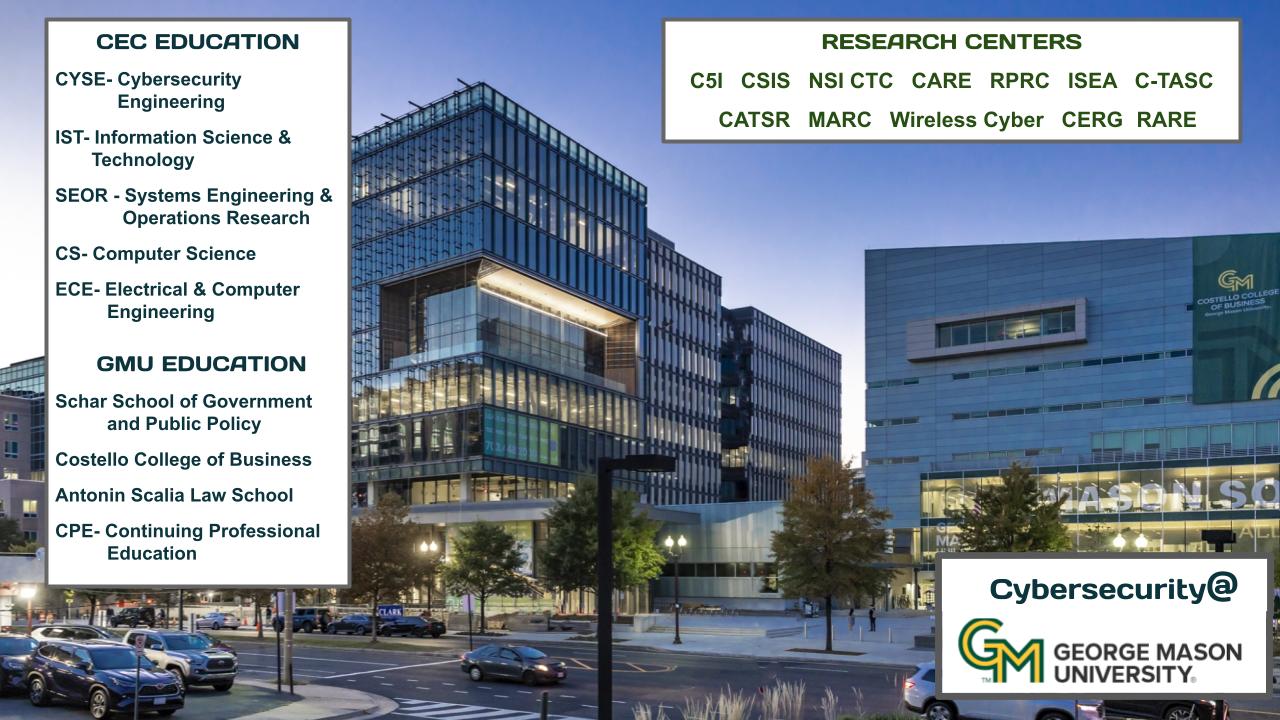
George Mason University has numerous departments, research centers, and labs focused on cybersecurity in addition to its AI2 Nexus initiative and partnerships with state and federal agencies such as the Commonwealth Cyber Initiative (CCI) and the All-In-Gov Council.
Key departments in the College of Engineering and Computing include:
- Cybersecurity Engineering Department (CYSE)
- Information Science & Technology Department (IST)
- Data Analytics Engineering Department (DAEN)
- Computer Science Department (CS)
- Electrical & Computer Engineering (ECE)
Key Research Centers, Labs, & Institutes include:
- Center for Secure Information Systems (CSIS)
- Center of Excellence in Command, Control, Communications, Computing, Cyber and Intelligence (C5I)
- Institute of Digital InnovAtion (IDIA)
- NSI Cyber and Technology Center (CTC)
- Sun Security Laboratory (SunLab)
- Center for Assurance Research and Engineering (CARE)
- Center for Cybersecurity Analytics and Automation (CCAA)
- Center for Trusted, Accelerated, and Secure Computing and Communication (C-TASC)
- Wireless Cyber Center (WirelessCyber@Mason)
- Center for Assurance Research and Engineering (CARE)
OnAir Post: GMU Cyber Security
News
GMU Cyber, – July 3, 2026
Dr. Alexandre Barreto, cybersecurity and system engineering professor at George Mason University, has finalized the Project Notebook for CYSE 587 & SYST 587 for the fall 2026 semester. Go here to learn more.
Focus in on ADOP, Agentic Development & Operations Platform using MCP, the Entrepreneurial Mindset with support from local and international shark venture capitalists.
AI can out-produce code, but it can’t connect the dots: Rethinking Cyber Engineering Curriculum through Entrepreneurially Minded Learning (EML).
The other day, I was chatting with my daughter, who is an architect. We were discussing the anxiety around AI taking over tech jobs.
I told her, “I don’t think software architects are going anywhere. But developers? Many of their traditional roles will likely vanish.”
Then the real problem hit us.
How do you become a great architect? You spend years as a junior, mid-level, and senior developer. You learn by doing, failing, and executing.
If AI eats the bottom of that ladder, where does the next generation of senior strategists come from? This is exactly the crisis facing Cybersecurity Engineering.
We probably won’t need armies of pentesters who memorize standard attack tooling; AI already generates that faster than any human can type.
What we’ll desperately need are engineers who connect business risk, human behavior, and complex systems to anticipate the attacks nobody has scripted yet.
I’m convinced the answer is Entrepreneurially Minded Learning (EML), the framework developed by KEEN (the Kern Entrepreneurial Engineering Network), built on a simple equation: Mindset + Skillset.
Curiosity (chase the context not given in the prompt). Connections (link technical decisions to other domains). Value Creation (security as business survival, not serverlocking).
AI owns the Skillset now. The Mindset is the part that’s still entirely human, and it’s the part most curricula still don’t teach on purpose.
But I’ll say the hard part out loud instead of skipping past it: mindset alone doesn’t build judgment.
Judgment used to come from a decade of breaking things as a junior. If that decade disappears, EML has to do something harder than “teach curiosity”; it has to compress or replace the scar tissue that once came from years in the trenches.
That’s the real test, and it’s the one I think most programs claiming to “future-proof” students aren’t actually solving. I believe it’s solvable. I don’t think it’s solved yet, anywhere, including in my own classroom.
So here’s my challenge to this network: if junior execution roles disappear before students graduate, what builds the judgment that used to come from trenches?
I’ll defend EML as the right starting point. I want to hear why I’m wrong, or what’s missing. Educators, CISOs, hiring managers: disagree with me in the comments. That’s where this gets useful.
Engineering Unleashed, – June 15, 2026
Transforming cybersecurity classes into a podcast with AI (Applying EML)
Anyone in engineering education knows that the best way to solidify a concept is often to have a lighthearted conversation about it. To put this to the test, I created an experiment using NotebookLM to generate a podcast focused on discussing the topics we cover in my cybersecurity classes, but in a completely casual and informal tone.
The idea goes beyond simply feeding content to an AI and letting it speak. I define the focus, the angle, and what I want to explore in each episode; the AI executes it, but I actively guide the pedagogical curation.
The main idea of this project is to transform heavy theory into a dynamic experience and connect students to the real-world applications of these concepts, explicitly applying the connections from the EML (Entrepreneurial Mindset Learning) approach.
The goal is to increase students’ understanding and stimulate ongoing debate, demonstrating that simple solutions can generate enormous value in learning.
We just released Chapter 2! You can see how the experiment is evolving here: https://www.youtube.com/playlist?list=PLz9ls-KwHLoGxSqhqgxPau3EPpxjezl83
I am currently working on an Engineering Unleashed Card to detail the process and the pedagogical curation behind this experiment, but I wanted to share these early results with the community first.
Have any of you experimented with NotebookLM or similar AI tools to create new formats for educational content? I would love to hear your thoughts and potentially incorporate some of this discussion into the upcoming Card.
After a career in industry, Peggy Brouse joined the Systems Engineering Department at George Mason in 1993. She now holds a joint appointment in the Systems Engineering and Operations Research Department and the Cyber Security Engineering Department.
Brouse is widely recognized as an exceptional classroom teacher with a commitment to instructional excellence. Her students praise her for her clarity, fairness, and her genuine interest in their success. Brouse has previously received the university’s David J. King Teaching Award (2023), the College of Engineering and Computing Academic Excellence Award (2024), and the Virginia Cybersecurity Educator Award (2024).
She has a long record of curriculum development, starting with her role as the original architect of the BS in cyber security engineering.
Brouse also designs and executes high-impact extracurricular and off-campus learning experiences for her students, such as cybersecurity competitions, senior design projects, and industry-sponsored initiatives. These efforts, along with her committed mentoring and advising, have resulted in strong employment outcomes for her students.
CYSE 587 Shark Seminar
On May 6, 2026 at 4:30 PM, Dr. Alexandre De Barros Barreto’s CYSE Shark Tank – Cybersecurity Innovation Seminar will present their shark tank seminar presentations! Each team will present for twenty minutes before a panel of sharks began to ask their questions.
Event Details
- Location: Nguyen Engineering Building, Room 1103
- Virtual Attendance: The Zoom room will open at 4:20 PM for those joining remotely.
- Address: 4400 Patriot Cir, Fairfax, VA 22030
Go here to learn more about the course, the student projects, and the Shark panel.
April 12, 2026
Dr. Yunlong Xing successfully defended his PhD thesis on software sanitization and patch generation in April 2026 and will join Michigan Technological University as an Assistant Professor.
Congrats to Yunlong
The George – April 15, 2026
George Mason University is launching a new artificial intelligence (AI)-focused accelerator housed in Fuse at Mason Square called Einstein Labs. A partnership between the Einstein family and Mason Enterprise, the lab will develop dual-use technologies for commercial big tech and government, initially focusing on three high-impact sectors: health, quantum, and cybersecurity technologies.
“Ten years ago, we set out with one dream: to create a place where the Department of War could meet Silicon Valley, and today, that dream is being realized with Mason Enterprise,” said Farhad Chowdhury, Mason Enterprise board member and founder of George Mason’s Entrepreneur in Residence program. “Einstein Labs brings together the best of established and emerging technology, and the government in one place, enabling the region to lead on high-impact collaborations.”
The initiative establishes a framework for academic collaboration, joint innovation, and workforce development. Mason Enterprise and Einstein Labs will also work together to expand interdisciplinary research and development opportunities, and create new curriculum offerings across George Mason’s schools and programs.
Two prominent leaders are joining the George Mason and Einstein Labs initiative:
- Steven Einstein—a 30-year mergers-and-acquisitions veteran and retired partner at PricewaterhouseCoopers (PwC), now the newest board member of Mason Enterprise.
- Tad Einstein—founder of Google Cloud’s Explore platform and global head of immersive experiences, and now serving as George Mason’s newest Entrepreneur-in-Residence.
Tad Einstein referenced a quote often attributed to his ancestor, Albert Einstein, which describes the mission of Einstein Labs: “We cannot solve our problems with the same thinking we used when we created them.”
He added, “Einstein Labs is anchored by the ‘Innovation Diamond’—a strategic concentration of industry, academia, government, and capital within a single location. By uniting these four assets under one roof, the lab breaks down traditional silos to accelerate breakthroughs.”
“The Einstein family brings both deep industry experience and a strong track record of building scalable, market-driven solutions,” said Paula Sorrell, associate vice president of innovation and economic development at George Mason. “Fostering cross-sector collaborations is essential to responsible digital innovation.”
Mason Enterprise leads the university’s efforts to build an inclusive, high-functioning entrepreneurial ecosystem across the region. The division supports more than 30,000 startups, small businesses, researchers, and industry partners seeking to innovate and accelerate growth, with an annual audience of 58,000 event and workshop attendees and a $2.8 billion annual impact on the economy.
Einstein Labs is a for-profit accelerator dedicated to advancing breakthroughs in AI across quantum, cyber, and health sectors. With support from leaders in the U.S. government, big tech, and academia, the organization aims to build the nation’s premier dual-use AI innovation platform.
George Mason University and Howard University have launched a new collaborative effort to prepare the next generation of cybersecurity and artificial intelligence (AI) professionals while strengthening the digital resilience of community based organizations.
The Cybersecurity + AI Clinic, a partnership between the National Security Institute’s Cyber and Tech Center (NSI CTC) at George Mason’s Antonin Scalia Law School and the Howard University School of Business (HUSB), welcomed its first cohort earlier this academic year.
The one-year program blends rigorous academic preparation with hands-on service, giving students the opportunity to apply what they learn in the classroom to real-world cybersecurity challenges. Supported by a seven-year, $1 million grant from Google, George Mason and Howard were selected to establish a cybersecurity and AI clinic that provides free support to nonprofits, local agencies, and other under-resourced organizations. As a member of the Consortium of Cybersecurity Clinics, the program engages in faculty-level collaboration, shared learning, and ongoing development of best practices at the intersection of cybersecurity, law, and technology.
“AI is transforming every corner of our national security landscape, and cybersecurity has long been a critical concern for enterprises large and small,” says Jamil Jaffer, founder and executive director of NSI and principal investigator for the clinic. “We need leaders who understand both technology and policy and can apply them in practice. That is exactly what the clinic enables students to do. By tackling real challenges faced by our clients, students gain the hands-on, innovation-driven experience needed to lead in a world where cyber and AI touch every part of our society.”
The inaugural class includes 14 students: eight law students from George Mason and six HUSB undergraduates with a mix of computer science and mechanical engineering backgrounds. The cohort reflects George Mason’s bold educational approach to the interdisciplinary nature of today’s cybersecurity and AI landscape by bringing together students who can analyze problems from technical, legal, and policy perspectives.
In the fall 2025 semester, Howard students traveled to George Mason’s Fuse at Mason Square to attend class alongside Scalia Law students and gained a strong foundation in cybersecurity, risk management, data governance and privacy, and AI concepts. Two instructors—Kathryn Ciano Mauler, a product counsel attorney at Google, and Ali Jessani, counsel at WilmerHale in privacy, cybersecurity, and AI law—guided the students through their coursework.
“This clinic is truly a unique experience for students because it provides them with an opportunity to apply the knowledge and skills they learn in the classroom in a real-world setting,” says Jessani. “While some classes offer doctrinal lessons and others offer applied skills, this clinic provides students with both.”
“Here they learn not just the nuts and bolts of privacy and cybersecurity, but also the experience of speaking with clients, thinking on the spot, and tying together diverse experiences and issue spotting to provide real-world value in a supervised setting,” says Mauler. “The clinic classroom has brought together a diversity of experience across undergrad and law school students and their perspectives in a rich discussion.”
In addition to coursework, the students have gained professional skills essential for client-facing work, including learning how to conduct client interviews, present technical findings to nontechnical audiences, navigate project challenges, and draft written Recommendations.
Scalia Law School student Mike Niebergall says he applied to the clinic because he’s interested in how technologies like AI will affect the entertainment industry and the commercial world in general. “I have a background in music. With no cybersecurity or computer science background, the clinic has been incredibly eye-opening and has taught me how cybersecurity practices apply across many different spaces.”
“I wanted to gain experience learning how to work within legal frameworks to protect business operations and consumers with the rise of AI usage,” says HUSB undergraduate Courtney Gill. “As a senior at Howard University interested in practicing law, [I felt] the class simulated what it feels like to be in a law school classroom.”
“While many of my law classes asked me to consider harms that had already occurred, the clinic challenged me to think about managing risk and preventing legal liability from arising in the first place,” says Scalia Law School student Liam McGettigan. “For anyone interested in learning how to run an organization—and understanding the unavoidable challenges of the digital world—the Cybersecurity + AI Clinic should be on your radar.”
Some students, like law student Tate Kaufman, have been able to immediately apply what they learned in class. “The clinic has provided an invaluable look into the work of cyberlaw practitioners, while enabling me to stay on the cutting edge of AI law,” says Kaufman. “Knowledge from the clinic directly translated to my work as a clerk on the Senate Judiciary Committee, where I worked on issues relating to the emergence of generative AI and copyright.”
Entering the spring semester, students transitioned to hands-on client work, a core part of the clinic’s community-focused mission. Working in small groups of three to four students, and supported by expert instructors, each group is partnered with a client organization that may not have the expertise or resources to manage cybersecurity risk on their own.
The first group of clients includes the Arlington Free Clinic, Washington, D.C.-based Bread for the City, Center for Child and Family Advocacy in Arlington, and the charter school Digital Pioneer Academy.
NSI CTC continues to welcome new partners who are looking to strengthen their cybersecurity resilience, and the clinic has a goal of increasing the number of clients served each clinic cycle.
Under the guidance of instructors and the leadership of Clinic Director Jessica Jones, students are providing a range of services for their clients, including conducting cybersecurity risk assessments; mapping organizational vulnerabilities; reviewing or drafting cybersecurity, AI-use, or incident response policies; and providing practical recommendations tailored to strengthen an organization’s overall security posture.
In May, students formally present their findings and recommendations to client representatives. They also present to their fellow students, with each group highlighting project results, sharing real-world challenges they faced, and reflecting on the lessons learned throughout their client engagements. The clinic’s year-long experience is a core part of preparing students for careers in a cyber field that increasingly demands interdisciplinary understanding and practical experience.
Admission to the program is competitive. Howard students apply as rising seniors, and George Mason students currently come from the law school. Applicants are not required to have prior cybersecurity experience—just interest and a willingness to engage.
All participants receive a stipend, helping ensure that financial barriers do not prevent qualified students from participating.
Looking ahead, the clinic anticipates welcoming students from a broader range of disciplines and additional George Mason programs, such as public policy, engineering, and business, to strengthen the interdisciplinary preparation needed to address evolving cyber and AI challenges.
6 PM – 8:30 PM EDT (GMT-4)
JC Bistro, GMU Campus
Fairfax, Virginia, United States
The George, – February 16, 2026
With the support of the National Science Foundation’s CyberCorps® Scholarship for Service (SFS) program, George Mason University’s Department of Cyber Security Engineering (CYSE) and Department of Information Sciences and Technology (IST) are training the next generation of cybersecurity professionals committed to public service.
Funded by a $3.9 million grant, the SFS program provides students who commit to working in federal, state, or local government cybersecurity roles after graduation with two or three years of full tuition. The first cohort of five students is already demonstrating how financial support, professional development opportunities, and a shared service mission can accelerate careers in the public interest.
The students receive professional development support not only through exclusive networking events and job opportunities but also through funding for certifications, conferences, and workshops.
“That kind of professional support is a big deal,” said senior DJ Strigel. “It really helps you build credentials while you’re still a student.” Strigel, a CYSE Bachelor’s to Accelerated Master’s (BAM) student concentrating in artificial intelligence, added that the scholarship made graduate study feasible.
Ailene (Diemmi) Dao, a CYSE BAM student specializing in digital forensics, said the scholarship allows her to focus fully on learning and skill development. “The [CYSE] program itself is really fun, including interesting, engaging, hands-on labs. This scholarship lets me concentrate on building the experience I’ll need to do this work well.”
For junior Shanti Nadimi, the program aligns with a strong sense of civic responsibility. “Without federal and Virginia state aid, I wouldn’t be able to go to college at all,” Nadimi said, “so I feel like I should give back. I want to contribute to our nation’s security.”
“I grew up liking the security and structure of government and the sense of service that comes with government work,” added senior Tristan Boyd.
As the first cohort, these students are shaping the culture of the program. The group regularly shares job leads, internship advice, and guidance on navigating federal hiring and security clearance processes.
“We all send each other opportunities and teach each other about the process,” said Carlos Javier Navarro‑Montanez, a sophomore. “That camaraderie has been really important.”
For George Mason, the SFS program is both a powerful student support mechanism and a mark of distinction. It reflects the university’s national leadership in cybersecurity education and its role as a trusted pipeline for public‑sector talent. Professor Kun Sun, principal investigator of the program, is excited by how well the first cohort started. “The students have already shown impressive technical skill, curiosity, and a real sense of purpose around public service and cybersecurity,” he said.
The cohort’s work is already paying off. One student has completed an internship with the Department of Homeland Security while two others will complete internships for the Department of Defense.
With strong faculty mentorship, federal investment, and students already entering public‑service cybersecurity roles, George Mason’s SFS program is helping safeguard the future by preparing those committed to serving it.
Learn more about George Mason’s SFS program: https://sfs.cec.gmu.edu/prospective-students/
Mason’s Computer Science Club and PatriotHacks hosted HackFax x PatriotHacks, a 72-hour hacking challenge, from Friday, Feb. 13 to Sunday, Feb. 15 on campus. The event brought students from over 30 colleges and a total of over 500 participants, according to the organizers.
The community-building event was both a Capture The Flag (CTF), where participants completed short security challenges, and a hackathon where participants collaborated to build software or hardware projects in a short amount of time. The hackathon was also an official Major League Hacking member event.
Major League Hacking is dedicated to building the hacker community across the world, giving insight and guidance on organizing major events. The organization sent a representative to Hackfax x PatriotHacks to ensure the event went smoothly.
They also provided students access to developer tools like Gemini, GitHub Copilot, DigitalOcean, ElevenLabs, Solana and Snowflake. Students at the event could borrow devices from the DigiKey hardware lab like Raspberry Pi, Google Home and Arduinos to return at the end of the weekend.
Throughout the weekend, students participated in workshops on various topics including “User Interface/User Experience” design by Peraton, “How to Pitch Ideas” by Colorstack, “How to Maximize Total Compensation” by the National Society of Black Engineers and a women in STEM panel and early career panel provided by Microsoft employees.
Note: Also see article in Mason News article HackFax x PatriotHacks 2026 entered the Major League with a 72-hour Valentine’s weekend event.
January 28, 2026
Hosted the NSF SFS PI meeting and Symposiurm at Mason Square on 1/28/2026 – 1/29/2026.
Governor Abigail Spanberger announced 12 appointees to the George Mason University Board of Visitors on Saturday, January 17:
- Anne Altman, BS Marketing ’82; co-founder and CEO of Everyone Matters, member of Dean’s Council for Costello College of Business and former BOV member 2007 to 2011;
- Bruce Caswell, president and CEO of Maximus;
- Shawn N. Chambliss-Purvis, MS Information Systems ’99, president and CEO of Sabel Systems Technology, and former BOV member 2015 to 2019;
- Former Congressman Tom Davis, partner at Holland and Knight and former George Mason BOV Rector 2014 to 2020;
- Paul Misener, JD ’93, Founder and Principal at Misener Innovation LLC;
- Trevor Montano, BS Accounting ’00;
- Former Congressman Jim Moran;
- Delbert Parks, vice president of Micron Technology and George Mason Board of Trustee member;
- George Schindler, former CGI president and CEO;
- Sumeet Shrivastava, MBA ’94, president and CEO of Unissant, Chair of George Mason Board of Trustees;
- Sean Spence, Senior Manager of Corporate Finance at BDO and adjunct professor in the Costello College of Business;
- Jennifer Taylor, MBA ‘98, president and CEO of the Northern Virginia Technology Council (NVTC).
Appointees will undergo confirmation hearings, beginning with the Virginia State Senate committee on Privileges and Elections, which meets Jan. 20.
Former BOV Rector Charles “Cully “ Stimson resigned his position effective noon Saturday. Vice Rector Michael Meese would take over leadership duties of the board. Visitor Robert Pence also resigned Saturday.
Current board members are Vice Rector Michael Meese, who will direct the board until its February 26 meeting when leadership elections are held, Secretary Armand Alacbay, and Visitors Jon M. Peterson and Jeffrey A. Rosen.
Complete biographies and photos of the new visitors will be posted on the Board of Visitors website when they are confirmed.
Sometimes, in genetics, two wrongs do make a right. A research team recently showed that two harmful genetic variants, when occurring together in a gene, can restore function—proving a decades-old hypothesis originally proposed by Nobel laureate Francis Crick. Their study, published in the Proceedings of the National Academy of Sciences (PNAS), not only experimentally validated this theory but also introduced a powerful artificial intelligence (AI)-driven approach to genetic interpretation led by George Mason University researchers.
The project began when Aimée Dudley, a geneticist at the Pacific Northwest Research Institute (PNRI), approached George Mason University Chief AI Officer Amarda Shehu after following her lab’s work on frontier AI models for predicting the functional impact of genetic variation. That conversation sparked a collaboration that married PNRI’s experimental expertise with George Mason’s computational innovation to discover some surprising ways variant combinations can shape human health.
The problem
Every year one in three Americans is diagnosed with a genetic disorder. Symptoms manifest in infancy for about 70% of individuals. Sadly, 35% die before the age of 5. Advancements in clinical genomics offer hope to better understand and possibly treat these disorders.
“High-throughput genomic screening has been a wonderful feat for humanity,” said Shehu, “but one of its side effects is that it has produced massive amounts of data, outpacing our ability to interpret what that data means for health and disease.”
Research in the Shehu lab has for years focused on building frontier AI models to advance genetic interpretation, but all data available link only isolated, single variants to measured functional activity. Because each person’s genome contains billions of base pairs, with about five million variants existing between two individuals’ genomes, looking at one variant at a time rather than combinations of variants could only reveal so much.
“It looked like we had hit a wall,” Shehu said, “that is, until Dr. Dudley contacted my lab more than a year ago.”
– December 9, 2025
On December 8th, 2025, Dr. Alexandre De Barros Barreto’s CYSE 587 class presented their shark tank seminar presentations! Each team presented for twenty minutes before a panel of sharks began to ask their questions.
It was an innovative and engaging night, full of discussion, collaboration, and problem solving. Thank you to all of the amazing sharks who came out, and to all of the presenters for their solutions to real world problems!
Please look at the overview post to view each team’s presentation and videos.
Key investments at Virginia Tech, George Mason, University of Virginia help the Commonwealth position itself as a home for AI innovation
George Mason University
Three years after Open Ai launched ChatGPT, Virginia continues to capitalize on its position as a global tech leader to solidify its place in the AI industry. With over 31,000 AI-related job postings in 2024, Virginia ranked fourth nationally in the Stanford AI Index Report, trailing only states with far bigger workforce populations (Texas, California, and New York).
Decades of strategic investment in the technology sector have propelled the Commonwealth to the forefront of the global AI landscape. Dubbed “Silicon Valley East” by Business Traveler, Virginia is unmatched in highly skilled and concentrated tech talent, especially in Northern Virginia. In 2024, the Commonwealth had the third-highest share of technology companies (per WalletHub), and Business Facilities ranked Virginia’s tech talent pipeline third in the country.
Virginia’s position as a top state for tech talent is not by chance, but the product of significant historical and ongoing investments in its tech talent pipeline, including the landmark Tech Talent Investment Program (TTIP). Launched in 2019, TTIP is a $1.1 billion, 20-year commitment to increasing the number of BS and MS graduates in computer science and related fields by at least 30,000. TTIP was conceived as part of Virginia’s 2018 winning proposal to Amazon for its HQ2 facility, and institutions are using TTIP monies and other funding sources to fuel research, facilities, and programs dedicated to expanding and maintaining a robust and innovative tech talent workforce.
“As we expand our three campuses across Northern Virginia to create a thriving tech corridor from Washington D.C. to Prince William County, George Mason and our partners have been propelling the region together,” said George Mason University President Gregory Washington. “The Commonwealth is seeing an enormous return on investment as our students graduate at record numbers and stay to work in the region, helping to propel the state as a leader in business, nationally and globally.”
BOV Minutes from Dec. 4, 2025 meeting, – December 4, 2025
ITEM NUMBER:
PhD in Cybersecurity Degree Program Proposal
PURPOSE OF ITEM:
The PhD in Cybersecurity degree program proposal is under consideration by the State Council of Higher Education for Virginia (SCHEV) for initiation in Fall 2026. The degree program was originally entitled, “PhD in Cyber Security Engineering.” Board action is required to approve the revised name of the degree program.
APPROPRIATE COMMITTEE:
Academic Affairs Committee
BRIEF NARRATIVE:
On September 26, 2024, the Board of Visitors approved George Mason University’s proposal for a PhD degree program in Cyber Security Engineering. The proposal was submitted to SCHEV in August of 2025. Feedback from SCHEV staff included discussion of a name change to the proposal that would eliminate unnecessary confusion between the terms “cybersecurity” and “cyber security engineering.” Faculty determined that a name change would benefit the degree program. The revised name, “PhD in Cybersecurity,” must be approved by the Board of Visitors before consideration of the degree program can resume at SCHEV.
The proposed degree program is built upon the existing bachelor’s and master’s degree programs in Cyber Security Engineering offered by the Department of Cyber Security Engineering in the College of Engineering and Computing and will create a pathway for doctoral level research and training for students in these degree programs.
The proposed program will train students to solve the next generation of engineering and research problems, educate the future workforce, and lead government agencies and industries in the domain of cybersecurity. The proposed degree program responds to the escalating challenges of an increasingly interconnected and digitized world. The proposed degree program will prepare students for the growing faculty and researcher positions in academia, industry, and government on cyber security education and research. Establishing a PhD program in cybersecurity will address the shortage of experts, foster a robust research community in Virginia, and contribute to the evolution of cutting-edge technologies and methodologies in cybersecurity.
REVENUE IMPLICATIONS:
The program at launch will be revenue neutral. The required core courses will be offered by existing faculty, and the program does not require new laboratory or other facilities. It is anticipated that the program to be revenue enhancing as it reaches maturity.
STAFF RECOMMENDATION:
Staff recommends Board approval.
I. Basic Program Information
Institution (official name) Degree Program Designation Degree Program Name
CIP code
Anticipated Initiation Date Governing Board Approval Date (actual or anticipated)
George Mason University Doctor of Philosophy Cybersecurity
Fall 2026
Anticipated December 4, 2025
STATE COUNCIL OF HIGHER EDUCATION FOR VIRGINIA
Program Announcement Form


II. Curriculum Requirements. Address the following using appropriate bolded category headings:
- Core Coursework and total credit hours (include course descriptor/designator, name, and credit hour value). Indicate new courses with an asterisk.
- Sub Areas (e.g., concentrations, emphasis area, tracks) and total credit hours. Include brief description of focus/purpose of sub area and required courses.
- Additional requirements (e.g., internship, practicum, research, electives, thesis, dissertation) and total credit hours
- Total credit hours for the curriculum/degree program.
Core Courses: 18 credits
CYSE 700: Research Methodology and Pedagogy in Cybersecurity (3 credits) CYSE 710: Advanced Networks and Cybersecurity (3 credits)*
CYSE 757: Cyber Law (3 credits)*
CYSE 780: Advanced Hardware and Cyber-Physical Systems Security (3 credits)* CYSE 788: Advanced Systems Engineering for Cybersecurity (3 credits)*
CYSE 789: Advanced Artificial Intelligence Methods for Cybersecurity (3 credits)*
Restricted Electives: 30 credits
Students select 6 credits from the following courses.
CYSE 760: Human Factors in Cyber Security (3 credits)* CYSE 770: Fundamentals of Operating Systems (3 credits)* ECE 646: Applied Cryptography (3 credits)
Students select 24 credits from a list of courses.
CS 530: Mathematical Foundations of Computer Science (3 credits)
CS 583: Analysis of Algorithms (3 credits)
CYSE 640: Wireless Network Security (3 credits)
CYSE 650: Topics in Cyber Security Engineering (3 credits)
CYSE 698: Independent Study and Research (3 credits)
CYSE 750: Advanced Topics in Cyber Security Engineering (3 credits) CYSE 765: Quantum Information Processing and Security (3 credits)* CYSE 785: Advanced Unmanned Aerial Systems Security (3 credits) ISA 764: Security Experimentation (3 credits)
ISA 862: Models for Computer Security (3 credits)
ISA 863: Advanced Topics in Computer Security (3 credits)
OR 719: Graphical Models for Inference and Decision Making (3 credits)

Program Announcement Form Page 1
Research Requirement: 12 credits
CYSE 998: Doctoral Dissertation Proposal (3-12 credits)*
Dissertation Requirement: 12 credits
CYSE 999: Doctoral Dissertation (1-12 credits)*
Total: 72 credit hours
III. Description of Educational Outcomes. Use bullets to list outcomes. (max. 250 words)
Students will learn to
• Apply foundational knowledge of cybersecurity to engineering applications.
• Analyze cyber-physical systems, networks, software, and hardware for vulnerabilities
to various attack scenarios.
• Integrate security fundamentals in building secure and resilient cyber infrastructure,
including large-scale cyber-physical systems and networks.
• Apply quantitative and qualitative methods to cybersecurity.
• Construct approaches for predicting, detecting, and responding to cyber threats
utilizing artificial intelligence.
• Evaluate the principles of cyber law and how they impact cybersecurity occurrences. • Design curriculum and pedagogical experiences for training the next generation of
cyber security engineers.
• Lead innovative research that contributes to the cyber security engineering knowledge
base.
IV. Description of Workplace Competencies/Skills. Use bullets to list outcomes. (max. 250 words)
V. Duplication. Provide information for each existing degree program at a Virginia public institution at the same degree level. Use SCHEV’s degree/certificate inventory and institutions’ websites.
Institution Program degree designation, name, and Degrees granted (most
CIP code recent 5-yr average)
*ODU is currently developing a stand-alone PhD degree program in Cybersecurity.
Graduate will be able to
- Conduct fundamental research to push the frontiers of cybersecurity defense andmitigation techniques.
- Train and educate undergraduate and graduate students and the population in computersecurity fundamentals.
- Analyze cyber security problems in critical infrastructure and design effective solutions.


Old Dominion University* | Doctor of Engineering (DEng)/Doctor of Philosophy (PhD) in Engineering, concentration in Cybersecurity, CIP code: 140101 | 31 (unable to aggregate by concentration) |

Program Announcement Form Page 2
VI. Labor Market Information. Fill in the tables below with relevant information from the Bureau of Labor Statistics (BLS) and Virginia Employment Commission (VEC). Insert correct years (2023 and 2033) to reflect the most recent 10-year projections. Add rows as necessary.
Labor Market Information: Bureau of Labor Statistics, 2022 -2032 (10-Yr)
Occupation Base Year Projected Total % Change Typical Entry Employment Employment and #s Level Education


Computer science teachers, postsecondary | 42000 | 44300 | 5.3 | Doctoral or professional degree |
Engineering teachers, postsecondary | 45500 | 49700 | 9.3 | Doctoral or professional degree |
Computer and Information Research Scientists | 36500 | 44800 | 22.7 | Master’s Degree |
Labor Market Information: Virginia Employment Commission, 2020 -2030 (10-Yr)
Occupation | Base Year Employment | Projected Employment | Total % Change and #s | Annual Change # | Education |
Computer Science Teachers, Postsecondary | 1523 | 1595 | 4.73 | 7 | N/A |
Engineering Teachers, Postsecondary | 1249 | 1357 | 8.65 | 11 | N/A |
Computer and Information Systems Managers | 14659 | 16636 | 13.48 | 198 | Bachelor’s degree |
Program Announcement Form Page 3
VII. Projected Resource Needs
Cost and Funding Sources to Initiate and Operate the Program
Program Initiation Year 2026 – 2027 | Program Full Enrollment Year 2030-2031 |

Informational Category
- 1 Projected Enrollment (Headcount)
- 2 Projected Enrollment (FTE)
8 22 6 16


Projected Revenue Total from Tuition and E&G Fees Due to the Proposed Program

3
VIII. Virginia Needs. Briefly indicate state needs for the degree program. (max. 250 words)
$228,072 $622,152
State Needs. This proposed program will further the State’s effort in developing a sustainable Cybersecurity industry in the Commonwealth. Although there are bachelor’s and master’s degree programs available in cybersecurity, there is no existing doctoral-level Cyber Security Engineering degree program in Virginia. This is a unique but timely program that will address the gap in producing academic doctoral-level academic and researchers in cybersecurity.
Employer Needs. The program will prepare students for international, national, and local employment in academia, government, contractors, think tanks, and non-government organizations. The program will provide rigorous academic training in cybersecurity required by the employers. Given the location of George Mason, the program has the potential to contribute to the Government needs in cybersecurity researchers. In addition, the program will address the growing need of academics in cybersecurity for academic roles, i.e., faculties and research scientists, opening throughout the country.
Student Needs. The success of the BS and MS in Cyber Security Engineering at George Mason underlines student participation and interest in higher education in cybersecurity. As noted from the BLS data there is significant growth is expected in cybersecurity related jobs, such as 31.5% growth in Information Security analysts over the next ten years. To rigorously train the workforce and continued innovation in cyber, students will need doctoral-level education and research experience. This program will address this unmet student demand.
When George Mason University cyber security engineering student Noah Hinger interned at Surefire Cyber in summer 2023, his managers were so impressed with his work that they invited him back. Thanks to his previous experience, the Honors College student was able to take on more responsibility this summer at the computer security company and contribute to more projects.
“The experience from my first summer here let me understand what was happening and contribute across the company,” said Hinger, who is a sophomore in the College of Engineering and Computing. “Surefire Cyber has an amazing internship program. They’re investing in us by having professional development meetings and providing us with the opportunity to talk to experts from different fields.” said Hinger.
 “I think it’s helped me a lot to be able to practice my independence and accountability,” said Hinger, who also competes in George Mason’s Chess and Competitive Cyber Clubs. “I’ve had the chance to do projects on my own without necessarily needing to report to someone, and I’ve also learned so much from all the smart people at Surefire Cyber.”
What made you choose Surefire Cyber for your internships?
Surefire Cyber is a digital forensics and incident response company. When an organization gets hacked, they call Surefire Cyber to conduct an investigation and restore systems so that everything’s OK. As a technology intern, I am helping develop the code that our forensic analysts use to figure out what’s happened and retrieve all the essential data. Surefire Cyber is really exceptional at using a lot of automation tools so that the forensic analysts can focus more on the big picture and the data they’re working with.
What does a typical day interning at Surefire Cyber look like for you?
I work under two groups: software development and information operations, or DevOps, and security engineering. For DevOps, I help to manage company infrastructure and work on a lot of coding assignments.
Traditionally, there are software developers, and there are operations, which maintain it. DevOps is kind of a hybrid role, which means it entails coding, setting up servers, and being responsible for maintaining the infrastructure.
How would you say George Mason has helped prepare you for this role?
I definitely think more critically when problem-solving this time around, and I think that’s in part due to George Mason, especially the Honors College research and literature classes that I’ve taken. I’m learning about a lot of new technologies in real time, so I have to be able to research and read about them and then apply that knowledge to my work. The courses have definitely helped me when it comes absorbing the information I’m reading about and then transferring it to my assignments at Surefire Cyber.
Another thing about the Honors College is that I get to meet different people from different disciplines, and that’s really helped me at Surefire Cyber when connecting and networking with colleagues. I think that’s been really rewarding and something that George Mason’s helped prepare me for.
I’ve also gotten a lot of experience in my systems engineering and digital systems engineering classes, and getting to see what goes into a lot of security minded decisions is very similar to what I’m doing in this internship.
What’s your favorite thing about interning at Surefire Cyber?
My favorite thing about the company is that it’s always driving innovation and new discoveries within cybersecurity and digital forensics. They’re always pushing for the best and trying to help people. That’s the whole point of digital forensics is to be there for and helping them out on the worst day of their life.
A team of faculty and students from George Mason University recently discovered a vulnerability in a widely used anonymization tool. They presented their findings last week in Taiwan at the Association for Computing Machinery Conference on Computer and Communications Security (ACM CCS), one of the world’s most prestigious computer security conferences, with a very low paper acceptance rate.
The project was supported by a Commonwealth Cyber Initiative (CCI) grant from the program, “Securing Interactions between Humans and Machines,” and as a requirement of the grant, the project crossed different parts of the university. The College of Engineering and Computing collaborated with Mason and Partners (MAP) Clinics, which provided the data.
Fatima Majid, a George Mason University senior majoring in cyber security engineering, was not just the only one-person team in the top 10 award winners at a recent National Defense Industrial Association (NDIA) cyber competition, she was the only student team. Majid placed ninth out of 51 teams, most of them comprising industry experts.
“I went in, and they were all professional teams, like from Lockheed Martin. I thought, ‘I want to go home,’” said Majid with a laugh, describing her initial cold feet. “But I told myself I could do it. It helped that it was hosted at George Mason, and I had professors there giving me support.”
Her project focused on how the Department of Defense (DoD) can protect critical U.S. infrastructure against low-cost drone attacks at scale, informed by Ukraine’s “Operation Spiderweb,” which used 117 drones to attack Russian air bases in June 2025.

Majid spent the summer in Richmond during a public policy internship. Photo provided
Majid’s lightbulb moment came with a flash as bright as a Virginia speed camera catching a lead-footed driver. Considering the significant network of traffic cameras in the commonwealth, she conceived SkyEyes. This applies an artificial intelligence (AI) model to the live feed of the Virginia 511 camera network, which provides real-time traffic information to citizens and transportation officials. SkyEyes demonstrated how a low-cost, AI-enabled surveillance layer could differentiate threats from non-threats, employing geofencing logic to define safe versus threat zones around sensitive sites.
“I understand how drones work because of what I’ve done at George Mason’s MIX lab—and since I know how to build it, I also know how to jam it. I trained the AI model on a data set provided from a contest sponsor, and that data set had drone imaging and drone prototyping,” she said. “The camera feeds can find objects flying, but what if it’s an Amazon drone, for example? Then I added geofencing and threat analysis to observe the behavior of the drone—if it’s a drone at 2 a.m., for example, maybe that’s sketchy. So, the model gets smarter.”
Majid said that to access the cameras, all she had to do was make a phone call to the right person and explain her project. She cited time spent this summer at the Virginia Academy of Science, Engineering, and Medicine in the Undergraduate Policy Program (VASEM UPP) in Richmond as giving her confidence and exposure to how government works.
K. L. Akerlof, an associate professor in the Department of Environmental Science and Policy at George Mason, said, “The VASEM UPP is a unique opportunity for undergraduates to learn about opportunities in science policy at the state level. The immersive experience of spending a week in Richmond visiting the General Assembly and state agencies, while getting a crash course in how research evidence relates to public policy, can open new doors and career pathways.”
Majid said the strong showing gave her tremendous exposure to influential professional contacts. She fielded several questions about her simulation and future professional plans from a man she only later realized was Retired Brigadier General and NDIA Executive Vice President Guy Walsh.
“Because he showed interest, after he walked away, a crowd of people gathered around to ask me questions. It was very validating.”
She also had a long conversation about her project with Harley Stout, acting chief digital and AI officer at the Joint Chiefs of Staff.
Majid is still pleasantly shocked by her top-10 finish. She is working with Mohamed Gebril, an associate professor in Cyber Security Engineering, on expanding the research. She is confident that such a cost-efficient solution for critical infrastructure protection against drone attacks will attract more funding opportunities.
She credited the supportive culture at Mason—and her family—for keeping her grounded and encouraging her throughout, saying their support made the accomplishment even more meaningful.
When George Mason University cyber security engineering major Connor Wadlin learned about ransomware attacks on organizations, such as the one on the Health Service Executive in Ireland, in his CYSE 445 System Security and Resilience class, it confirmed his commitment to dedicating his educational and professional career to protecting and preserving human lives.
“There’s nothing more important than protecting and defending others. As an engineer, I’m driven to get important work done by thinking about complex problems and finding suitable solutions,” said Wadlin, who is from Leesburg, Virginia.
Since winter 2024, the Honors College student has been interning at the Commonwealth Cyber Initiative(CCI) Northern Virginia Node, George Mason’s branch of the statewide network dedicated of excellence in cybersecurity research. CCI’s mission includes workforce development through training the next generation of cybersecurity experts.

“It’s a super exciting job because I get to work with AprilTags, which are on objects that the drone’s camera then sees and scans. Instead of sharing data, the tags utilize location information for navigation, tracking objects, or pathing purposes,” he said.
Wadlin is also simulating drone flight with the Microsoft tool Air Sim, a project he presented at the CCI Symposium in April. “I created a model with a 98% accuracy, really high F1 score—higher than what we could find on the market—detecting collisions so the drones would be able to respond to anomalous factors such as objects that get too close, environmental variables, cyber-attacks, and more,” he explained.
Wadlin learned about many of the tools he’s currently using for CCI in his classes with College of Engineering and Computing professors, such as his mentor Mohamed Gebril, an associate professor in the Department of Cyber Security Engineering.
“George Mason supports people where they are to get them where they want to be,” Wadlin said.
The skills Wadlin has acquired during his time at George Mason and in his work with CCI have enable him to help other students in their studies.
“Connor is a very skilled student and has been able to develop different programs, as well as 12 labs for sophomore- and freshman-level students at George Mason. He even assists the students during our workshops,” said Gebril.
Wadlin is participating in George Mason’s Bachelor’s to Accelerated Master’s Program and will to pursuing a master’s degree also in cyber security. Gebril said he’s looking forward to having Wadlin in his classes again as a graduate student.
“It will be a smooth transition from the undergraduate to the graduate level because the curriculum aligns well with the CCI mission, which is to equip our students with the tools to conduct research activity and develop cutting–edge technology,” said Gebril.
Wadlin’s team is also working to develop a first–of–its–kind cyber drone race that incorporates cybersecurity challenges and artificial intelligence for undergraduate students.
Wadlin was diagnosed with autism at 19 and sees this diagnosis as working to his advantage by allowing him to see things from different perspectives and approach problems with his own unique ideas.
“As an engineer, you have to ask yourself ‘how is this making the world a better place?’ That’s always got to be the end goal,” said Wadlin.
In the rapidly evolving field of cybersecurity, the integration of generative AI and large language models (LLMs) is a game-changer. While offering immense potential for positive applications, these tools also pose significant risks if misused. Mohamed Gebril, an associate professor at the Department of Cyber Security Engineering at George Mason University, is spearheading a project to use generative AI and LLMs to better identify the very threats they pose.
The project is a collaborative effort between George Mason and the Virginia Military Institute (VMI) funded by the Commonwealth Cyber Initiative Northern Virginia Node. Gebril, along with VMI’s Sherif Abdelhamid, is assembling a team including master’s and undergraduate students to assist with research and is preparing educational workshops to introduce high school and middle school students to the research topic. Gebril’s approach aims to equip future cybersecurity professionals with the knowledge and skills needed to tackle emerging threats.
Automating threat detection
The initiative aims to leverage the power of AI to enhance threat detection and response mechanisms, ultimately making cybersecurity operations more efficient and effective. One of the primary advantages of using AI in cybersecurity is its ability to automate processes that were traditionally manual and time-consuming. Harnessing the beneficial aspects of generative AI for threat-hunting operations involves detecting malicious activities and monitoring data logs in real-time.

“AI has been very helpful in automating this process instead of doing it manually,” Gebril explained. “It can generate the alerts, automate the notifications, and make the instant response.” By automating these tasks, organizations can respond to threats more quickly and efficiently, reducing the potential damage caused by cyberattacks.
Preparing for prompt-injection attacks
A significant challenge in the realm of AI-driven cybersecurity is the threat of prompt-injection attacks, which involve malicious actors using AI prompts to generate harmful outputs, such as malware, said Gebril. His core objective is to create mechanisms for detecting malicious intent, particularly in prompts that are subtle and indirect.
“What we’re hoping to get out of this project is to be able to develop a novel method, a novel mechanism, to detect such malicious intent that is meant to be used or developed by indirect prompt injection attacks,” Gebril said. This involves using advanced AI techniques, such as fuzzy reasoning and deep learning, to analyze and interpret data in real-time.
By leveraging the power of AI, Gebril and his team are working to create more robust and effective threat detection systems, ultimately contributing to a safer digital landscape.
George Mason University Cybersecurity Engineering associate professor Mohamed Gebril led a team of students to the first-ever BattleDrone competition, an exercise coordinated through the Commonwealth Cyber Initiative.
In April, Mohamed Gebril, an associate professor in George Mason University’s Cyber Security Engineering Department, took a team of students into “battle.” The team traveled to Blacksburg, Virginia, for a BattleDrones Competition that was hosted by the Commonwealth Cyber Initiative (CCI) at Virginia Tech’s Drone Park.
Gebril emphasized that the inaugural battle was not really a competition but a learning experience. CCI began working on this competition in 2020, but the pandemic halted its progress. This was the first time the event was held.
“It was not a competition per se. All the teams worked together to get this project off the ground,” said Gebril, who teaches in Mason’s College of Engineering and Computing. “CCI-VT ran into some issues with some of the computer vision tools, but overall it was a great learning experience.”
The main objective of the competition, according to Gebril, was to have student teams assemble their own drones with materials provided by CCI-VT research group, as well as promote interest in these kinds of activities among younger students.
For the competition, Gebril pulled together a team of Mason cyber security engineering majors interested in hands-on opportunities, which included senior Kylie Amison, senior Corrado Apostolakis, senior Brandon Henry, junior Casey Cho, sophomore Zaid Osta, and Mahmoud Zaghloul, an area high school student.
By all accounts, it was a successful trip.
“The team did really well,” Gebril said. “They were able to assemble the drone successfully. We are also working on continuing this project by adding cybersecurity features to enhance this learning experience.”
Will they compete again?
“Yes, indeed,” he said. “Our students love this project and how it applies concepts learned in classrooms toward this hands-on activity.”
CCI is a network of Virginia industry, higher education, and economic development partners dedicated to cybersecurity research, innovation, and workforce development. Mason leads the Northern Virginia Node of the network.
Mason News, – September 12, 2022
George Mason University is among the top 10 most diverse and innovative public universities in the country, as well as top 10 in undergraduate cybersecurity, according to U.S. News & World Report’s “2023 Best Colleges List” rankings released Monday.
Mason jumped five spots to seventh nationally for diversity, and moved up one place to eighth nationally and first in Virginia for innovation. Mason remains first in Virginia for both categories. The undergraduate cybersecurity program jumped to 10th nationally among public universities, up from 15th.
George Mason University has been recognized as a Cyber FastTrack National “Top Tier College” that is the best in the nation in Cybersecurity Talent Discovery.
Mason recently topped a nationwide Cyber FastTrack field of 5,200 U.S. colleges for the honor, with a contest-best 312 students discovering their aptitude for cybersecurity careers through a competition sponsored by the SANS Technology Institute. Cyber FastTrack is a free online program for college students and graduates that was designed by world leaders in cybersecurity and backed by Virginia Gov. Ralph Northam and 24 other U.S. governors in the hopes of closing the nation’s cyber skills gap with China and Russia.
About
Web Links
- CYSE
- IST
- CS
- ECE
- DAEN
- IDIA
- C5I
- CTC
- CARE
- CCAA
- WCC
- AI2 Nexus
- Commonwealth Cyber Initiative (CCI)
- C-TASC
- All-In-Gov Council
Departments
Cybersecurity Engineering Department (CYSE)
Cybersecurity Engineering Department (CYSE) breaks down silos. Our cybersecurity education and research feature multiple fields of study that extend beyond technological requirements. Study includes a broad array of programs in multiple departments
An urgent need exists for a workforce with advanced technical skills in everything related to security and communications. the CEC’s computing, IT, and engineering programs, with their emphasis on cybersecurity, prepare students to create and maintain crucial information systems that will protect our nation from cyber threats with innovative knowledge and effective tools.
Information Sciences and Technology (IST)
The Information Sciences and Technology (IST) department at George Mason is a vibrant community of coders, designers, cybersecurity specialists, AI/ML experts, and HCI researchers. Together we tackle real-world challenges-from smart technologies and transportation systems to cybersecurity and public safety solutions.
Our Vision
To lead excellence and innovation in research, teaching, and service in addressing societal problems using information sciences and technology.
IST promotes and maintains a departmental research culture by providing the facilities, means, and incentives for outstanding research. IST provides excellent education with leading-edge courses, by leveraging innovative instructional methods and emphasizing the enhanced student experience. IST provides continuous advising and mentorship to the students, faculty, and staff as well as ongoing service to the college, university, alumni, and the community.
Data Analytics Engineering (DAEN)
George Mason University’s data analytics engineering programs at Volgenau prepare students for their future careers in a growing discipline.
All of our programs are taught by our industry-leading faculty members across schools and colleges in Mason, giving our students the ability to see the numerous possibilities a data-driven degree can offer.
- Master of Science –– The MS in data analytics engineering is a multidisciplinary degree program at the Volgenau School of Engineering. It provides students with an understanding of the technologies and methodologies necessary for data-driven decision-making.
- Certificate –– The graduate certificate in data analytics engineering gives students a foundation of basic data analytics and data science principles.
- Master of Science Online –– The online MS program gives students the flexibility to earn an advanced degree and expand their knowledge in data analytics in an asynchronous format.
- Certificate Online –– The online graduate certificate in data analytics engineering gives students a foundation of basic data analytics and data science principles with the flexibility of an online asynchronous format.
Data analytics engineering is an expanding field. Therefore, all our programs instruct students on current and innovative tools and prepare them to be adaptable to the future of the field.
Research Centers
There are many Research Centers, Labs, & Institutes at GMU related to cybersecurity including:
- Center for Secure Information Systems (CSIS)
- Center of Excellence in Command, Control, Communications, Computing, Cyber and Intelligence (C5I)
- Center for Assurance Research and Engineering (CARE)
- Center for Cybersecurity Analytics and Automation (CCAA)
- Center for Trusted, Accelerated, and Secure Computing and Communication (C-TASC)
- Center for Assurance Research and Engineering (CARE)
- NSI Cyber and Technology Center (CTC)
- Sun Security Laboratory (SunLab)
- Institute of Digital InnovAtion (IDIA)
- Wireless Cyber Center (WirelessCyber@Mason)