CYSE- Cyber Security Engineering Department

The Department of Cyber Security Engineering (CYSE) was established to meet the urgent and growing demand for professionals capable of protecting complex systems at the intersection of the physical and digital worlds.

Building on George Mason’s leadership in engineering and information security, CYSE launched the first bachelor’s program of its kind in the United States, creating a model that integrates cybersecurity into system design from the very beginning. Since then, the department has expanded to include master’s and accelerated degree programs, a thriving capstone experience, and a dynamic research enterprise recognized nationally and internationally.

Our Mission
To educate and inspire the next generation of cybersecurity engineers through rigorous programs that combine technical knowledge, practical application, and innovative thinking, while contributing impactful research that strengthens the security and resilience of society’s critical systems.

CYSE is committed to advancing research that anticipates emerging threats, develops adaptive defenses, and secures cyber-physical systems across critical domains such as infrastructure, communications, and smart technologies. We prepare future leaders through rigorous programs that build advanced technical skills and problem-solving abilities, while supporting students with scholarships, mentorship, and experiential learning. Through partnerships with government, industry, and academia, we ensure our work guides practice, informs policy, and strengthens the resilience of global systems.

Source: Website

OnAir Post: CYSE- Cyber Security Engineering Department
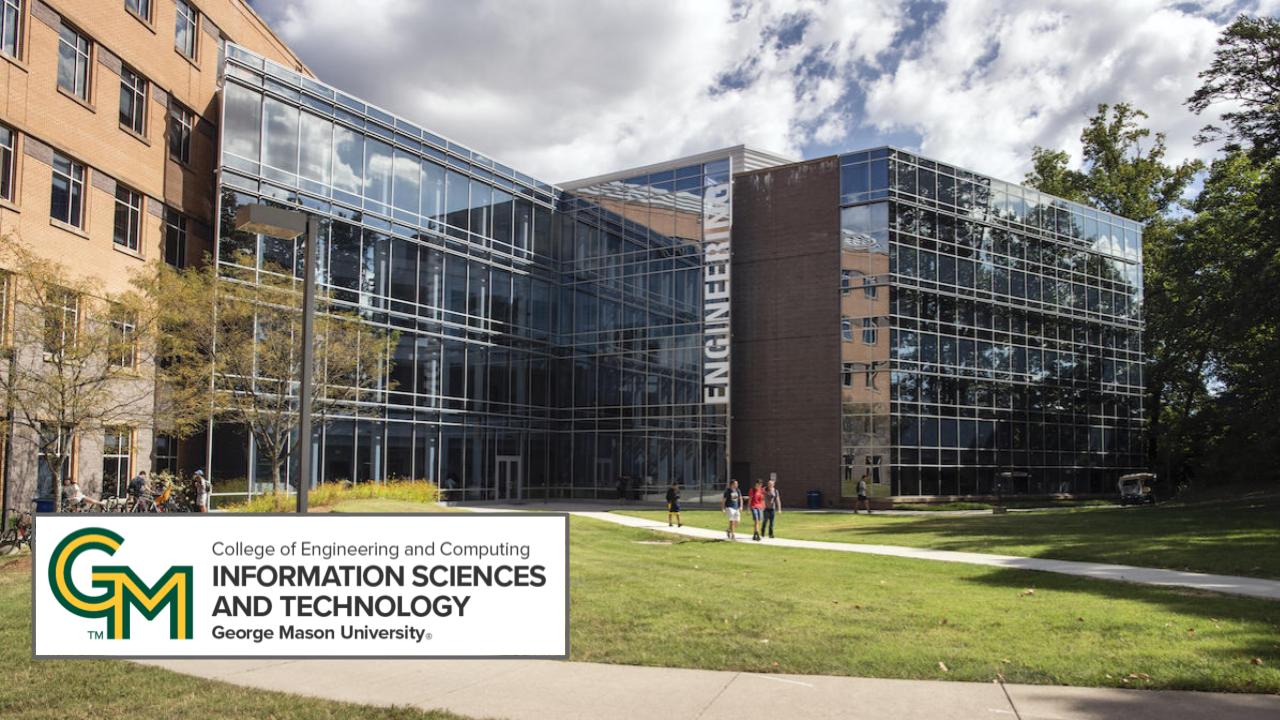
IST – Information Sciences and Technology

The Information Sciences and Technology (IST) department at George Mason is a vibrant community of coders, designers, cybersecurity specialists, AI/ML experts, and HCI researchers. Together we tackle real-world challenges-from smart technologies and transportation systems to cybersecurity and public safety solutions.

Our Vision
To lead excellence and innovation in research, teaching, and service in addressing societal problems using information sciences and technology.

IST promotes and maintains a departmental research culture by providing the facilities, means, and incentives for outstanding research. IST provides excellent education with leading-edge courses, by leveraging innovative instructional methods and emphasizing the enhanced student experience. IST provides continuous advising and mentorship to the students, faculty, and staff as well as ongoing service to the college, university, alumni, and the community.

onAir Post

Source: Website

OnAir Post: IST – Information Sciences and Technology

CS- Computer Science Department

With over 80 full-time faculty members and 12 administrative staff, theDepartment of Computer Science is the largest department in the College of Engineering and Computing, the largest department on campus, and the largest Computer Science department in the Commonwealth of Virginia.

Today, not only is computing pervasive in society, but computational methods are used in almost every field of scholarly endeavor ranging from the arts and humanities to the hard sciences and engineering, as well as every sector of industry. The department offers two Bachelor of Science programs with a total enrollment of over 2400 students: the B.S. in Computer Science and the inter-disciplinary B.S. in Applied Computer Science; three M.S. programs in Computer Science, Information Systems, and Software Engineering with a total enrollment of over 700 students; and a Ph.D. program in Computer Science of over 220 students. The department’s faculty also teach and participate in the inter-disciplinary M.S. in Data Analytics Engineering, M.S. in Artificial Intelligence, and the Ph.D. in Information Technology offered by the College of Engineering and Computing.

OnAir Post: CS- Computer Science Department

ECE – Electrical and Computer Engineering

Welcome to the Department of Electrical and Computer Engineering, one of the oldest and largest departments in the College of Engineering and Computing.

The department was established more than 40 years ago, initially offering a degree in electronics engineering.

Through the years, we’ve added more programs and now have more than 800 students across our seven undergraduate and graduate programs combined.

Some students choose to pursue dual degrees or minors to complement their degrees. Thousands of students have graduated from our accredited programs and gone on to prosperous careers in engineering and related fields.

Over thirty full-time faculty and many adjunct faculty support the educational and research aspirations of our students.

Our industry advisory board provides valuable direction and insight to our department and its initiatives.

We also support other George Mason Engineering programs through our interest in interdisciplinary collaboration in both education and research.

Source: Website

OnAir Post: ECE – Electrical and Computer Engineering

Ken Ball

Kenneth S. Ball, PhD, PE is Dean of the College of Engineering and Computing at George Mason University in Fairfax, Virginia. Since arriving at Mason in 2012, Ball has led the college through extensive growth and rapid change increasing research awards and expenditures, expanding enrollment, and establishing several first-of-their-kind programs to attract future generations of engineering and computing professionals.  

Under Ball’s leadership, the college’s ranking and reputation have improved. In the most recent U.S. News and World Report rankings of our nation’s Best Graduate Schools, the college placed in the top 100 among public universities. Ball helped the college keep pace with its strong growth in student enrollment, advocating for more faculty and staff. He led a proactive response to the needs of our students, placing a high priority on ensuring the college has the faculty to maintain student-faculty ratios to allow vigorous levels of student-faculty interaction and mentoring, to limit the number of large-enrollment classes, and to be able to offer all of the courses that students need to graduate, including elective courses. These efforts keep diversity and inclusion at the forefront by expanding access and inclusion.

Source: webpage

OnAir Post: Ken Ball

DAEN – Data Analytics Engineering

George Mason University’s data analytics engineering programs at Volgenau prepare students for their future careers in a growing discipline.

All of our programs are taught by our industry-leading faculty members across schools and colleges in Mason, giving our students the ability to see the numerous possibilities a data-driven degree can offer.

  • Master of Science –– The MS in data analytics engineering is a multidisciplinary degree program at the Volgenau School of Engineering. It provides students with an understanding of the technologies and methodologies necessary for data-driven decision-making.
  • Certificate –– The graduate certificate in data analytics engineering gives students a foundation of basic data analytics and data science principles.
  • Master of Science Online –– The online MS program gives students the flexibility to earn an advanced degree and expand their knowledge in data analytics in an asynchronous format.
  • Certificate Online –– The online graduate certificate in data analytics engineering gives students a foundation of basic data analytics and data science principles with the flexibility of an online asynchronous format.

Data analytics engineering is an expanding field. Therefore, all our programs instruct students on current and innovative tools and prepare them to be adaptable to the future of the field.


Source: GMU

OnAir Post: DAEN – Data Analytics Engineering

Amarda Shehu

Shehu is an accomplished administrator, teacher, and scholar. She currently serves as George Mason’s Inaugural VP and Chief AI Officer in which capacity she also continues to provide leadership for the Institute of Digital InnovAtion (IDIA) for which she served as Associate Vice President for Research during 2022 and 2024.

Shehu also serves as an Associate Dean for AI Innovation in the College of Engineering and Computing (CEC), where she is also a tenured Professor in the Department of Computer Science.

Source: CEC webpage

OnAir Post: Amarda Shehu

AI2 Nexus

George Mason is building a nexus of collaboration and resources on campus, throughout the region with our vast partnerships, and across the state, called AI2Nexus.

As a model for universities, AI2Nexus is based on four key principles: Integrating AI to transform education, research, and operations; Inspiring with AI to advance higher education and learning for the future workforce; Innovating with AI to lead in responsible AI-enabled discovery and advancements across disciplines; and Impacting with AI to drive partnerships and community engagement for societal adoption and change.

George Mason University is driving rapid AI adoption and advancements across the Commonwealth.

As the largest and most diverse university in Virginia, just outside Washington, D.C., George Mason University is leading the future of inclusive artificial intelligence (AI) and developing responsible models for AI research, education, workforce development, and community engagement within a modern university.

As AI reshapes industries, George Mason combines fearless ideas that harness the technology’s boundless potential to address the world’s grand challenges, while creating guardrails based on informed, transdisciplinary research around ethical governance, regulatory oversight, and social impact.

Led by the university’s inaugural vice president and chief artificial intelligence officer (CAIO) Amarda Shehu with an AI Visioning Task Force, George Mason is reimagining operational excellence in every facet of the university.

Source: AI Webpage

OnAir Post: AI2 Nexus

Skip to toolbar