George Mason Cybersecurity

George Mason University has numerous departments, research centers, and labs focused on cybersecurity in addition to its AI2 Nexus initiative and partnerships with state and federal agencies such as the Commonwealth Cyber Initiative (CCI) and the All-In-Gov Council.

Key departments in the College of Engineering and Computing include:

  • Cybersecurity Engineering Department (CYSE)
  • Information Science & Technology Department (IST)
  • Data Analytics Engineering Department (DAEN)
  • Computer Science Department (CS)
  • Electrical & Computer Engineering (ECE)

Key Research Centers, Labs, & Institutes include:

  • Center for Secure Information Systems (CSIS)
  • Center of Excellence in Command, Control, Communications, Computing, Cyber and Intelligence (C5I)
  •  Institute of Digital InnovAtion (IDIA)
  • NSI Cyber and Technology Center (CTC)
  • Sun Security Laboratory (SunLab)
  • Center for Assurance Research and Engineering (CARE)
  • Center for Cybersecurity Analytics and Automation (CCAA)
  • Center for Trusted, Accelerated, and Secure Computing and Communication (C-TASC)
  • Wireless Cyber Center (WirelessCyber@Mason)
  • Center for Assurance Research and Engineering (CARE)

OnAir Post: George Mason Cybersecurity

IDIA – Institute of Digital InnovAtion

Vision

The Institute of Digital InnovAtion (IDIA) is George Mason University’s commitment to inclusively shaping the future of our digital society, promoting well-being, security, and prosperity.

IDIA is a sector leader that provides transdisciplinary research, innovation, and next-generation workforce development strategy across the university for scaled, sustainable growth in digital innovation, leverages synergies, strengthening the innovation ecosystem and growing capacities for transdisciplinary research, scholarship, and innovation, supports placemaking, instigating and building research and innovation communities around places and activating and supporting a culture of transdisciplinary research and shared research infrastructure, and amplifies the visibility and awareness of George Mason University as a globally recognized leader for its world-class research, innovation, and economic impact activities, as well as its next-generation students and scholars.

OnAir Post: IDIA – Institute of Digital InnovAtion

Massimiliano Albanese

I am a Professor and the Associate Chair for Research in the Department of Information Sciences and Technology at George Mason University, and I serve as the Executive Director of the Institute for Digital Innovation (IDIA) and the Director of the Center for Infrastructure Security in the Era of AI (ISEAI). I received my Ph.D. degree in Computer Science and Engineering in 2005 from the University of Naples Federico II. In 2011, I joined George Mason University after serving as a Postdoctoral Researcher at the University of Maryland, College Park.

My research interests are in the area of Information and Network Security, with a particular emphasis on Modeling and Detection of Cyber Attacks, Cyber Situational Awareness, Network Hardening, Moving Target Defense, Configuration Security, and Vulnerability Metrics. I have participated in sponsored projects totaling $13M, with my personal share amounting to $3.5M. I hold six U.S. patents and have co-authored two books as well as over 90 publications in peer-reviewed journals and conference proceedings. In 2014, I was honored as one of the three recipients of the Mason Emerging Researcher/Scholar/Creator Award, one of the most prestigious honors at Mason.

I have served on the technical program committee of numerous conferences and am a member of the Editorial Board of Springer International Journal of Information Security, Elsevier Co

Source: Website

OnAir Post: Massimiliano Albanese

Ken Ball

Kenneth S. Ball, PhD, PE is Dean of the College of Engineering and Computing at George Mason University in Fairfax, Virginia. Since arriving at Mason in 2012, Ball has led the college through extensive growth and rapid change increasing research awards and expenditures, expanding enrollment, and establishing several first-of-their-kind programs to attract future generations of engineering and computing professionals.

Under Ball’s leadership, the college’s ranking and reputation have improved. In the most recent U.S. News and World Report rankings of our nation’s Best Graduate Schools, the college placed in the top 100 among public universities. Ball helped the college keep pace with its strong growth in student enrollment, advocating for more faculty and staff. He led a proactive response to the needs of our students, placing a high priority on ensuring the college has the faculty to maintain student-faculty ratios to allow vigorous levels of student-faculty interaction and mentoring, to limit the number of large-enrollment classes, and to be able to offer all of the courses that students need to graduate, including elective courses. These efforts keep diversity and inclusion at the forefront by expanding access and inclusion.

Source: webpage

OnAir Post: Ken Ball

IST – Information Sciences and Technology

The Information Sciences and Technology (IST) department at George Mason is a vibrant community of coders, designers, cybersecurity specialists, AI/ML experts, and HCI researchers. Together we tackle real-world challenges-from smart technologies and transportation systems to cybersecurity and public safety solutions.

Our Vision
To lead excellence and innovation in research, teaching, and service in addressing societal problems using information sciences and technology.

IST promotes and maintains a departmental research culture by providing the facilities, means, and incentives for outstanding research. IST provides excellent education with leading-edge courses, by leveraging innovative instructional methods and emphasizing the enhanced student experience. IST provides continuous advising and mentorship to the students, faculty, and staff as well as ongoing service to the college, university, alumni, and the community.

onAir Post

Source: Website

OnAir Post: IST – Information Sciences and Technology

CYSE- Cyber Security Engineering Department

The Department of Cyber Security Engineering (CYSE) was established to meet the urgent and growing demand for professionals capable of protecting complex systems at the intersection of the physical and digital worlds.

Building on George Mason’s leadership in engineering and information security, CYSE launched the first bachelor’s program of its kind in the United States, creating a model that integrates cybersecurity into system design from the very beginning. Since then, the department has expanded to include master’s and accelerated degree programs, a thriving capstone experience, and a dynamic research enterprise recognized nationally and internationally.

Source: Website

OnAir Post: CYSE- Cyber Security Engineering Department

Alexandre Barreto

Alexandre Barreto is an Associate Professor, Department of Cyber Security Engineering at George Mason University.

He has applied his significant experience as an air traffic and air defense infrastructure manager to a career specializing in the field of cybersecurity and networking, which in conjunction with his research on cyber impact assessment, has led to applications in cyber and transportation security, and decision support systems in defense and critical infrastructure areas. These topics are at the core of his classroom activities at both graduate and undergraduate levels, as well as his research path.

Barreto is a researcher in impact assessment and secure air transportation protocols and developed innovative applications and extensions that aid in the fight against cyber-warfare. He received his MS and PhD from Instituto Tecnológico de Aeronáutica in Brazil.

OnAir Post: Alexandre Barreto

Connor Wadlin

I’m Connor Wadlin, a Cybersecurity specialist with a keen eye on the world around me! As an Engineer, my focus is on improving the lives of everyone, not just the rich and powerful.

At onAir, I am the Hub Coordinator for Cybersecurity. That means I do a little bit of everything, from curating posts, hosting my own onAircast series titled “Cybersecurity @GMU”, and helping others do the same. My focus is on providing the BEST platform for people to learn, discuss, and engage around Cybersecurity so that we can ALL live happier, safer, and more fulfilling lives together!

I’m happy you’re here, so thank you for taking some time out of your day to learn 🙂

OnAir Post: Connor Wadlin

Özlem Uzuner

Özlem Uzuner, department chair of Information Sciences and Technology, speaks three languages—English, French, and Turkish—but it’s her fourth language that could help save lives.

Uzuner is an expert in natural language processing, a field of computer science that involves turning human language into coded form. She is working on algorithms that translate physicians’ narratives about their patients into data that can be analyzed to find better treatments.

Research

  • Natural Language Processing
  • Health Informatics
  • Public Health Informatics
  • Mental Health Informatics
  • Computational Social Science

Degrees

  • PhD, Technology Management and Policy, Massachusetts Institute of Technology
  • MEng, Electrical Engineering and Computer Science, Massachusetts Institute of Technology
  • BS, Electrical Engineering and Computer Science, Massachusetts Institute of Technology

Source: Website

OnAir Post: Özlem Uzuner

CSIS – Center for Secure Information Systems

Information systems security is of increasing importance in government, military and commercial arenas.  The Center for Secure Information Systems (CSIS) provides a dedicated environment to encourage the development of expertise in both the theoretical and applied aspects of information systems security.  CSIS emphasis on information security makes it unique among the institutions of higher learning in this country.

Securing the World’s Cyber Infrastructure

Established in 1990, CSIS has the distinction of being the first academic center in security at a U.S. university. CSIS differentiates itself from other centers by working in a broad spectrum of security topics and issues.  The Center resides within the College of Engineering and Computing (CEC) at George Mason University.

OnAir Post: CSIS – Center for Secure Information Systems

Sushil Jajodia

Sushil Jajodia is a University Professor, BDM International Professor, and the founding director of the Center for Secure Information Systems in the College of Engineering and Computing. He is also the founding site director of the NSF IUCRC Center for Configuration Analytics and Automation at Mason. His research interests include security, privacy, databases, and distributed systems. His current research sponsors are the U.S. Army Research Office (ARO), the U.S. Office of Naval Research (ONR), The U.S. National Security Administration (NSA), The National Science Foundation (NSF), the National Institute of Standards and Technology (NIST), Northrop Grumman, and The MITRE Corporation.

He was recognized for the most accepted papers at the 30th anniversary of the IEEE Symposium on Security and Privacy. His h-index is 86 and Erdös number is 2; both indicate a broad citation in scholarly publishing. He is the founding consulting editor of the Springer International Series on Advances in Information Security and SpringerBriefs in Computer Science. He has served in different capacities for various journals and conferences. Sushil Jajodia has supervised 27 doctoral dissertations.

Source: GMU webpage

OnAir Post: Sushil Jajodia

Kun Sun

Kun Sun received his PhD in computer science from North Carolina State University. His research focuses on systems and network security. He has more than 20 years of working experience in both industry and academia and serves as the director of the Sun Security Laboratory (SunLab) and the Associate Director of the Center for Secure Information Systems (CSIS). He won the Presidential Award for Faculty Excellence in Research from George Mason University in 2022 and the College of Engineering and Computing (CEC) Faculty Excellence Award for Research in 2024.

Research

  • Artificial Intelligence and Machine Learning
  • Cybersecurity

Teaching

  • Computer Programming
  • Networking and Telecommunications
  • Operating System
  • Information Security

Degrees

PhD, computer science, North Carolina State University

OnAir Post: Kun Sun

Paulo Costa

Paulo Costa has applied his significant experience as a fighter pilot to a career specializing in the field of electronic warfare and flight safety, which in conjunction with his research on probabilistic reasoning has led to applications in cyber and transportation security, heterogeneous data fusion, and decision support systems in healthcare, defense, and other areas. These topics are at the core of his classroom activities at both graduate and undergraduate levels, as well as his research path. Costa leads the research of graduate-level students in understanding security objectives and verification protocols, bringing in the science of probabilistic reasoning and challenging PhD-level candidates to consider theory and methods for building computationally efficient software agents that reason, act, and learn in environments characterized by noisy and chaotic traffic.

Costa is a key researcher in the field of probabilistic ontologies and has developed innovative applications and extensions that aid in the fight against cyber-warfare. In addition to his Mason assignments as Chair of the Cyber Security Engineering Department and Director of the C5I Center, Dr. Costa is Vice President for Securing Automation and Supply Chain Security (cymanii.org). He is a former President and current elected member of the Board of Directors of the International Society of Information Fusion (isif.org), as well as an IEEE Senior Member (SM13).

Degrees

  • PhD, Information Technology, George Mason University
  • MS, Systems Engineering, George Mason University
  • BS, Engineering, Brazilian Air Force Academy

Source: CEC Page

OnAir Post: Paulo Costa

GMU C5I

The C5I (Center of Excellence in Command, Control, Communications, Computing, Cyber and Intelligence) at George Mason University is the nation’s first and only civilian university-based entity offering a comprehensive academic and research program in military applications of information technology and cyber security.

Vision
To serve as a multi-disciplinary hub connecting faculty and researchers with interests in the Center’s mission and be widely recognized as a premier source of knowledge and innovation to military and civilian authorities.
Mission
The Center’s mission is to perform advanced research in defense, intelligence, and security-related applications in IT and Cyber; bridging cultural gaps and aligning requirements between government, industry, and academia.

OnAir Post: GMU C5I

Duminda Wijesekera

Duminda Wijesekera is a professor in the Cyber Security Engineering Department at George Mason University. He was the inaugural chairman of the Cyber Security Engineering Department until December 2022, and a visiting research scientist at the National Institute of Standards and Technology (NIST) between 2007-2022. He leads the Mason Innovation Laboratory at Mason Square. He is also a fellow at the Potomac Institute of Policy Studies.

His current research addresses multiple areas. The first is the security and safety of cyber-physical systems. Research in this area includes the safety and security of Intelligent Transportation Systems (ITS) that include trains, aircraft, and connected/automated automobiles. Another area is digital forensics. Research in digital forensics includes creating potential scenario from evidence and creating frameworks for argumentations, error management of forensic data, and adding odds ratio between different scenarios that fit the evidence. A third area is applying formal methods to CPS safety and security.

Source: Webpage

OnAir Post: Duminda Wijesekera

CS- Computer Science Department

With over 80 full-time faculty members and 12 administrative staff, theDepartment of Computer Science is the largest department in the College of Engineering and Computing, the largest department on campus, and the largest Computer Science department in the Commonwealth of Virginia.

Today, not only is computing pervasive in society, but computational methods are used in almost every field of scholarly endeavor ranging from the arts and humanities to the hard sciences and engineering, as well as every sector of industry. The department offers two Bachelor of Science programs with a total enrollment of over 2400 students: the B.S. in Computer Science and the inter-disciplinary B.S. in Applied Computer Science; three M.S. programs in Computer Science, Information Systems, and Software Engineering with a total enrollment of over 700 students; and a Ph.D. program in Computer Science of over 220 students. The department’s faculty also teach and participate in the inter-disciplinary M.S. in Data Analytics Engineering, M.S. in Artificial Intelligence, and the Ph.D. in Information Technology offered by the College of Engineering and Computing.

OnAir Post: CS- Computer Science Department

NSI Cyber and Technology Center (CTC)

The NSI Cyber and Technology Center (CTC) expands NSI’s current efforts to promote American leadership in technology innovation and engage with policymakers on critical issues at the intersection of technology and national security.

NSI CTC’s mission is to promote – through dialogue with experts, engagement with policymakers, and cutting-edge research – American technology leadership and to tackle critical innovation, cyber, and emerging technology challenges.

Throughout much of the 20th century, the United States led the world in technological innovation, with the new systems and industries arising from this leadership driving sustained economic growth and underpinning U.S. national security capabilities. To maintain its global leadership, the U.S. must continue to promote rapid innovation and economic growth domestically, and create effective capabilities to protect and defend the U.S. and allied economic base.

NSI CTC’s focuses on critical issue areas for U.S. technological innovation:

  • Harnessing and advancing U.S. technology innovation, including emerging technologies such as artificial intelligence, as it relates to U.S. economic and national security;
  • Bringing together the public and private sectors to create a collaborative, productive, and effective national cyber defense to confront the evolving cyber threat environment;
  • Working with allies and partners to ensure a global tech ecosystem that promotes trusted systems and U.S. competitiveness;
  • Affirming the U.S.’s dominance in blockchain innovation to protect U.S. national security; and
  • Maintaining U.S. dominance in technology innovation through growing and strengthening the U.S. tech workforce.

Source: Website

OnAir Post: NSI Cyber and Technology Center (CTC)

Simeon Omorodion

こんにちは, Hi! I am currently expanding my skills in Information Technology and rapidly learning Japanese as it’s my favorite foreign language.

Throughout, my tenure in Mason, I learned how to model Databases, program in Java, and even study abroad in Japan as an international student! With these skills, I feel empowered to tackle global technological challenges.

OnAir Post: Simeon Omorodion

Anup Ghosh

Anup Ghosh is the Chief Executive Officer (CEO) at ThreatMate. Prior to Threatmate, Ghosh was CEO of Fidelis Cybersecurity. An established cybersecurity leader, Ghosh brings extensive senior leadership experience, successfully managing and expanding markets for start-ups and mature cybersecurity companies. Mr. Ghosh’s expertise has been featured on Wall Street Journal, New York Times, Forbes, Associated Press, CNN, Fox News, Federal Times, Market Watch, and USA Today. Ghosh’s charter is to establish Fidelis as the go-to partner for high fidelity adversarial detection and response solutions in the Global 2000 and Government segments.

Ghosh was also managing director and global platforms lead at Accenture Security, where he led strategic technology investments that scaled Accenture Security’s rapid growth in the managed security services business. Previously Ghosh founded and ran Invincea, Inc., a Virginia-based machine learning cybersecurity company, through its acquisition by Sophos in March 2017.

Prior to founding Invincea, he was Chief Scientist for the GMU Center for Secure Information Systems and a Program Manager at the Defense Advanced Research Projects Agency (DARPA) where he created and managed an extensive portfolio of cybersecurity programs for the US Government DOD and Intelligence Community.

OnAir Post: Anup Ghosh

Brian Krebs

Brian Krebs worked as a reporter for The Washington Post from 1995 to 2009, authoring more than 1,300 blog posts for the Security Fix blog, as well as hundreds of stories for washingtonpost.com and The Washington Post newspaper, including eight front-page stories in the dead-tree edition and a Post Magazine cover piece on botnet operators.

In 2014, he was profiled in The New York Times, Business Week, NPR’s Terry Gross, and by Poynter.org. More recently, he was invited to an “Ask Me Anything” discussion on Reddit about investigative reporting.

Testing 1, 2, 3

Source: Website

OnAir Post: Brian Krebs

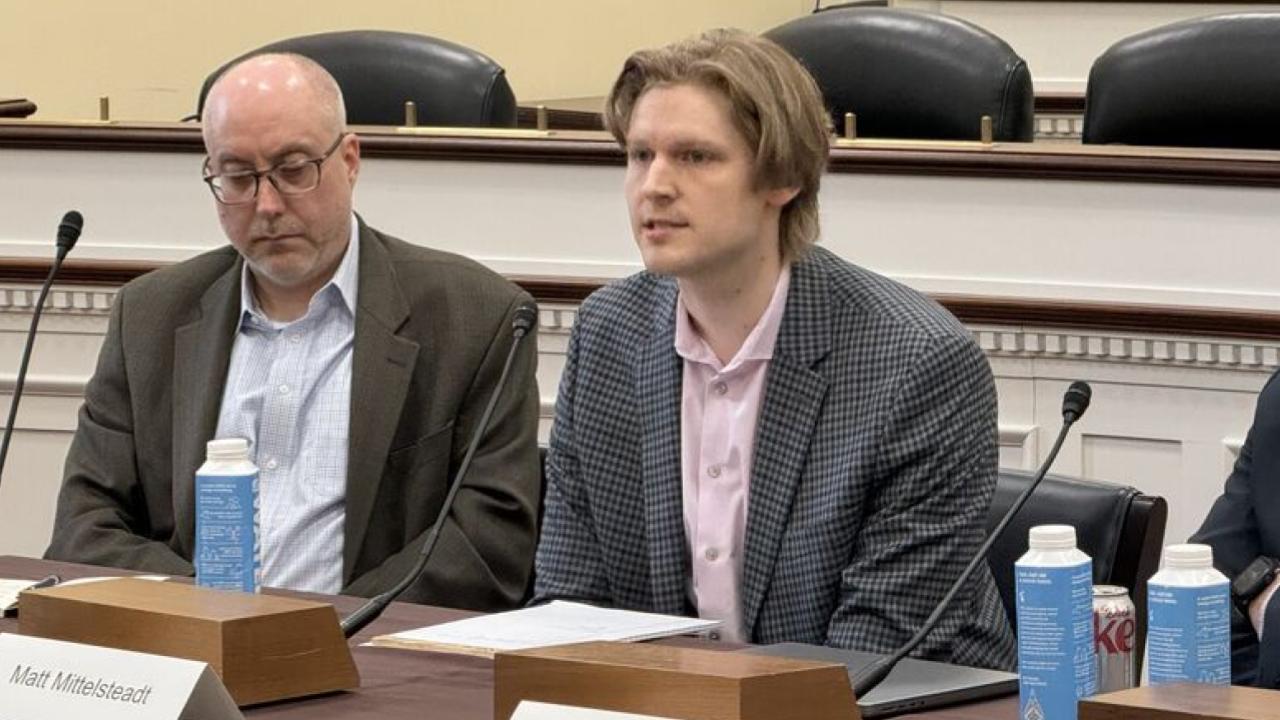
Matthew Mittelsteadt

Matthew Mittelsteadt is a technology policy research fellow at the Cato Institute. His research focuses on the intersection of policy, cybersecurity, and emerging technologies including artificial intelligence and quantum computing. Matthew’s work concentrates on ensuring emerging tech adoption and innovation, enabling robust cybersecurity, and preserving tech market access and international trade. His work has appeared in The Hill, National Review, Noema Magazine and his Substack Digital Spirits.

Prior to joining Cato, Matthew worked as an AI policy fellow at both the Mercatus Center at George Mason University and Syracuse Law School. In the private sector, he developed his tech expertise as a healthcare IT professional. He holds a BA in economics and Russian Studies from St. Olaf College, an MPA from Syracuse University, and an MS in cybersecurity from New York University.

OnAir Post: Matthew Mittelsteadt

Commonwealth Cyber Initiative (CCI)

The Commonwealth Cyber Initiative (CCI) is Virginia’s main access point for cybersecurity research, innovation, workforce development, and news. In this community, researchers find funding and collaboration, students discover diverse career possibilities, and new innovations come to life.

CCI: Advancing People and Technology for a Secure Tomorrow

Virginia is the ideal locale for CCI due to its strong base of research excellence and its diverse higher education system. These factors combined with the state’s ecosystem of venture capital investment and high-growth firms, along with its density of cybersecurity talent, bring a confluence of contributors to the future success of CCI.

Vision
To establish Virginia as a global center of excellence in cybersecurity research and serve as a catalyst for the commonwealth’s economic diversification and long-term leadership in this sector.

Mission
To serve as an engine for research, workforce development, and innovation at the intersection between cybersecurity, autonomous systems, and intelligence.


OnAir Post: Commonwealth Cyber Initiative (CCI)

Skip to toolbar